The problem
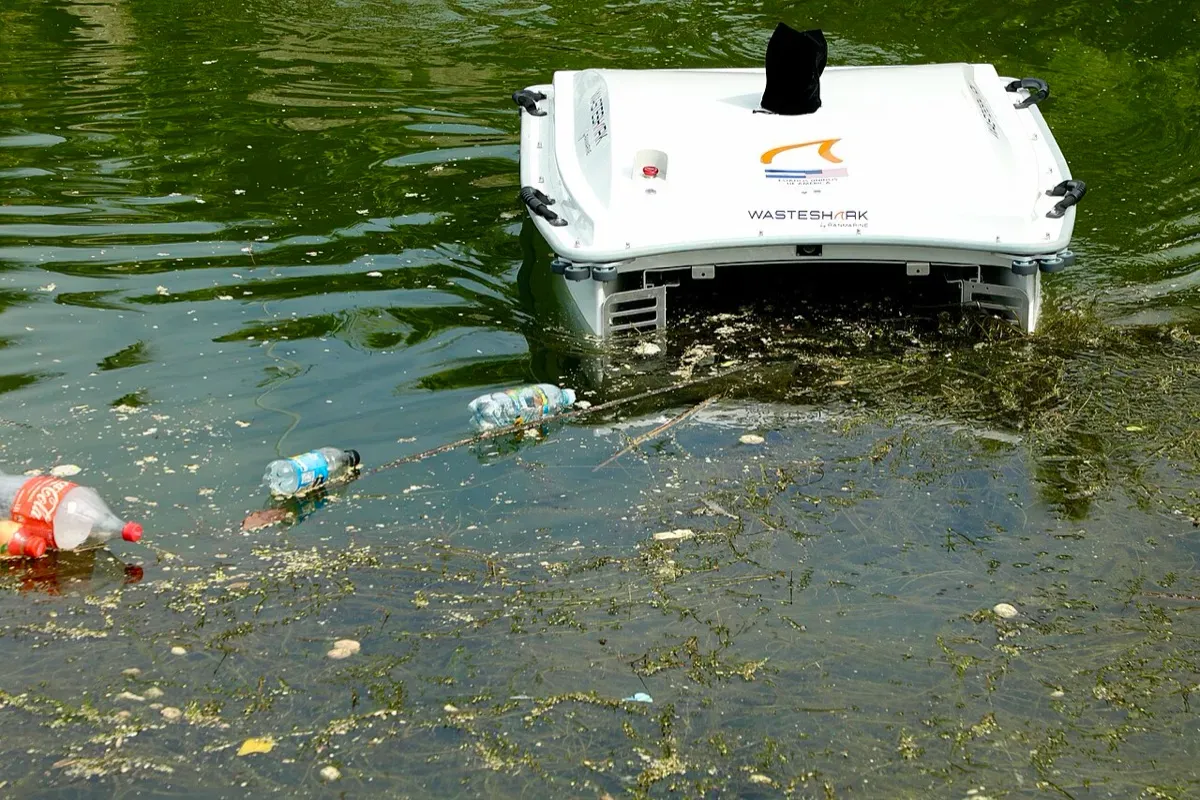
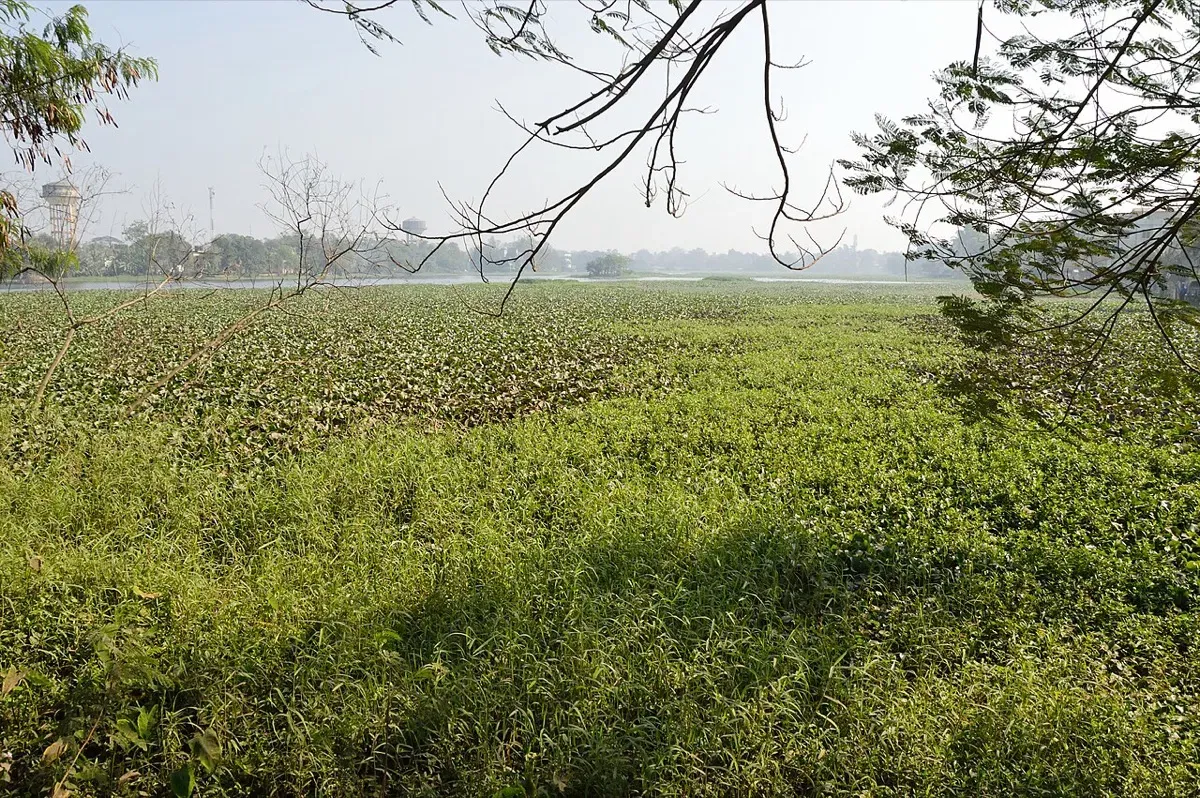
India’s water bodies carry two loads at once. One is solid waste: plastic bottles, bags, thermocol and flowers and offerings from religious festivals, which collect along harbour walls, river ghats and lake edges. The other is biological: water hyacinth, an invasive plant that doubles its cover quickly, blocks sunlight, starves water of oxygen, clogs pumps and breeds mosquitoes.
The usual response is people in small boats or on the bank with rakes and nets, or diesel weed harvesters that are hard to move between sites. The work is dirty, sometimes dangerous, and hard to measure. City bodies rarely know how much they removed, from where, or whether the problem is getting better.
The product
Clearbot started as a student project at the University of Hong Kong. Sidhant Gupta and Utkarsh Goel built a first prototype in Bali and in 2019 their team was first runner-up in the student competition at the Global Grand Challenges Summit in London. In 2022 the venture won the Lloyd’s Register Captain’s Table competition. Today the Indian operation, Clear Robotics India Pvt Ltd, is based in Bengaluru.
The fleet has three main products:
- Class 3, a mid-size electric catamaran for harbours and coastlines, with an 8-hour working day, water-quality sensors and an onboard camera system that spots and logs waste;
- Class 2, a smaller boat for lakes and canals that carries up to about 150 kg of waste per load and also works for 8 hours;
- Alligator, a weed harvester designed to cut and lift water hyacinth.
The boats can be driven remotely or follow programmed routes, and a fleet management system records where they went, what they collected and the water readings along the way.
How it works
- Survey. The site is mapped and the operator sets routes along the worst-hit edges.
- Detect. Cameras and AI software identify floating items, which helps steer the boat and log the type of waste.
- Collect. A conveyor at the bow lifts waste or cut weed into an onboard bin.
- Measure. Sensors log water quality, and the system records weight and location.
- Offload. Full bins are emptied at a jetty for sorting, recycling or composting.
- Report. Clients get dashboards showing tonnes removed and where the waste builds up.
Timeline
| Date | Milestone |
|---|---|
| 2019 | HKU team wins first runner-up in the Global Grand Challenges Summit student competition, London |
| 2022 | Wins Lloyd’s Register Captain’s Table competition; removes about 260 tonnes of water hyacinth in a Hong Kong project |
| Feb 2024 | Fleet has grown from 1 to 11 boats, with a target of 100 |
| May 2024 | Class 3 starts work on Umiam Lake, Meghalaya |
| Oct 2024 | Class 3 starts work at Jawaharlal Nehru Port Authority (JNPA), Navi Mumbai |
| Feb to Mar 2025 | Alligator clears 14,164 m² of hyacinth in Adoor, Kerala, in 44 days |
| May 2025 | Two Class 3 boats start at Gateway of India and Badhwar Park, Mumbai |
| Sep 2025 | 5.5 tonnes removed from the Falgu river, Gaya, during Pitru Paksha |
| 3 Dec 2025 | India’s first fleet of 25 AI Clearbots announced |
| Sep 2026 | Mumbai civic body approves Rs 3.64 crore for two more boats |
Impact and numbers
Ports, rivers and lakes each show a different use. At JNPA in Navi Mumbai, a Class 3 boat has removed more than 6.5 tonnes of waste since October 2024; the company’s own project page now gives over 7,000 kg. In Mumbai, the city corporation’s two boats at the Gateway of India and Badhwar Park collect about 80 to 90 kg a day. In September 2026 the corporation approved Rs 3.64 crore for two more, for Sassoon Dock and the Jamshedji port area, each with a range of around 500 metres from base.
On the Falgu river in Gaya, Bihar, during the Pitru Paksha pilgrimage in 2025, boats removed 5.5 tonnes of waste in 15 days. On Umiam Lake in Meghalaya, a Class 3 has cleared more than 44 tonnes since May 2024. In Adoor, Kerala, under the national AMRUT urban water mission, the Alligator cleared 14,164 m² of water hyacinth between 6 February and 27 March 2025, about 44 tonnes of weed, or roughly 500 m² a day. In early 2024 the company told Lloyd’s Register its boats collected around 80 kg an hour, with a target of 200 kg.
Honest caveats
Mostly self-reported. Tonnages come from the company and its clients. Figures sometimes differ between sources, as at JNPA. No independent audit was found.
Clean-up, not prevention. Boats remove what has already entered the water. Waste management on land, and better handling of festival offerings, decide whether the water stays clean.
Hyacinth grows back. Harvesting gives relief, but unless nutrient pollution from sewage and farms is cut, the weed returns.
What happens to the waste. Collected plastic and weed must be sorted, recycled or composted. Dumping it on the bank moves the problem.
Scale. A boat that collects 80 to 90 kg a day is a meaningful help at a landmark site, but small against the waste of a city the size of Mumbai.
What’s next
The December 2025 launch tied the fleet to India’s Harit Sagar green ports guidelines and the AMRUT mission, which give ports and cities a policy reason to buy. The Mumbai order for two more boats in 2026 suggests public buyers are moving from pilots to repeat purchases. The next test is whether the data the boats collect is used to fix the drains and dumping spots where the waste comes from.
Why it matters for Europe and green buyers
For Europe, Clearbot is a useful comparison. European ports and canal cities have similar floating-litter problems, and European makers offer smaller drones for the same job. Clearbot shows how an Asian startup can build a full service, boats plus data plus operators, at Indian cost levels. European buyers and investors looking at port clean-up and invasive weed control, which is a growing issue in southern European rivers, can learn from its pay-for-service model.
For India, this is a home-grown product that answers national schemes directly. Ports under Harit Sagar, city corporations under AMRUT and lake authorities in states from Kerala to Meghalaya can buy a measurable service instead of paying for unrecorded manual work. The important step is to pair the boats with better waste collection on land, so that the tonnes they report each year go down, not up.
Sources & image credits
- Business News Chronicle, “Clearbot launches India’s first fleet of AI-powered marine robots” (3 Dec 2025). https://businessnewschronicle.com/technology/clearbot-launches-indias-first-fleet-of-ai-powered-marine-robots-to-drive-sustainable-waterbody-rejuvenation
- Clearbot India, JNPA waste collection project. https://www.clearbot.in/new-projects/projects-jnpa-clearbot-waste-collection
- Clearbot, “Cleaning up River Falgu in Bihar”. https://www.clearbot.org/new-projects/cleaning-up-river-falgu-in-bihar
- Clearbot, water hyacinth removal (Adoor and Umiam Lake). https://www.clearbot.org/blog-post/water-hyacinth-removal
- Hindustan Times, “BMC plans two unmanned electric boats to clear garbage off Gateway” (May 2025). https://www.hindustantimes.com/cities/mumbai-news/bmc-plans-two-unmanned-electric-boats-to-clear-garbage-off-gateway-101747163876387.html
- Free Press Journal, “BMC approves Rs 3.64 crore for two more unmanned boats” (27 Sep 2026). https://www.freepressjournal.in/mumbai/bmc-approves-364-crore-for-two-more-unmanned-boats-to-remove-floating-waste-from-mumbai-coastline
- Lloyd’s Register, Horizons, “Clearbot: the autonomous workboat venture” (Mar 2024). https://www.lr.org/en/knowledge/horizons/march-2024/clearbot-the-autonomous-workboat-venture-that-is-cleaning-our-oceans/
- HKU Department of Electrical and Electronic Engineering, Clearbot at GGCS 2019. https://www.ece.hku.hk/hk-team-clearbot-got-the-1st-runner-up-at-the-student-competition-of-2019-global-grand-challenges-summit-ggcs-in-london/
- Wikimedia Commons, “Grass and Water Hyacinth, Santragachi Lake, Howrah”. https://commons.wikimedia.org/wiki/File:Grass_and_Water_Hyacinth_-_Santragachi_Lake_-_Howrah_2013-01-25_3578.JPG
Images: “Grass and Water Hyacinth, Santragachi Lake, Howrah”, Biswarup Ganguly, 25 January 2013, CC BY 3.0, via Wikimedia Commons. Illustrative: shows the weed problem, not a Clearbot.