The problem
The silicon solar industry depends on a long chain of steps: polysilicon, ingots, wafers, cells and modules. China controls most of each step, which creates risks around trade disputes, supply shocks and forced labour in parts of the polysilicon supply chain. Governments in the US, India and Europe all want solar hardware with a different supply chain.
There is also the question of performance in hot climates. Silicon panels lose more output as they heat up, which matters in India, the Middle East and the US Southwest.
The product
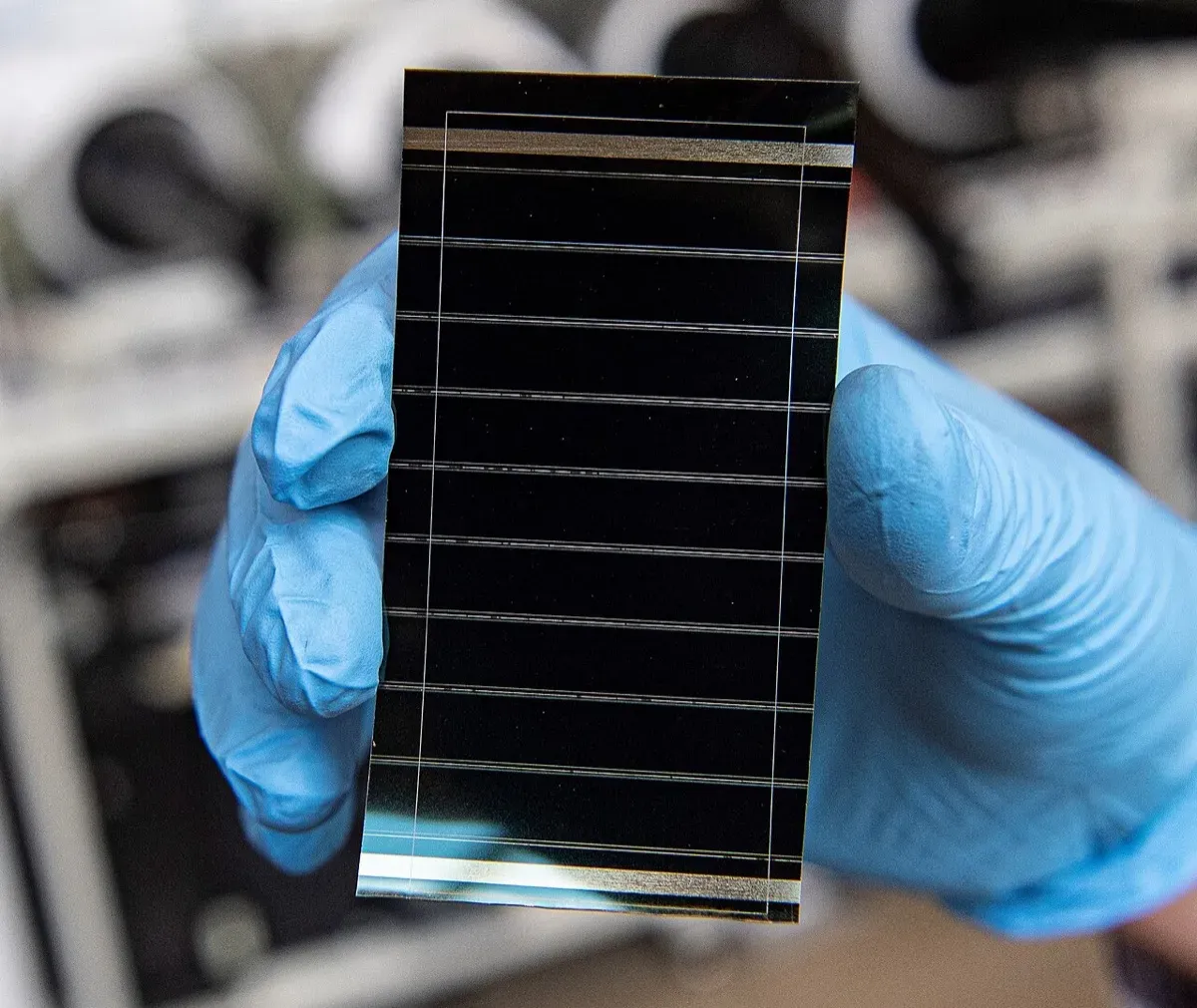
Series 7 is First Solar’s largest module. Instead of silicon wafers, it uses a semiconductor film of cadmium telluride a few microns thick, deposited directly onto a sheet of glass. The whole module, from glass to finished panel, is made in one continuous line in about four hours (First Solar). A new back-rail mounting design speeds up installation, and the module is warranted against power loss from cell cracking, a common problem with thin silicon cells.
The Indian version, Series 7 FT1, is made at Sriperumbudur near Chennai. It measures 2,300 x 1,216 mm and is rated from 505 to 550 W, with efficiency of 18.1% to 19.7%. First Solar offers a 10-year product warranty and a 25-year performance warranty with a 0.3% annual degradation rate, which it calls the industry’s best. The module is on India’s ALMM list and eligible for domestic content requirements (datasheet).
How it works
- Glass first: a sheet of glass coated with a transparent conductor enters the line.
- Thin film: cadmium telluride and other semiconductor layers are deposited by vapour transport, only a few microns thick.
- Scribing: lasers divide the film into long, narrow cells connected in series on the same sheet.
- Sealing: a back glass sheet is laminated on, and the edges are sealed.
- Performance: CdTe has a better temperature coefficient than silicon and handles diffuse light and humidity well, so it loses less output in heat.
- End of life: returned modules are recycled to recover the semiconductor material, glass and metals.
Timeline
| Date | Milestone |
|---|---|
| 2005 | First Solar starts the solar industry’s first global PV recycling programme |
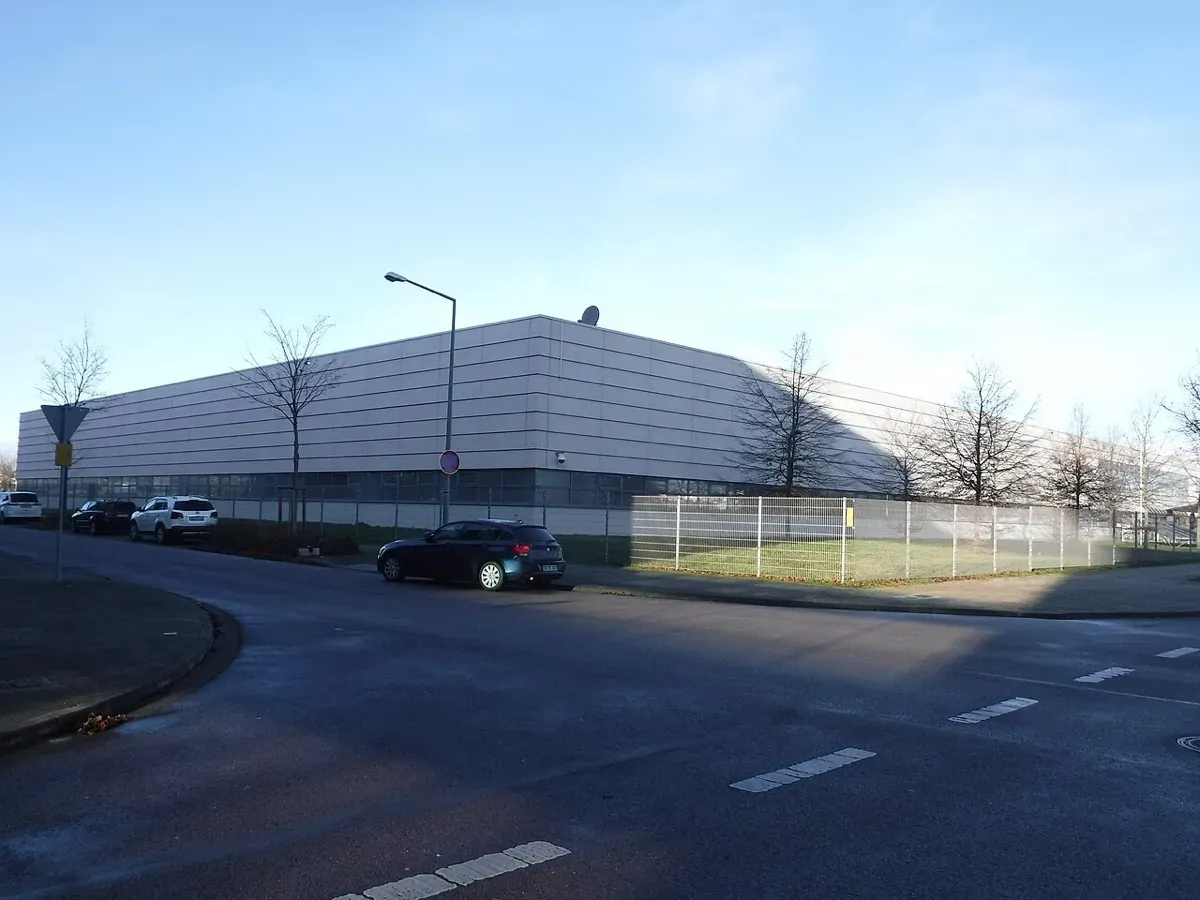
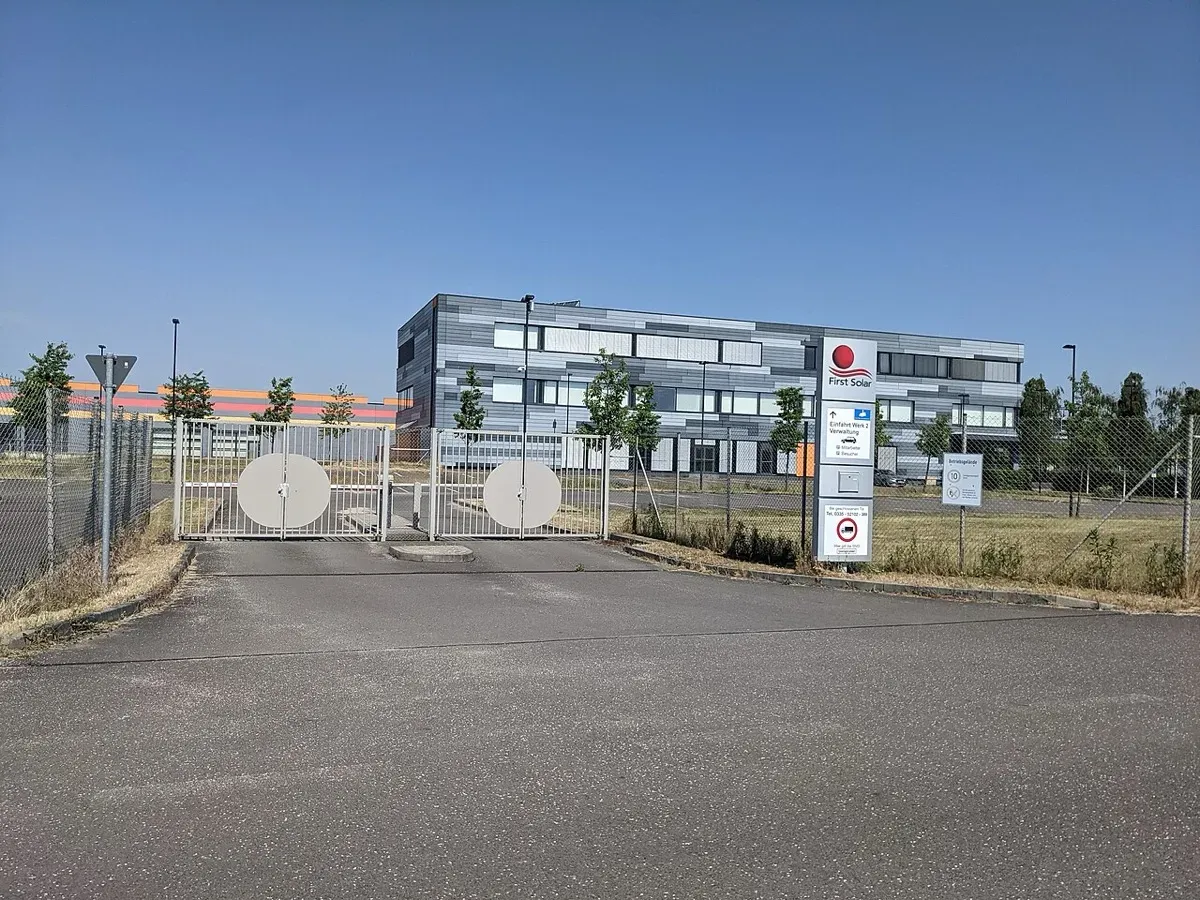
| 17 Apr 2012 | Announces closure of its Frankfurt (Oder) factory in Germany, citing the European market downturn |
| 2023 | Series 7 production starts in Ohio |
| 2024 | Sriperumbudur, Tamil Nadu, factory starts producing Series 7 FT1 |
| 2025 | 2.8 GW produced in India; recycling recovery above 95% |
| 24 Feb 2026 | Signs non-exclusive US perovskite patent licence with Oxford PV |
| 30 Jul 2026 | Q2 results: 45.1 GW backlog and more than 100 GW sold cumulatively |
Impact and numbers
- Scale: First Solar has sold more than 100 GW of modules worldwide and had 45.1 GW of contracted backlog at the end of June 2026, extending through 2030. Its 2026 guidance is 17.0 to 18.2 GW of sales and $4.9 to $5.2 billion of revenue (SEC filing).
- India: the Sriperumbudur plant is the world’s first net-zero water withdrawal PV factory and India’s first high-value PV recycling facility, according to First Solar. Since 2011, it has sold 5 GW of products in India (CR report).
- Energy payback: a Series 7 module pays back the energy needed to make it in under two months, and a full ground-mounted system in four to six months in India and the US.
- Energy return: First Solar’s report claims that a Series 7 module made and installed in India has an energy return on energy invested 2.5 times higher than a 22.9% efficient silicon module imported from China, arguing that nameplate efficiency alone does not decide lifetime energy yield. This is a company calculation, not an independent study.
- Avoided emissions: First Solar estimates its 2.8 GW of 2025 Indian production will avoid about 3 million tonnes of CO2e a year.
- Recycling: recovery rates exceed 95%, including the semiconductor material, which is reused in new modules.
Honest caveats. Cadmium is toxic, even though it is locked into a stable compound sealed between glass, and responsible take-back and recycling are essential. Tellurium is a rare by-product of copper refining, which could limit growth at very large scale. Efficiency, under 20%, is lower than the best silicon modules, so projects need more land and mounting per watt. First Solar’s profits rely heavily on US policy: its 2026 guidance assumes $2.10 to $2.19 billion of Section 45X manufacturing tax credits. Second-quarter sales fell 4% year on year, partly because of customer contract terminations. The company is also a petitioner in US trade cases against Asian and Indian competitors, which critics see as protectionist (pv magazine). Finally, Europe has seen First Solar leave once: it closed its Frankfurt (Oder) factory in 2012 (SEC).
What’s next
First Solar is building a finishing facility in South Carolina and expanding US output. It is also working on next-generation technologies, including CuRe, which replaces copper in the cell to improve long-term energy yield, and perovskite-based tandems, helped by its patent licence from Europe’s Oxford PV (Oxford PV).
Why it matters for Europe / green buyers
For Europe, First Solar is both a cautionary tale and a possible partner. The company once made panels in Frankfurt (Oder), but closed the plant when European demand collapsed in 2012, showing how fragile solar manufacturing becomes without stable policy. Today, CdTe offers European buyers a non-silicon, non-Chinese module option with a low carbon footprint, strong hot-climate performance and an established recycling loop, which fits the EU’s push for resilient, low-carbon products under the Net-Zero Industry Act.
In India, First Solar’s Tamil Nadu plant is one of the country’s few fully integrated solar factories, producing modules from glass rather than assembling imported cells. That makes it one of the clearest answers to India’s cell shortage and its goal of reducing reliance on Chinese supply chains.
Sources & image credits
- First Solar, “First Solar, Inc. Announces Second Quarter 2026 Financial Results and Reaffirms Guidance”, 30 July 2026 (SEC Exhibit 99.1): https://www.sec.gov/Archives/edgar/data/1274494/000127449426000169/ex991pressreleaseq2-2026.htm
- First Solar, “Series 7: Made in America, for America”: https://www.firstsolar.com/en/Products/Series-7
- First Solar, “Series 7: Made in India, for India”: https://www.firstsolar.com/en-IN/Products/Series-7
- First Solar, “Series 7 FT1” datasheet: https://www.firstsolar.com/-/media/First-Solar/Technical-Documents/Series-7/Series-7-FT1-Datasheet.pdf
- First Solar, “2026 Corporate Responsibility Report”: https://www.firstsolar.com/-/media/First-Solar/Sustainability-Documents/2026_Corporate-Responsibility_Report.pdf
- Oxford PV, “First Solar, Oxford PV enter into patent licensing agreement for US markets”, February 2026: https://www.oxfordpv.com/press-releases/first-solar-oxford-pv-enter-into-patent-licensing-agreement-for-us-markets
- First Solar, “First Solar Restructures Operations to Align With Sustainable Market Opportunities”, 17 April 2012 (SEC Exhibit 99.1): https://www.sec.gov/Archives/edgar/data/1274494/000119312512165498/d335741dex991.htm
- pv magazine, “Waaree determined to have evaded AD/CVD orders on solar imports, finds U.S. Customs”, 26 June 2026: https://www.pv-magazine.com/2026/06/26/waaree-determined-to-have-evaded-ad-cvd-orders-on-solar-imports-finds-u-s-customs/
Images:
- “FirstSolarWerk” (First Solar in Frankfurt/Oder) by Hanno Böck, released under CC0 1.0 (http://creativecommons.org/publicdomain/zero/1.0/deed.en), via Wikimedia Commons: https://commons.wikimedia.org/wiki/File:FirstSolarWerk.jpg