The problem
Laptops are among the most carbon-intensive devices people own, and most of their footprint comes from manufacturing. Yet many modern laptops have memory and storage soldered to the board and batteries glued in, so upgrading or repairing them is hard or impossible. When the processor feels slow or the battery fades after a few years, the usual answer is to buy a whole new machine, and the old one often ends up as e-waste.
Europe is starting to push back. The EU’s Right to Repair Directive, adopted in 2024, requires manufacturers to offer repair for certain products and makes it easier for consumers to get them fixed. But the most durable solution is to design the product so that the owner can fix and upgrade it.
The product
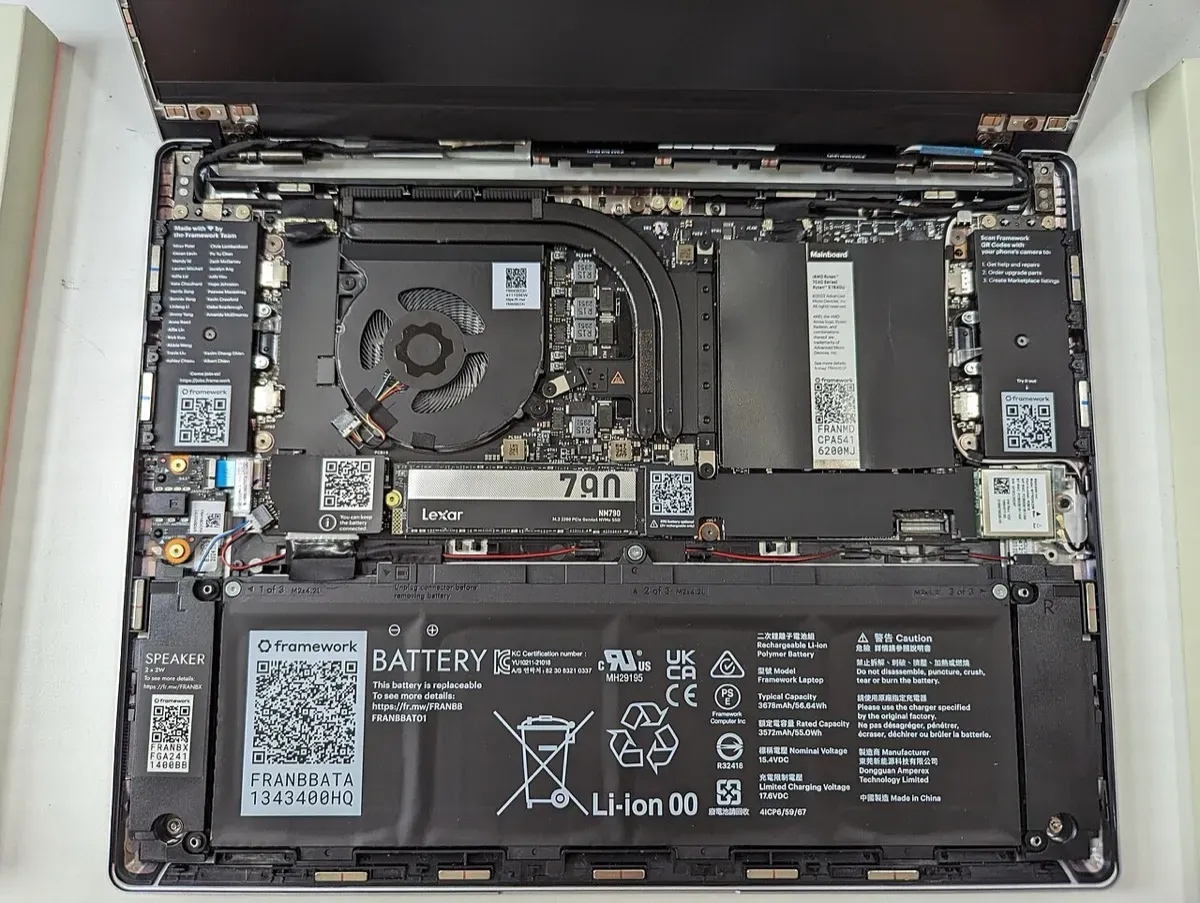
Framework opened pre-orders for its first 13.5 inch laptop in May 2021 and shipped it in July. iFixit’s teardown found that every major part, from battery and display to keyboard and mainboard, could be removed with the included screwdriver, and awarded it “an exceedingly rare 10/10” for repairability. Its only nitpick was that the four USB-C ports were soldered to the board (iFixit).
On 21 April 2026 Framework announced the Laptop 13 Pro, which founder Nirav Patel described as a ground-up redesign. It uses Intel’s Core Ultra Series 3 processors, a 74 Wh battery (22% larger than before), LPCAMM2 memory that brings efficient LPDDR5X into a replaceable module, a fully machined aluminium chassis weighing 1.4 kg, Framework’s first touch display with up to 700 nits, and its first haptic touchpad. It is Framework’s first Ubuntu Certified system. Prices start at USD 1,199 for the DIY Edition and USD 1,499 for pre-built models (Framework).
How it works
- Captive screws: the bottom cover and battery are held by captive screws, so nothing gets lost and no glue needs to be removed.
- Expansion Cards: four slots take small swappable modules for USB-C, USB-A, HDMI, DisplayPort, card readers, storage or Ethernet, so users choose their ports.
- Replaceable mainboard: the processor board can be swapped for a newer generation, turning an old laptop into a new one without replacing the chassis, screen or keyboard.
- Labelled parts and marketplace: components carry QR codes that link to replacement parts and repair guides on Framework’s own marketplace.
- Second life for old boards: an old mainboard can be reused as a small home server or desktop computer, keeping it in use.
Timeline
| Date | Milestone |
|---|---|
| 2019 | Framework founded in San Francisco |
| May 2021 | Framework Laptop 13 pre-orders open |
| Jul 2021 | First shipments; iFixit awards 10/10 |
| 2022 to 2025 | New Intel, AMD and RISC-V mainboards, higher-resolution screens and a larger battery |
| 21 Apr 2026 | Laptop 13 Pro announced from USD 1,199 |
| 10 Jun 2026 | First Pro shipments delayed to July and August |
| Jul to Aug 2026 | Rescheduled first Pro shipments with revised touchpad board and display firmware |
Impact and numbers
- Upgrades: Ars Technica counts six distinct mainboard versions for the Laptop 13 over five years, or seven including a RISC-V board, all fitting the same chassis (Ars Technica).
- Cross-generation compatibility: the new Core Ultra board fits an existing Laptop 13, and every board back to the original 11th-generation Intel model fits the new Pro chassis to gain its display, battery and touchpad. Older boards get BIOS updates for the new parts.
- Battery life: Framework reports more than 20 hours of 4K Netflix streaming on the Pro, about 12 hours more than the previous generation, and the battery keeps up to 80% of its capacity after 1,000 cycles. The company says it will publish full test videos because “battery life claims from device makers are often bogus”.
- Upgrade kits: current owners can buy just the new mainboard (from USD 449), the display, or a Bottom Cover Upgrade Kit with the new battery and touchpad.
- Europe: Framework ships to more than 30 countries, including most EU member states, the UK, Norway and Switzerland (Framework).
Honest caveats. The Pro’s first shipments slipped by about a month. Framework found an electrical grounding problem in the haptic touchpad’s circuit board that made it reset after repeated clicks, and a display bug that stopped one panel from starting, so it held production until a new board and firmware were ready (The Verge). The redesign also breaks part of the compatibility promise: the new bottom cover, keyboard and battery do not fit the old Laptop 13, and owners moving to the new board must buy new LPCAMM2 memory, a format with very few retail options, at a time of high memory prices. Framework laptops cost more than mainstream laptops with similar specifications, so the economic case depends on actually upgrading rather than replacing. The standard warranty is one year, with a three-year option only in the US. Framework is a private company that does not publish detailed sales or financial results. Finally, iFixit’s 2021 warning still applies: repairable brands only succeed if they survive long enough to keep making parts.
What’s next
Framework says the Pro is “the ultimate expression” of its vision, a “MacBook Pro for Linux users” that keeps repairability. Next steps are catching up on delayed batches, publishing battery test videos, rolling out BIOS updates for older boards and broadening LPCAMM2 memory supply.
Why it matters for Europe / green buyers
For European buyers, Framework is the clearest example of what the EU’s repair rules aim for: a laptop that can be repaired, upgraded and kept for many years. For companies and universities with large fleets, swapping mainboards instead of whole laptops can cut both cost and Scope 3 emissions, and Framework offers business sales. Its open documentation and Linux support also suit public sector buyers looking for open and long-lived IT.
In India, Framework is not yet available: buyers can only register interest, and the company says it will not announce a date until it is ready (Framework Community). India’s large repair culture would suit the design well, and an Indian launch or local partner would be a strong signal for repairable computing in the region.
Sources & image credits
- Framework, “Introducing Framework Laptop 13 Pro”, Nirav Patel, 21 April 2026: https://frame.work/blog/introducing-framework-laptop-13-pro
- Ars Technica, “Framework Laptop 13 Pro is a major overhaul for the modular, upgradeable laptop”, 21 April 2026: https://arstechnica.com/gadgets/2026/04/framework-laptop-13-pro-is-the-first-major-revision-to-the-original-framework-laptop/
- The Verge, “Framework delays its first Laptop 13 Pro shipments by a month”, 10 June 2026: https://www.theverge.com/gadgets/948044/framework-laptop-13-pro-delay-shipment-july-august
- iFixit, “Framework Laptop Teardown: 10/10, But is it Perfect?”, 28 July 2021: https://www.ifixit.com/News/51614/framework-laptop-teardown-10-10-but-is-it-perfect
- Framework Help Center, “What countries and regions do you ship to?”, updated 29 April 2026: https://knowledgebase.frame.work/en/what-countries-and-regions-do-you-ship-to-r1899ikiO
- Framework Community, “When Will Framework Start Shipping To India?”: https://community.frame.work/t/when-will-framework-start-shipping-to-india/82301
- EUR-Lex, Directive (EU) 2024/1799 on common rules promoting the repair of goods: https://eur-lex.europa.eu/eli/dir/2024/1799/oj/eng
Images:
- “Framework Laptop 13 - 2023 AMD Ryzen - Internal motherboard and component view” by Ogidya, 2024, licensed under CC BY 4.0 (https://creativecommons.org/licenses/by/4.0), via Wikimedia Commons: https://commons.wikimedia.org/wiki/File:Framework_Laptop_13_-_2023_AMD_Ryzen_-_Internal_motherboard_and_component_view.jpg