The problem
Buildings account for almost 40% of global annual CO2 emissions, and about 10% come from building materials alone, according to Made of Air (Made of Air). Façades are a big part of this. Aluminium cladding, for example, is light and durable, but making primary aluminium is very energy-intensive.
At the same time, forestry and farming produce large amounts of waste wood, shells and residues. When these rot or are burned, the carbon they absorbed from the air returns to the atmosphere within months or years.
The product
Made of Air combines the two issues. It converts waste biomass into biochar, a stable, almost pure form of carbon, and uses it as the main ingredient in a durable composite that can be formed into building panels.
The first product, HexChar, was installed in spring 2021 on an Audi dealership in Munich-Trudering. Audi needed an alternative to its usual aluminium-clad façade to obtain planning permission under strict local environmental rules. About 600 square metres of hexagonal panels were produced in a co-development programme; Made of Air created the compound, developed the design, manufactured the boards and supported installation (urbanNext). The company says the installed price was at parity with conventional materials.
The current product, Sequoia, is a rainscreen façade cladding system made from biocarbon and bio-based resin. Made of Air introduced it in June 2025, pitching it at fast-growing building types such as data centres, and said in April 2026 that it was “now available across Europe”. Sequoia panels weigh 9.8 kg per square metre, which reduces structural loads, and have a carbon performance of -17 kg CO2e per square metre (Made of Air). In March 2026 the company showed a new coating technology that adds colour to the dark panels.
How it works
- Biomass waste: plants have already captured CO2 from the air through photosynthesis. Made of Air has sourced forestry and farm waste from around Berlin.
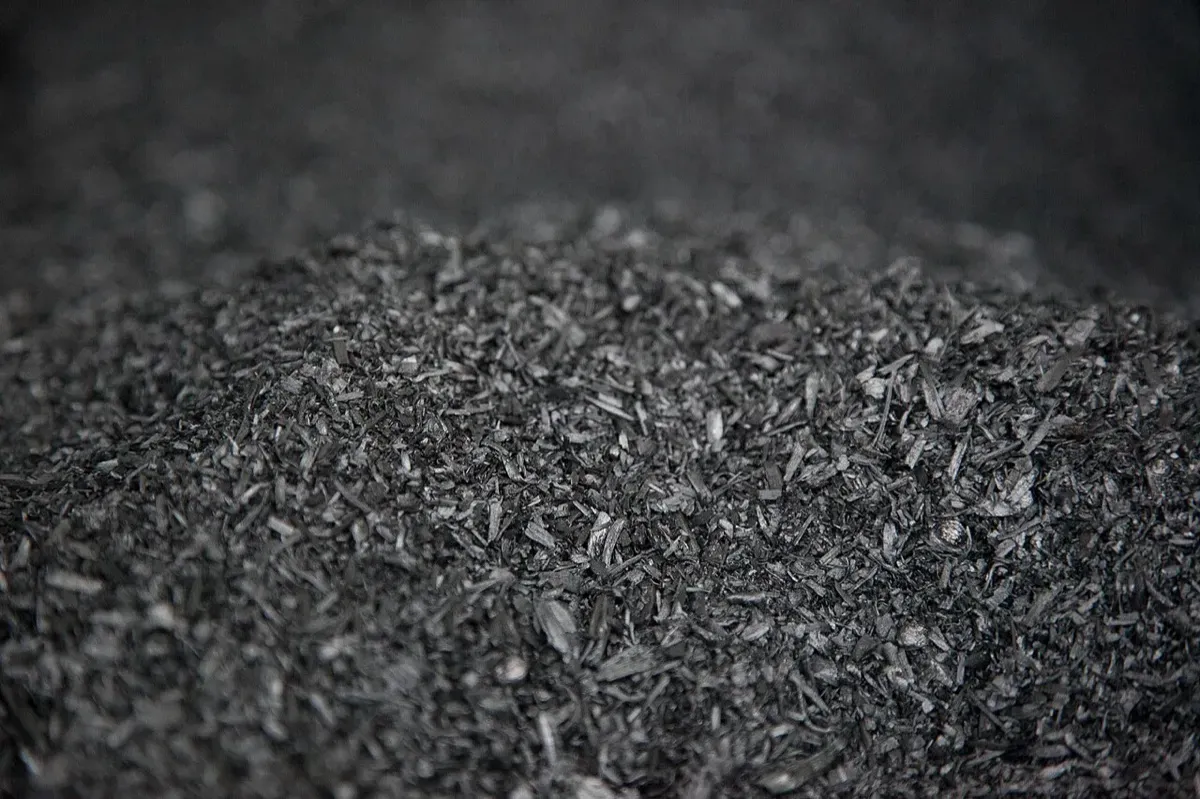
- Pyrolysis: the biomass is heated without oxygen, so instead of burning it turns into biochar, a near-elemental carbon that can stay stable for centuries.
- Functionalising: a proprietary process turns the biochar into a filler for composites. In the early material it was combined with a sugar-cane-based binder to make granules that can be moulded like a normal thermoplastic.
- Boards and façades: the composite is pressed into boards that are fixed to buildings as a ventilated rainscreen, so the carbon stays locked in the wall for the life of the building.
Timeline
| Date | Milestone |
|---|---|
| 2016 | Made of Air founded in Berlin |
| Nov 2020 | Limited-edition sunglasses made with H&M |
| Spring 2021 | HexChar panels installed on Audi dealership, Munich-Trudering |
| Jun 2021 | Plans to scale production 100-fold to store 2,000 t CO2e a year |
| 3 Jun 2025 | Sequoia carbon-negative cladding introduced |
| 14 Oct 2025 | EUR 960,000 IBB ProFIT grant for Sequoia announced |
| 11 Mar 2026 | New colour coating for Sequoia shown |
| 29 Apr 2026 | Sequoia “now available across Europe” |
Impact and numbers
- Carbon storage: Made of Air says the HexChar material stores carbon at -1.95 kg CO2e per kg, and that the Audi façade removed about 10 tonnes of CO2 (Made of Air). In a 2021 interview the company said a life cycle analysis showed the cladding stores 14 tonnes of carbon in about seven tonnes of panels (Dezeen). The two figures use different units and assumptions.
- Double benefit: the company says the HexAudi panels removed 22 kg CO2 per square metre and avoided about 120 kg CO2 per square metre compared with typical aluminium cladding, a total difference of 143 kg CO2 per square metre (Made of Air).
- Durability: since installation in 2021 the panels have been through several weather cycles while keeping their look and mechanical properties, and passed weathering and UV tests.
- Material: the original material is about 90% carbon and stores about two tonnes of CO2e per tonne of material.
Honest caveats. Made of Air is a small company, and its track record rests mainly on one flagship façade, the 2021 Audi dealership. Its 2021 plan to scale capacity 100-fold within a year to store 2,000 tonnes of CO2e a year has not been publicly confirmed as achieved. All carbon figures are the company’s own calculations, and the published numbers differ between sources. The permanence of biochar carbon in a façade depends on what happens at the end of the building’s life: if panels are burned, the carbon returns to the air. The EU’s new certification framework for carbon removals, adopted in 2024, is still developing the methods for carbon stored in long-lasting products, so these claims are not yet certified under it (EUR-Lex). Biochar materials have been more expensive than fossil plastics, and Sequoia still needs fire, building code and long-term performance data for each market.
What’s next
With its ProFIT grant from Investitionsbank Berlin and the EU, Made of Air is focused on product development and manufacturing scale-up for Sequoia, and on winning its first wave of commercial projects, especially large, simple building types such as data centres and logistics halls. As whole-life carbon rules for buildings tighten in Europe, materials that store carbon could gain value in building assessments.
Why it matters for Europe / green buyers
For architects and developers in Europe, Sequoia is one of the few façade products that claims to store more carbon than it emits, which can help projects meet embodied-carbon limits in planning rules, as the Audi case showed in Bavaria. It also links two circular streams: farm and forest residues become a long-lived building product instead of being burned or left to rot. Buyers should ask for an EPD, fire classification and a clear end-of-life plan.
In India, millions of tonnes of crop residue are burned in fields every year, causing severe air pollution in the north of the country. Made of Air does not work in India, but converting that residue into biochar for durable building materials is the kind of circular model that could tackle both air pollution and the carbon footprint of India’s construction boom.
Sources & image credits
- Dezeen, “Atmospheric CO2 is ‘our biggest resource’ says Made of Air”, 24 June 2021: https://www.dezeen.com/2021/06/24/carbon-negative-plastic-biochar-made-of-air-interview/
- Made of Air, “HexAudi: A beautiful testament to sustainability” (case study): https://www.madeofair.com/blog/hexaudi-panels-case-study
- urbanNext, “The HexAudi Project: Carbon-negative Façade”, 20 August 2026: https://urbannext.net/the-hexaudi-project-carbon-negative-facade/
- Made of Air, “Carbon-negative material applications”: https://www.madeofair.com/carbon-negative-material-applications
- Made of Air, home page (Sequoia and technology): https://www.madeofair.com/
- Made of Air, “Public funding announcement!” (EUR 960K IBB ProFIT for Sequoia): https://www.madeofair.com/blog/moa-profitannouncement
- Made of Air on LinkedIn, Sequoia panel specifications, 29 April 2026: https://www.linkedin.com/posts/made-of-air_carbonegative-facadecladding-buildingenvelope-activity-7455277335940841473-gVJK
- Made of Air on LinkedIn, “Introducing Sequoia”, 3 June 2025: https://www.linkedin.com/posts/made-of-air_datacenters-carbonnegative-fa%C3%A7ades-activity-7335627384567607296-uVKC
- EUR-Lex, Regulation (EU) 2024/3012 establishing a Union certification framework for permanent carbon removals, carbon farming and carbon storage in products: https://eur-lex.europa.eu/eli/reg/2024/3012/oj
Images:
- “Biochar pile” by Oregon Department of Forestry, 2014, licensed under CC BY 2.0 (https://creativecommons.org/licenses/by/2.0), via Wikimedia Commons: https://commons.wikimedia.org/wiki/File:Biochar_pile.jpg