The problem
According to UNEP’s Food Waste Index Report 2024, food service outlets wasted about 290 million tonnes of food in 2022, 28% of the global total (UNEP). In the EU, Eurostat estimates put food waste at over 59 million tonnes a year, around 132 kg per person, with more than half coming from households.
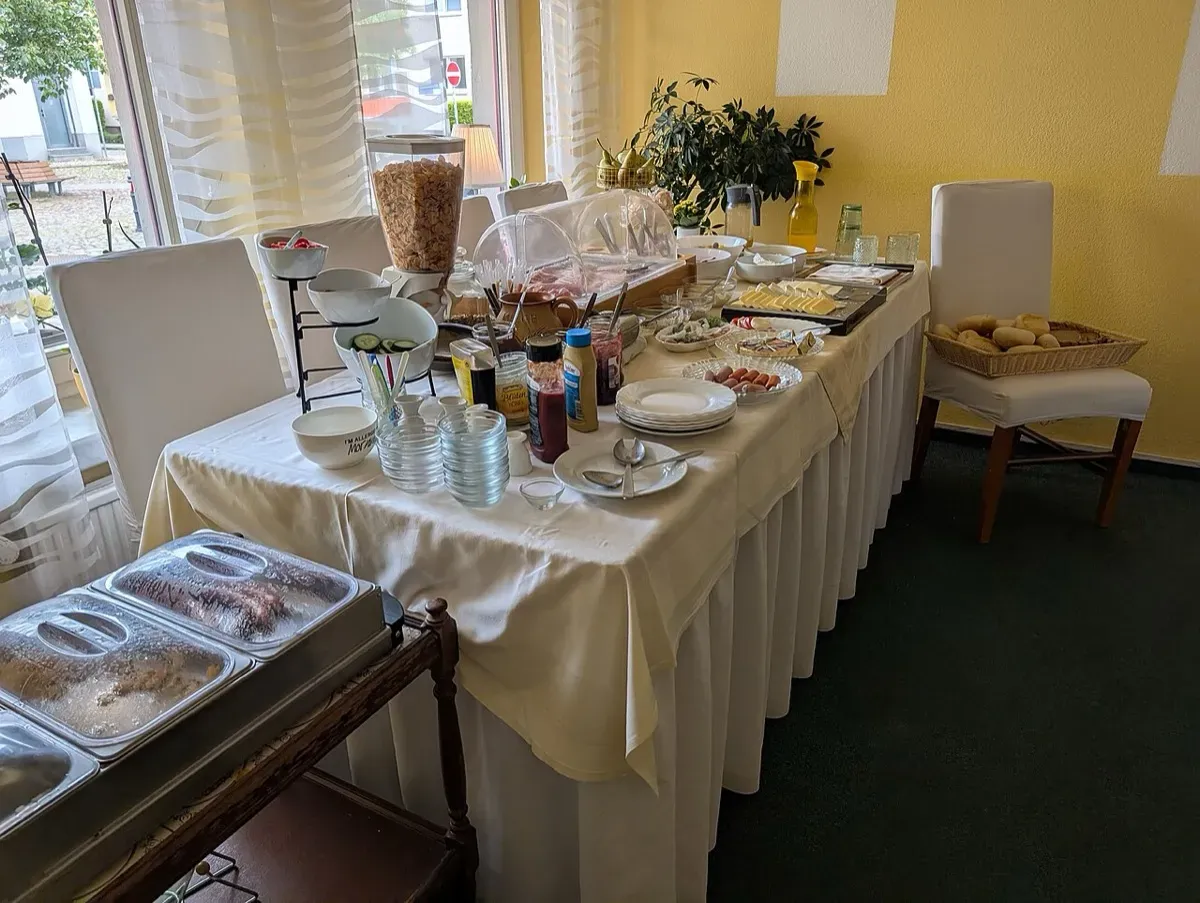
Hotels and caterers face a structural problem. Guests expect full buffets until the last minute, menus are planned weeks ahead and purchasing is often based on instinct. Waste is scattered across preparation, overproduction and plate leftovers, and everything ends up mixed in the same bins. Without data, kitchens cannot tell whether the problem is the scrambled eggs at 10:30 or the salad bar at lunch.
The product
Orbisk was started by Olaf van der Veen and Richard Beks, who both worked for Dutch supermarket chain Albert Heijn, together with developer Bart van Arnhem. In a 2022 interview, Beks said they had been “mostly just selling people more and more bad food” and wanted to use their skills for a more sustainable food and service industry. They began work in 2018 and built the first prototype in early 2019 (IO+).
The result is the Orbi, an AI food waste monitor for hotels, catering services, cruise ships, hospitals and restaurants. It registers food waste, identifies its operational causes and presents the results in a dashboard with advice on process changes (Orbisk, 9 December 2024). Customers pay a monthly fee, and Orbisk says they typically save three to ten times that fee in food costs.
How it works
The Orbi combines a weighing scale under the waste bin with a camera module and a touchscreen. In early versions, staff briefly showed food to the camera before throwing it away. The current system captures every ingredient above the bin automatically, before items mix, with no buttons, logging or training, according to Orbisk’s website.
Image recognition software, which the founders built themselves, distinguishes between foods even in half-eaten form. Beks explained that it can tell the difference between zucchini and lasagne, or recognise a cheese sandwich. Each discard is stored as a photo with a weight and time. A distinctive feature is that the Orbi can separate the preparation bin from the leftovers bin, which shows why waste occurs and not just how much. Orbisk says first insights arrive within 24 hours, and the dashboard ranks recommended actions by impact.
Typical changes are simple: smaller batches cooked more often, revised portion sizes, removing dishes guests consistently leave, and ordering based on actual demand rather than habit.
Timeline
| Date | Milestone |
|---|---|
| 2018 | Founders start developing image recognition for food waste |
| Early 2019 | First Orbi prototype built; Richard Beks joins Olaf van der Veen and Bart van Arnhem |
| February 2022 | Orbi at about 100 locations, with a target of around 250 that year, according to the founders |
| 9 December 2024 | Orbisk announces a Series A of more than €8 million and operations in over 40 countries |
| 2025 | Orbi systems deployed on selected Carnival Cruise Line ships after a successful pilot |
| 16 October 2025 | Revised EU Waste Framework Directive with binding food waste targets enters into force |
| 2026 | Orbisk reports more than 1,000 professional kitchens using its system |
Impact and numbers
- Reach: more than 1,000 professional kitchens worldwide, according to Orbisk’s website, and over 40 countries on five continents as of December 2024.
- Per-kitchen figures claimed by Orbisk: €70,000 saved per kitchen per year, 45 tonnes of CO2 prevented per kitchen, food waste reductions of up to 70% and a 12-times return on investment (Orbisk).
- Case studies published by Orbisk: Novotel Amsterdam City cut waste by 33% and saved €27,000 within 12 months; Novotel Warszawa Centrum cut waste by 69% and saved €60,000 over two years; Frankfurt Marriott achieved a 24% reduction and €38,000 in savings in six months; Fairmont Royal York reduced waste by 37% in seven months, saving 68,818 kg of CO2.
- Healthcare: Leiden University Medical Center saved 17,000 kg of food in one year, according to Orbisk.
- Partners: Accor says it is on track to cut food waste by 60% by 2030 across participating hotels, helped by Orbisk.
Honest caveats. The headline figures are Orbisk’s own averages and case studies, not independent audits, and results vary widely by kitchen type. Per-kitchen savings in hotels with large buffets will be far higher than in a small restaurant. In 2022 the founders set a goal of saving over 100 million kilos of food a year by 2025; Orbisk has not publicly reported whether it reached that figure.
What’s next
With the Series A, Orbisk is developing its AI, improving integrations with customer systems and expanding in the United States, where it sees strong traction, with Asia as a later step. Its investor Regeneration.VC said 20% of global food waste occurs in hospitality. Back in 2022, the founders also described two product directions: a cheaper, simpler monitor for smaller kitchens with tighter budgets, and a smart assistant that moves from describing waste to calculating how much food a kitchen should buy. Both point the same way, from reporting what was thrown away to preventing it before it is cooked. In Europe, Directive (EU) 2025/1892 requires member states to cut food waste per person across retail, restaurants, food services and households by 30% by 2030, against a 2021 to 2023 baseline, and to transpose the rules by 17 June 2027 (European Commission). National governments will likely lean on large food service operators to measure and report, which favours automatic systems.
Why it matters for Europe / green buyers
Orbisk is a European example of turning a policy goal, halving food waste under SDG target 12.3, into a product that pays for itself. Photos of every discard settle arguments in a busy kitchen: the team sees exactly what is thrown away and when. That shared picture is often what changes behaviour.
For buyers comparing food waste systems, ask how capture works during peak service, whether the system separates waste streams such as preparation and plate waste, how data feeds into purchasing, and whether results are independently checked. Combine the system with clear targets per site, and use it to support CSRD waste reporting where relevant.
Sources & image credits
- Orbisk, “AI powered food waste company Orbisk secures more than €8 million series A funding”, 9 December 2024: https://orbisk.com/blog/press-release-orbisk-secures-more-than-8-million-series-a-funding/
- IO+, “AI smart food monitor is at your service”, interview with Richard Beks, 14 February 2022: https://ioplus.nl/archive/en/ai-smart-food-monitor-is-at-your-service/
- Orbisk website and case studies (accessed 6 October 2026): https://orbisk.com/
- UNEP, Food Waste Index Report 2024 press release, 27 March 2024: https://www.unep.org/news-and-stories/press-release/world-squanders-over-1-billion-meals-day-un-report
- European Commission, “Revised Waste Framework Directive enters into force”, 16 October 2025: https://environment.ec.europa.eu/news/revised-waste-framework-directive-enters-force-2025-10-16_en
- EIT Food, Orbisk start-up profile: https://www.eitfood.eu/community/startups/orbisk
- EIT Food, Mimica impact story (citing Eurostat: 59 million tonnes, 132 kg per inhabitant): https://www.eitfood.eu/impact-stories/mimica-unlocking-the-true-shelf-life-of-food-with-bump
Images:
- “Breakfeast buffet in Hotel Marcus, Germany” by Андрей Романенко, licensed CC BY-SA 4.0 (https://creativecommons.org/licenses/by-sa/4.0), via Wikimedia Commons: https://commons.wikimedia.org/wiki/File:Breakfeast_buffet_in_Hotel_Marcus,_Germany.jpg