The problem
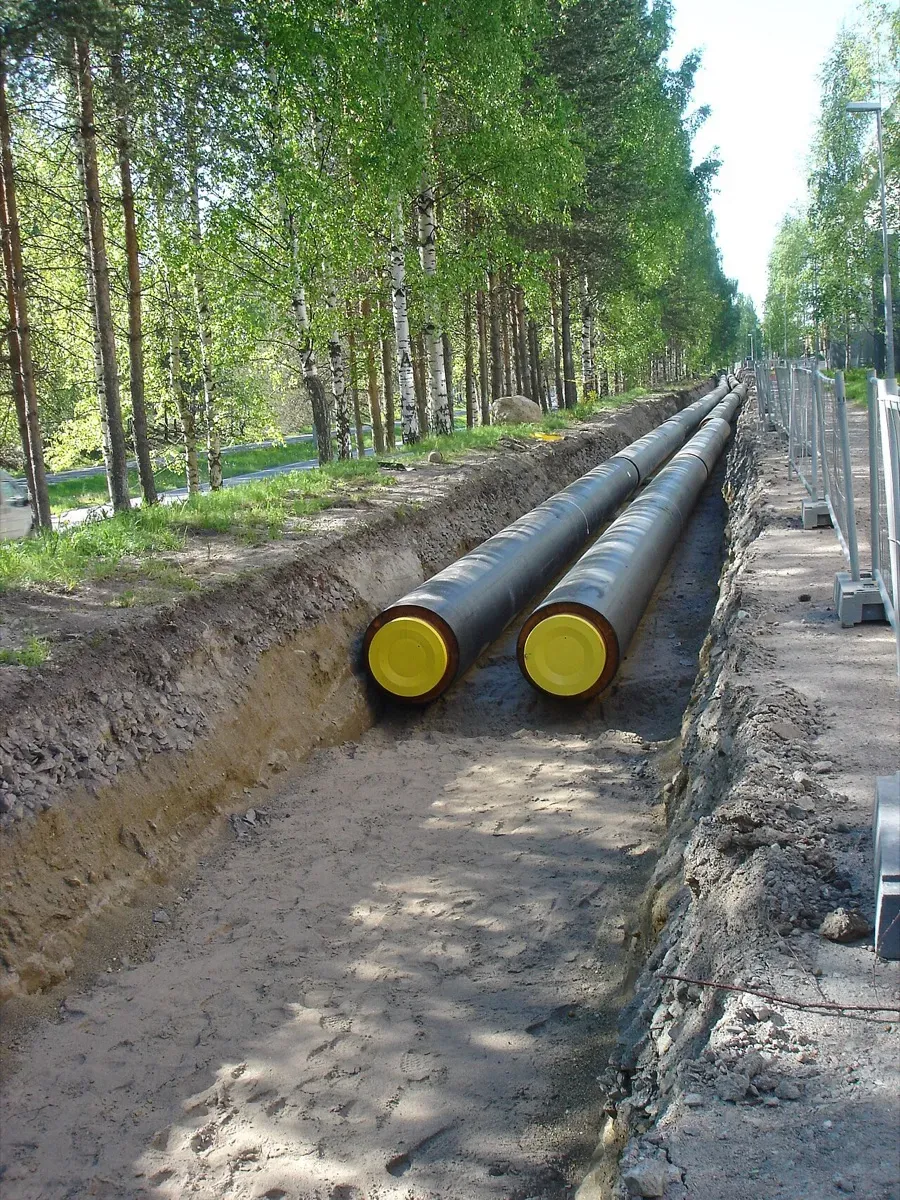
Heating is the largest energy job in cold countries, and in the Nordics much of it runs through district heating: hot water piped from a central plant to schools, flats and offices. Many small networks still depend on burning biomass, natural gas or oil. Meanwhile, Finland’s grid is filling up with wind turbines whose output swings from hour to hour, pushing spot prices close to zero on windy nights and far higher on still, cold days.
Lithium-ion batteries shift electricity by a few hours but are an expensive way to store energy for a week. Heat pumps are efficient, but they consume power at the moment heat is needed. What a district heating operator wants is a cheap, robust tank of heat it can fill whenever power is cheap and draw on whenever it is not.
The product
The Sand Battery is that tank. It is an insulated steel silo filled with sand or a similar granular material, threaded with heat transfer pipes, plus external fans, valves, automation and a heat exchanger or steam generator (Polar Night Energy). The storage medium can reach about 600°C, and the company says the maximum is set by its construction materials rather than by the sand. Output can be hot water, hot air or steam, at 60°C to 400°C, which Polar Night Energy says covers about 36% of all industrial process heat demand.
The flagship system sits in Pornainen, a municipality of about 5,000 people in central Uusimaa. Built for the local district heating company Loviisan Lämpö (owned by CapMan Infra), it delivers 1 MW of thermal power and stores 100 MWh, ten times the capacity of the first commercial unit in Kankaanpää, launched in 2022 (Polar Night Energy, 2025). Its storage medium is 2,000 tonnes of crushed soapstone, a surplus by-product from the fireplace maker Tulikivi (Uusimaa Regional Council). That is enough heat for almost a month of Pornainen’s summer demand, or about a week in winter.
For new customers the company now sells a standard Sand Battery 2 MW: 2 MW of heat output, 3 MW of charging power, 2,400 tonnes of sand-based medium, and a silo about 16 m across and 15 m high. It is aimed at sites with annual heat demand of 6 GWh or more.
How it works
The Sand Battery is a form of sensible heat storage, meaning it stores energy by raising the temperature of a solid:
- Charging: electricity from the grid or a local wind or solar farm powers resistive heaters that warm air in a closed loop.
- Storing: the hot air circulates through pipes buried in the sand. Sand stores far more energy per cubic metre than water because it can be heated well above 100°C without pressurisation, and it insulates itself.
- Discharging: cooler air is blown through the pipes, picks up heat, and passes it to water or steam through a heat exchanger.
- Earning: because charging power can be changed quickly, the system can also sell flexibility to Fingrid’s reserve markets.
The silo can hold heat for months, and the company designs units for between 20 and 200 charge and discharge cycles a year.
Timeline
| Date | Milestone |
|---|---|
| 2018 | Polar Night Energy founded in Tampere |
| 2022 | First commercial Sand Battery opens in Kankaanpää |
| Jun 2025 | Pornainen Sand Battery (1 MW / 100 MWh) commissioned for Loviisan Lämpö |
| Nov 2025 | Lahti Energia orders a 2 MW / 250 MWh Sand Battery for Vääksy |
| Jun 2026 | Pornainen first-year results published: 70% emissions cut |
| Spring 2027 | Vääksy commissioning scheduled to start |
Impact and numbers
- Emissions: in its first year, the Pornainen battery cut emissions from the local network by 70%, ended oil use and cut biomass use by 60%, with efficiency above 85% and no interruptions to heat supply (Polar Night Energy, 11 June 2026).
- Cheaper power: CapMan Infra says the battery charged at prices about 70 to 80% below the average spot price, and more than 90% below in some months.
- Network growth: the extra capacity allowed Pornainen to connect a new sports and events hall and a renovated school to district heating.
- Scaling up: the Vääksy unit for Lahti Energia will store 250 MWh, the largest sand-based heat store in the world on completion, and is expected to cut fossil emissions from that network by about 60% and natural gas use by about 80% (Polar Night Energy, 8 June 2026; pv magazine).
- Recognition: CNBC called Pornainen the world’s largest commercial sand battery (CNBC, 25 July 2026); it won a dena Global District Energy Climate Awards 2025 certificate of merit and the Nordic PropTech Awards 2026 energy category.
Honest caveats. The performance figures come from Polar Night Energy and its customers, not from an independent audit. The 70% emissions cut depends on charging with low-carbon, low-cost electricity; in a grid dominated by fossil power, a resistive heater would raise emissions. Turning electricity into heat with resistors gives at most one unit of heat per unit of power, so in many settings a heat pump uses less electricity; the Sand Battery’s case rests on storage and price flexibility, not efficiency. The company’s often-quoted figure that the technology could cut up to 100 Mt of CO2e by 2030 comes from a 2020 Mission Innovation assessment and is a potential, not a measured result. Power-to-heat-to-power is still a pilot.
What’s next
Foundation work at Vääksy was under way by June 2026, with the silo following later that summer and commissioning from spring 2027. Polar Night Energy has announced expansion into the Baltic market and says it is in talks with district heating companies and industrial customers across Europe. The bigger prize is industrial steam: food, pulp and paper and chemicals plants that burn gas for steam at 150°C to 250°C. The Valkeakoski pilot will test whether stored heat can be turned back into electricity at useful efficiency.
Why it matters for Europe / green buyers
For a European district heating utility, the Sand Battery is a practical way to replace an ageing biomass or gas boiler with a store that profits from the growing number of hours when wind and solar push prices down. It uses abundant local minerals rather than lithium or cobalt, has no combustion on site, and gives the operator a hedge against price spikes. With about 28 million heat pumps already installed in Europe (EHPA, March 2026), network-scale heat storage is the natural complement for the hours when electricity is scarce. Buyers should model their own spot prices, reserve market rules and grid connection costs.
India has little district heating, but the same idea could supply process heat to textile, food and dairy plants with cheap daytime solar, if tariffs reward flexible demand.
Sources & image credits
- Polar Night Energy, “Sand Battery” product page and FAQ: https://polarnightenergy.com/sand-battery/
- Polar Night Energy, “World’s Largest Sand Battery Now in Operation”, 2025: https://polarnightenergy.com/news/worlds-largest-sand-battery-now-in-operation/
- Polar Night Energy, “World’s Largest Sand Battery achieves its targets: Emissions reduced by 70%”, 11 June 2026: https://polarnightenergy.com/news/worlds-largest-sand-battery-achieves-its-targets-emissions-reduced-by-70/
- Polar Night Energy, “Lahti Energia’s Sand Battery construction progresses on schedule”, 8 June 2026: https://polarnightenergy.com/news/lahti-energias-sand-battery-construction-progresses-on-schedule/
- pv magazine, “Finland’s Polar Night to build 250 MWh sand battery for district heating provider”, 25 November 2025: https://www.pv-magazine.com/2025/11/25/finlands-polar-night-to-build-250-mwh-sand-battery-for-district-heating-provider/
- CNBC, “Sand battery: Finland’s radical answer to a renewable energy headache”, 25 July 2026: https://www.cnbc.com/2026/07/25/finland-sand-battery-renewable-energy-storage.html
- Uusimaa Regional Council, “Pornainen made headlines with the world’s largest sand battery”, 4 March 2026: https://uudenmaanliitto.fi/en/pornainen-made-headlines-with-the-worlds-largest-sand-battery/
- European Heat Pump Association, “Pump it up: why heat pump sales rose in 2025”, March 2026: https://ehpa.org/wp-content/uploads/2026/04/20260325_Pump-it-up-why-heat-pump-sales-rose-in-2025_EHPA.pdf
Images:
- “District Heating Tampere” by Cryonic07, licensed CC BY-SA 3.0 (https://creativecommons.org/licenses/by-sa/3.0), via Wikimedia Commons: https://commons.wikimedia.org/wiki/File:District_Heating_Tampere.JPG