The problem
Protein for a growing world ties up vast amounts of farmland, water and fertiliser. Livestock and feed crops drive deforestation and biodiversity loss, and their output rises and falls with rainfall, heat and disease. Plant proteins help, but they still need fields, harvests and long supply chains.
Solar Foods set out to answer a simple question: could protein be made with almost no farmland, wherever there is renewable electricity? The idea came from a power-to-food pilot run by VTT Technical Research Centre of Finland and LUT University, which grew edible microbes using electricity, water and CO2.
The product
Solein is a dried, yellowish powder made of whole microbial cells. The company says it is rich in protein and can also be a source of iron, fibre and B vitamins. According to the European Commission’s summary of the novel food application, the organism is a non-genetically modified strain of Xanthobacter, designated SoF1. Solar Foods markets Solein as an all-purpose ingredient for meat and dairy alternatives, egg replacement and sports nutrition.
Its first market was Singapore, which approved Solein as a novel food in September 2022. In the United States, the company reached self-affirmed GRAS status in September 2024 and launched there with dishes at New York restaurant Olmsted. In H1 2026 the first consumer product went on sale: sports nutrition company Ambrosia Collective launched Planta, a ready-to-mix protein powder made with Solein. In June a US lifestyle company also ordered Solein for product development.
How it works
- Split water. Renewable electricity drives electrolysis, producing hydrogen and oxygen.
- Feed the microbe. The bacterium uses hydrogen for energy and carbon dioxide as its carbon source.
- Add minerals. Small amounts of minerals support growth.
- Grow continuously. Cells multiply in a gas fermentation bioreactor, independent of season and weather.
- Harvest. The culture is drawn off and separated.
- Dry. Whole cells are dried into Solein powder.
Timeline
| Date | Milestone |
|---|---|
| 2017 | Solar Foods founded, building on VTT and LUT power-to-food research |
| 29 Oct 2021 | EU novel food application submitted |
| Sep 2022 | Singapore novel food approval |
| 15 Apr 2024 | Factory 01 in Vantaa starts commercial-scale production |
| Sep 2024 | Self-affirmed GRAS in the US; shares listed on Nasdaq First North |
| Feb 2025 | Solar Foods answers EFSA questions with Factory 01 data |
| Jan 2026 | Private placement raises about EUR 25 million |
| 17 Jun 2026 | Business Finland grants EUR 77.8 million for Factory 02 |
| 11 Aug 2026 | H1 report: Factory 02 enters final design; US patent granted for the Solein process |
Impact and numbers
Factory 01 is a demonstration plant. Solar Foods says its bioreactor grows as much protein a day as a 300-cow dairy farm produces as milk protein, and it can reach about 160 tonnes of Solein a year.
Factory 02 is the scale-up. The company plans to build it in phases at Selkäharju in Lappeenranta, with a first-phase design capacity of 3,200 tonnes a year, operational at the end of 2028, and a total of 6,400 tonnes. It has signed exclusivity with Germany’s GEA to negotiate process equipment and a strategic partnership, a development agreement with Fortum for energy services, and appointed Vicus Capital Advisors as financing advisor. The final investment decision is intended during 2026.
Public money underpins the plan. On 17 June 2026 Business Finland granted EUR 39.6 million as a grant and EUR 38.1 million as an R&D loan under the EU hydrogen IPCEI, conditional on the investment decision and total financing.
The H1 2026 numbers show a company still in development: revenue of EUR 52,199, an operating loss of EUR 6.8 million, a net loss of EUR 7.4 million and cash of EUR 27.0 million, up from EUR 12.7 million a year earlier after the January share issue. Solar Foods says it does not expect significant revenue before Factory 02.
Honest caveats
EU approval still pending. The application went in on 29 October 2021. In February 2025 the company said it expected approval during 2026 and still thought that achievable; by the August 2026 report it was still “working very actively” on it. Solein cannot yet be sold as food in the EU.
Conditions for Factory 02. Solar Foods lists binding offtake deals with large international companies, a full financing plan, EU approval and an FDA “No Questions” letter as conditions for the investment decision. About EUR 21 million of the IPCEI allocation has no funding decision yet.
Cash burn. Losses are widening as the company grows, and Factory 02 will need far more capital than it has.
Climate claims depend on power. The benefit relies on clean electricity and a low-carbon CO2 source; no independent life-cycle figures were reviewed for this article.
Changed leadership. Founding CEO Pasi Vainikka led the company at the Factory 01 opening; Rami Jokela is now CEO.
What’s next
Watch for three decisions: the EFSA opinion and EU authorisation, the FDA letter, and the Factory 02 investment decision. Solar Foods has also joined the EU-funded BalticSeaH2 hydrogen project, with EUR 350,000 to develop Solein production as a hydrogen use case. Commercially it is focused on US health and performance nutrition, pitching Solein as an alternative as whey prices rise.
Why it matters for Europe and green buyers
Solein is a European technology built with EU hydrogen funding that can be sold in Singapore and the US but not yet in the EU. That gap tests whether Europe’s novel food system can keep pace with its own innovators. If approval comes, European food makers gain a protein that needs no farmland and can be made next to renewable power.
For India, where protein deficiency persists and land and water are under strain, factory-grown protein could one day complement farming, though costs and approvals are far from settled. For the world, decoupling protein from land is one of the boldest ideas in food.
Sources & image credits
- VTT, “Food from air with a new process: power-to-x solution and pilot equipment by LUT and VTT”. https://www.vttresearch.com/en/news-and-ideas/food-air-new-process-power-x-solution-and-pilot-equipment-lut-and-vtt
- European Commission, summary of novel food application 2021-1730 (Solein), 2023 (PDF). https://food.ec.europa.eu/system/files/2023-08/novel-food_sum_ongoing-app_2021-1730.pdf
- Solar Foods, press release on Factory 01 opening, 15 April 2024 (PDF). https://solarfoods.com/wp-content/uploads/2024/04/Solar-Foods-press-release-15-April-2024-Opening-the-window-to-the-food-industrys-future-the-worlds-first-factory-growing-food-out-of-thin-air-launches.pdf
- Solar Foods, “Solar Foods launches Solein in the United States”, 2024. https://solarfoods.com/solar-foods-launches-solein-in-the-united-states/
- Solar Foods, “Solar Foods moves one step closer to introducing Solein to the European market”, February 2025. https://solarfoods.com/solar-foods-moves-one-step-closer-to-introducing-solein-to-the-european-market/
- Solar Foods, “Solar Foods proceeds to the next design phase of Factory 02”. https://solarfoods.com/solar-foods-proceeds-to-the-next-design-phase-of-factory-02/
- Solar Foods, “Solar Foods receives EUR 77.8 million grant and loan financing for Factory 02”, 17 June 2026. https://solarfoods.com/solar-foods-receives-eur-778-million-grant-and-loan-financing-for-the-construction-and-commissioning-of-factory-02/
- Solar Foods, “Half-year report January to June 2026”, 11 August 2026. https://investors.solarfoods.com/release/fbdcc495-192e-4add-972c-e1bb35980f14
- Wikimedia Commons, “Green algae in a bioreactor”. https://commons.wikimedia.org/wiki/File:Green_algae_in_a_bioreactor.jpg
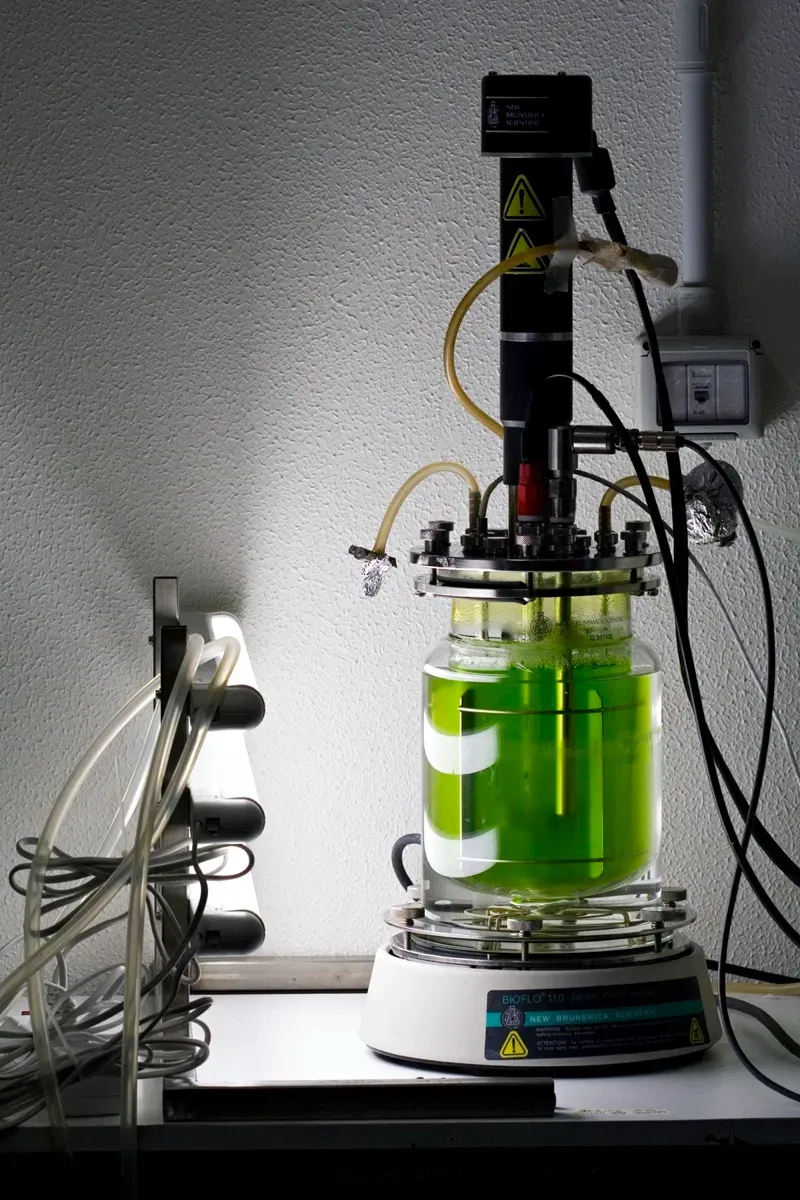
Images: “Green algae in a bioreactor”, Umberto Salvagnin, CC BY 2.0, via Wikimedia Commons. Illustrative; no freely licensed photo of Solein or Factory 01 was found.