The problem
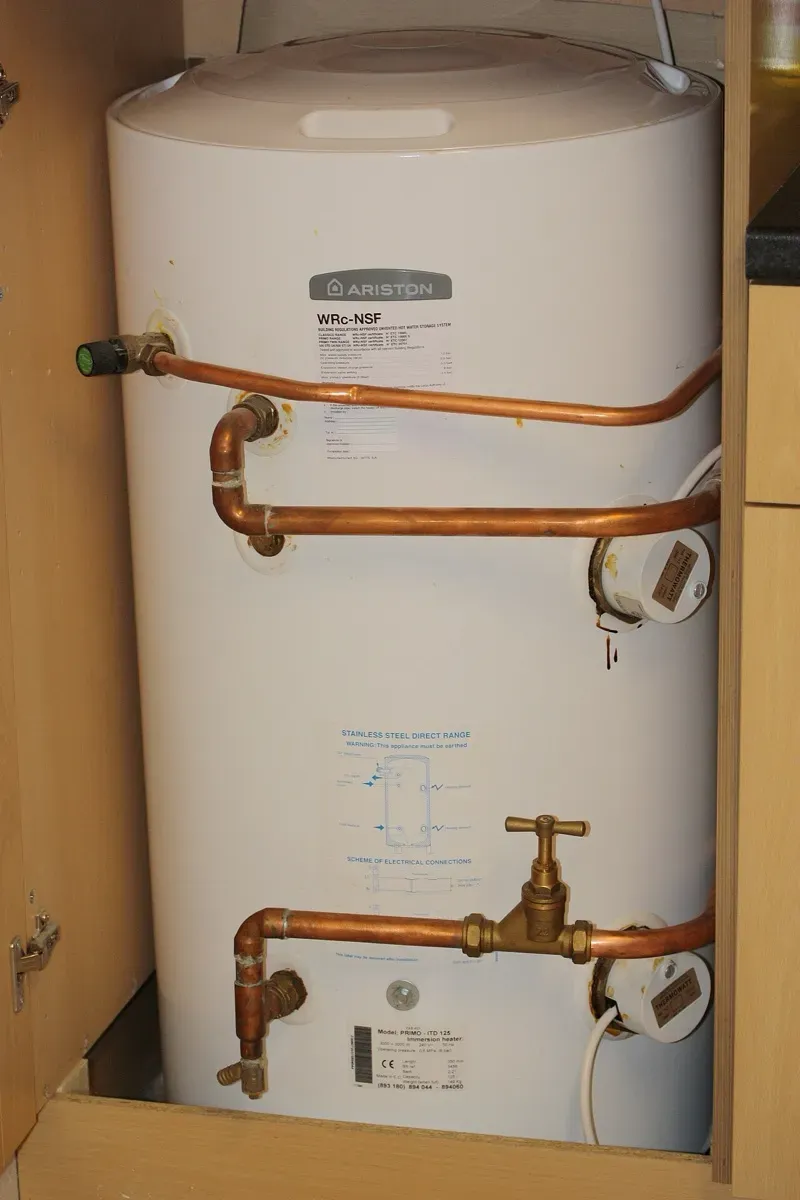
Hot water is the stubborn part of home heating. A heat pump can warm radiators slowly and efficiently, but people want a hot shower on demand, so most heat pump installations need a stored volume of hot water. Water stores only about 35 Wh per litre over a typical temperature swing, so the cylinders are big. In small flats and terraced houses, where airing cupboards were removed long ago for gas combi boilers, there is often nowhere to put them.
Big tanks also lose heat around the clock, which is why conventional cylinders need periodic high-temperature cycles to control Legionella. And electric water heaters can create sharp peaks in demand that strain building wiring and local grids just as homes add heat pumps and electric cars.
The product
Thermino is a heat battery: an insulated box containing a heat exchanger embedded in Plentigrade, Sunamp’s proprietary PCM. The company says Thermino occupies up to four times less space than an equivalent cylinder, and delivers instant mains-pressure hot water (Sunamp).
There are two families:
- Thermino ePlus replaces direct electric cylinders. Four sizes (70, 150, 210 and 300) store the equivalent of 74 to 306 litres, with 1.8 or 2.8 kW heating elements and standing losses of 0.48 to 0.84 kWh a day. Their energy class is C, as for any direct electric water heater.
- Thermino xPlus replaces indirect cylinders heated by a heat pump, boiler or solar thermal. Three sizes store the equivalent of 128 to 256 litres, with flow rates of 15 to 25 litres a minute and energy class A+.
Sunamp has certified integrations with heat pumps from NIBE, Mitsubishi Electric, Midea and Haier through its Optimino control key, and partners such as tepeo combine it with space heating heat batteries (Sunamp news). In March 2025 it added low-power models for homes with limited electrical supply, and in March 2026 it launched Central Bank Mini, its first product for commercial and industrial waste heat, storing up to 80 kWh in its P58 version (Sunamp, 25 March 2026).
How it works
Thermino uses latent heat, the energy needed to melt a solid, rather than simply heating water:
- Charging: heat from an electric element, heat pump or boiler melts the Plentigrade P58 inside the battery at about 58°C.
- Storing: the molten material holds that energy at a near-constant temperature. Vacuum insulation panels reduce standing losses.
- Discharging: when a tap opens, cold mains water flows through the heat exchanger, the PCM freezes back into a solid, and its latent heat warms the water instantly.
- Repeating: the material changes phase again and again; Sunamp says its composition stays unchanged, like the gel in a reusable pocket hand warmer.
Plentigrade was developed with the University of Edinburgh and studied at Diamond Light Source, the UK’s national synchrotron (Sunamp, Plentigrade). Sunamp can tune the melting point, from minus 30°C for refrigeration to 118°C for sterilisation, which opens the door to cooling and industrial uses.
Timeline
| Date | Milestone |
|---|---|
| Aug 2020 | £4.5 million Series A financing |
| Jan 2020 | Heat batteries with heat pumps replace gas in 364 tower block homes in Sunderland |
| Sep 2021 | £6 million Series B from the Scottish National Investment Bank |
| Nov 2021 | Fourth-generation Thermino heat batteries unveiled |
| Nov 2022 | £9.25 million UK Government award to trial extended-duration storage in 100 homes |
| Aug 2025 | Founders step back; Grant Richardson becomes CEO |
| Oct to Nov 2025 | Manufacturing partnerships in California (HTEC) and China (Gomon) announced |
| Mar 2026 | Central Bank Mini launched for industry at MCE, Milan |
Impact and numbers
- Space: up to four times smaller than an equivalent cylinder, according to Sunamp; P58 stores about 140 Wh per litre against about 35 Wh for water over the same use.
- Durability: RAL certification for no noticeable degradation over 10,000 cycles (Sunamp, Plentigrade).
- Grid peaks: in a trial at Liberty Elementary School in Springfield, Massachusetts, a Thermino 80 ePlus peaked at about 2.4 kW against 7.1 kW for an 80-gallon electric tank, a 66% cut, and used about 30% less energy (Sunamp case study).
- Investment: the Scottish National Investment Bank lists £27 million invested and more than 15,000 units sold (SNIB).
- Recognition: King’s Awards for Enterprise in 2023 and 2024 (Innovation) and an Institute of Physics Business Innovation Award in December 2025.
Honest caveats. The headline numbers are Sunamp’s own, and the school trial was run by a distribution partner rather than an independent lab. A heat battery stores heat; it does not create it, so the climate benefit depends on what charges it: a heat pump or solar PV, rather than peak-time grid power. Direct electric ePlus units still turn one unit of electricity into one unit of heat. Upfront prices are typically higher than for a basic cylinder, and the founders’ departure from executive roles in August 2025 marks a change of leadership that buyers of long-life products may want to watch. Sunamp is privately held and does not publish detailed accounts in its news releases.
What’s next
Sunamp is shifting from a residential niche towards scale and new markets. Partnerships with Jiangsu Gomon New Energy Technology in China and Heat Transfer Equipment Company in California aim to make heat batteries closer to Asian and North American customers. Hydro Québec approved Thermino and Central Bank Mini for its commercial rebate programme in May 2026, and a June 2026 agreement with Urel Engineering targets industrial heat in Turkey. The bigger test is whether housebuilders and social landlords adopt PCM storage as standard in all-electric homes.
Why it matters for Europe / green buyers
Europe sold about 2.62 million heat pumps in 2025, with UK sales of ground and water source units up 32% (EHPA, March 2026). Compact storage removes one of the practical objections to those installations: the missing cupboard. For landlords and installers, Thermino can also shift water heating to cheap or solar hours and soften peaks on crowded local networks. Buyers should check compatibility with their heat pump, flow rates for their household and the warranty terms.
In India, where electric geysers are common and rooftop solar is growing fast, PCM heat batteries charged by midday solar could cut evening demand, provided costs come down.
Sources & image credits
- Sunamp, “Work with Thermino” (product range and specifications): https://sunamp.com/en-gb/work-with-thermino/
- Sunamp, “Plentigrade: Phase Change Material (PCM) Technology”: https://sunamp.com/ie/plentigrade/
- Sunamp, “Latest news” (company announcements 2020 to 2026): https://sunamp.com/latest-news/
- Scottish National Investment Bank, portfolio page “Sunamp”: https://www.thebank.scot/portfolio/sunamp
- Sunamp, “Leadership transition at Sunamp”, 4 August 2025: https://sunamp.com/blog/leadership-transition-at-sunamp/
- Sunamp, “Cutting peak demand by 66% and eliminating Monday morning reheat spikes in a US school”: https://sunamp.com/case-studies/thermino-cuts-peak-demand-by-66-percent-in-a-us-school/
- Sunamp, “Sunamp launches breakthrough PCM thermal storage for the industrial market”, 25 March 2026: https://sunamp.com/blog/sunamp-launches-breakthrough-pcm-central-bank-mini-for-industrial/
- European Heat Pump Association, “Pump it up: why heat pump sales rose in 2025”, March 2026: https://ehpa.org/wp-content/uploads/2026/04/20260325_Pump-it-up-why-heat-pump-sales-rose-in-2025_EHPA.pdf
Images:
- “Hot water storage” by Julie Anne Workman, licensed CC BY-SA 3.0 (https://creativecommons.org/licenses/by-sa/3.0), via Wikimedia Commons: https://commons.wikimedia.org/wiki/File:Hot_water_storage.jpg