The problem
Large commercial buildings use a lot of electricity, and their owners increasingly want to generate it on site. Rooftop solar is the obvious choice, but it produces nothing at night and much less in a northern European winter, exactly when demand and grid prices can be high. Batteries help, but they add cost.
Wind would be a natural partner because it often blows hardest in the evening and in winter. But small conventional turbines have struggled on buildings for decades. Spinning blades cause noise and vibration that travel through the structure, raise concerns about birds and ice, and are hard to get planning permission for. Aeromine’s chief executive Mark Swanson describes building-mounted wind as “a very tough slog” that has been “basically stagnant” while rooftop solar boomed (Commercial Observer).
The product
Carsten Westergaard, who designed blades at Vestas and later taught wind engineering at Texas Tech University, invented and patented the technology in 2015. The basic science was validated with Sandia National Laboratories and Texas Tech (Aeromine).
Each unit sits on the roof edge facing the prevailing wind. Instead of a large rotor, it has fixed, vertical wing-like aerofoils that create low pressure and pull air through a small internal turbine, only about 90 centimetres in diameter. Each unit is rated at about 5 kW, and a typical system would line the edge of a warehouse or distribution centre. Aeromine says the units are quiet, do not vibrate, take up much less roof space than solar for the same output, and are built from durable, recyclable materials (BMW Group).
How it works
- Building effect: wind hitting the side of a building is pushed up and speeds up as it flows over the roof edge.
- Venturi: four vertical aerofoils form a narrowing channel, like a thumb over a hose, that speeds up the air further and creates a low-pressure zone.
- Manifold: that low pressure draws air down through a duct into a small turbine and generator hidden inside the unit.
- Power: the electricity is connected to the building’s electrical system and can share inverters, storage and grid connection with rooftop solar.
- Array: many units are placed side by side along the windward edge, so the system can grow with the building.
Timeline
| Date | Milestone |
|---|---|
| 2015 | Technology invented and patented by Carsten Westergaard |
| 2021 | Aeromine Technologies founded |
| 2022 | First pilot unit with BASF in Wyandotte, Michigan |
| 2023 | Danish EUDP project with DTU and DSV awarded DKK 7.7 million |
| May 2024 | About USD 9 million Series A led by Veriten |
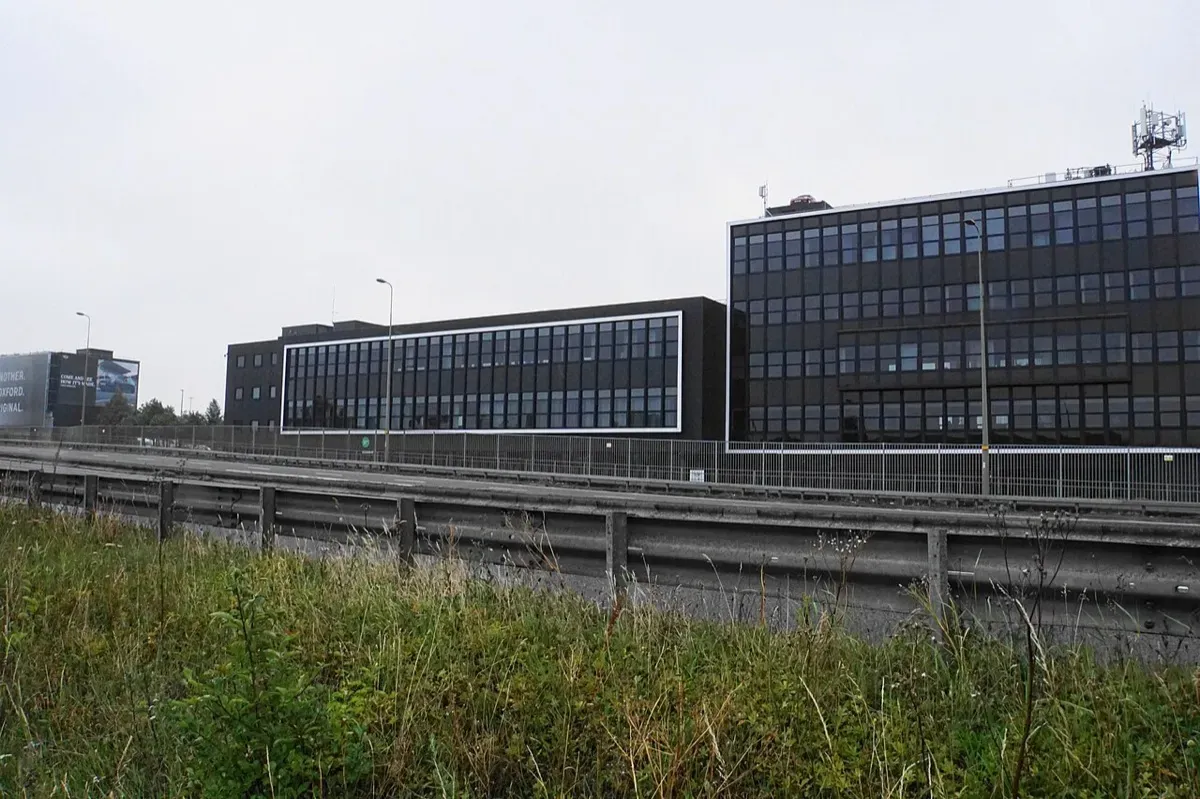
| Sep 2024 | UK’s first “motionless” wind unit at MINI Plant Oxford |
| Sep 2024 to May 2025 | Prototype power tests at DTU’s Risø campus |
| Early 2027 | Planned full commercial launch |
Impact and numbers
- Funding: the Series A of about USD 9 million was led by energy investor Veriten, with engineering firm Thornton Tomasetti and family offices also investing (PR Newswire).
- Demand: Aeromine reported nearly 11,000 inquiries from more than 6,500 companies and a pipeline of 400 qualified projects, mostly from logistics, industry, automotive and property portfolio owners.
- Danish demonstration: the EUDP project “Rooftops: an untapped source of wind energy” has a budget of DKK 10.93 million for 2023 to 2026, including a DKK 7.7 million grant, to install 10 units on DSV’s new logistics building in Ringsted and develop faster, cheaper installation methods (EUDP).
- Independent testing: DTU Wind measured a 5 kW prototype at Risø from September 2024 to May 2025 and built a model to predict annual energy production, while stressing that the results apply only to the prototype, not a future commercial product (DTU).
- BMW: the Oxford unit complements more than 11,000 solar panels on the plant’s Body Shop, which are less effective in winter and in the evening (BBC).
Honest caveats. Aeromine is still finishing its research and development stage, with no volume production yet. In mid-2025 its chief executive said limited production would start around the second quarter of 2026; the company now says full commercial launch is planned for early 2027. Swanson admitted the system has not yet been built at the planned 40-unit scale, and that around six systems were in the field. Because the units do not turn to face the wind, they only work well where it blows steadily from one main direction: he described one site where the wind blows the right way for half the year and “doesn’t do anything at all” for the other half. Tall neighbouring buildings can also ruin performance. The claim that it can supply “up to 100 percent” of a building’s energy, and that its cost of energy will compete with rooftop solar, are company projections. Each unit is small at 5 kW, so a large system means dozens of units, and the company relies on venture capital and was planning a larger Series B. BMW itself called the Oxford trial “small”.
What’s next
The Ringsted installation and DTU’s model are meant to feed final design changes before launch. Aeromine plans to sell through the existing rooftop solar industry, using the same installers, finance and incentives, and is aiming at warehouses, data centres and distribution hubs in windy coastal areas of northern Europe and the US.
Why it matters for Europe / green buyers
Europe has vast areas of flat logistics and factory roofs, many in windy places such as Denmark, the Netherlands and the UK, and grid connections are often hard to expand. A quiet wind unit that produces in the evening and in winter could make on-site renewable power much more balanced and reduce the battery storage needed. The DTU testing also gives buyers something rare in small wind: independent performance data. Buyers should still wait for measured annual output at commercial scale before committing.
For India and other countries, the technology may be relevant to coastal industrial parks in Gujarat or Tamil Nadu with steady monsoon winds, but only once it is proven commercially and priced against very cheap rooftop solar.
Sources & image credits
- Aeromine Technologies, “About: Our vision and history”, accessed October 2026: https://aerominetechnologies.com/about
- PR Newswire, “Veriten Leads Latest Funding Round For Aeromine Technologies’ Innovative Distributed Power Wind Energy Solution”, 22 May 2024: https://www.prnewswire.com/news-releases/veriten-leads-latest-funding-round-for-aeromine-technologies-innovative-distributed-power-wind-energy-solution-302152339.html
- BMW Group, “BMW Group Trials Wind Energy Innovation in UK First”, 4 September 2024: https://www.press.bmwgroup.com/global/article/detail/T0444783EN/bmw-group-trials-wind-energy-innovation-in-uk-first?language=en
- BBC News, “BMW trials ‘motionless’ wind energy system”, 23 September 2024: https://www.bbc.com/news/articles/c07ngp4yz7jo
- EUDP (Danish Energy Agency), “Tagflader: En uudnyttet kilde til vindenergi” (Rooftops: an untapped source of wind energy), project 2023 to 2026: https://eudp.dk/en/node/16994
- DTU Wind and Energy Systems, “The Rooftops Experiment: Power Performance Assessments”, report I-1828, 2025: https://orbit.dtu.dk/en/publications/the-rooftops-experiment-power-performance-assessments/
- Commercial Observer, “Aeromine’s Mark Swanson Wants to Make Wind Capture Viable for Real Estate”, 3 June 2025: https://commercialobserver.com/2025/06/aeromine-wind-commercial-real-estate/
Images:
- “Cowley BMW Mini plant” by Bill Boaden, 2020, via geograph.org.uk, licensed under CC BY-SA 2.0 (https://creativecommons.org/licenses/by-sa/2.0), via Wikimedia Commons: https://commons.wikimedia.org/wiki/File:Cowley_BMW_Mini_plant_-_geograph.org.uk_-_6543621.jpg