The problem
India generates more than 300 million tonnes of construction and demolition (C&D) waste a year, with less than 1% officially recycled, according to CarbonCraft (CarbonCraft). Most is dumped on open land, riverbanks and landfills. At the same time, conventional fired bricks and vitrified tiles need high temperatures and a lot of energy. India is the world’s second-largest brick producer, and brick kilns are a major source of black carbon, a component of fine particulate pollution that is harmful to health and strongly warms the climate (NationofChange / CNN).
The product
CarbonCraft’s first product, the Carbon Tile, used black carbon captured from vehicle and factory exhausts by Graviky Labs, the makers of AIR-INK. The carbon pigment was mixed with cement and marble waste from quarries and hand-pressed into tiles using the traditional Athangudi technique of Tamil Nadu. Each tile contained at least 70% waste material, and the company said one tile was equal to cleaning 30,000 litres of air. The tiles were made with a hydraulic press instead of firing, which the company said used one-fifth of the energy of vitrified tiles.
The current range, Deewaar (Hindi for “wall”), moves from air pollution to bulk waste. Deewaar tiles contain at least 95% industrial by-products, and each square foot uses 1.9 kg of waste. The range includes Mono (225 x 75 x 10 mm), Slate (240 x 60 x 10 mm) and Contour (210 x 60 x 10 mm) formats with satin matte and blasted finishes (CarbonCraft). Early adopters include Adidas, which used Deewaar tiles in eight stores across India, and brands such as Good Earth, Subko and Royal Enfield.
How it works
CarbonCraft calls its process MATR, for “Matrix of Memory and Matter” (CarbonCraft):
- Collect: industrial by-products such as C&D debris, quartz waste and other mineral-rich residues that would otherwise go to landfill.
- Process: the waste is crushed, refined and blended into high-performance material mixes.
- Build: the blends are combined with natural aggregates and pressed into tiles, bricks and panels by trained artisans.
- Cure: tiles cure at ambient conditions, with no kiln firing or heating, which cuts energy use and emissions.
The new tiles supported by the government are geopolymer claddings made from recycled quartz waste and multi-grade quartz sand, bonded by a chemical reaction rather than by fired clay or large amounts of cement.
Timeline
| Date | Milestone |
|---|---|
| 2018 | Architectural Association Visiting School workshop develops “Breathe”, a façade made with air pollution |
| 9 Dec 2019 | Carbon Craft Design Pvt. Ltd. incorporated in Mumbai |
| 22 Jan 2020 | CarbonCraft’s “carbon story” begins with Carbon Tile prototypes |
| 2020-21 | Carbon Tile and AIR-INK tiles launched online from Dharwad during Covid |
| Later | Carbon Lab set up in Hubli; Deewaar wall series launched; Adidas uses it in eight stores |
| 26 Feb 2026 | Technology Development Board agreement to fund a geopolymer tile factory |
| 1 Apr 2026 | India’s Construction and Demolition Waste Management Rules, 2025 apply |
Impact and numbers
- Waste use: 1.9 kg of industrial by-products per square foot of Deewaar, at least 95% waste by composition.
- Energy: no kiln firing; the original Carbon Tile used about one-fifth of the energy of vitrified tiles, according to the company.
- Public backing: the Technology Development Board, under India’s Department of Science and Technology, signed an agreement to provide financial assistance for a “state-of-the-art manufacturing facility for geopolymer-based tiles developed using indigenous technology” (TDB). TDB says the project should help replace imported architectural cladding.
- Projects: murals in government projects in Bengaluru and at the National Gallery of Modern Art in Mumbai.
Honest caveats. CarbonCraft describes its tiles as “carbon-negative”, but it does not publish an environmental product declaration or a third-party life cycle assessment on its website, so this claim cannot be checked. Unfired tiles still use binders, and the carbon footprint depends on how much cement or alkali activator is used. The early “one tile equals one day of clean air” message was a communication device rather than a measured air quality benefit. CarbonCraft is a small start-up, and neither the amount of TDB funding nor its production volumes have been disclosed, so its new factory is the key test of whether it can move from design projects to volume production. Tiles are a decorative, low-tonnage use of waste: real progress on India’s C&D waste will also need recycled aggregates in concrete and roads.
What’s next
The TDB-backed factory for geopolymer wall claddings is CarbonCraft’s next step from artisanal batches to industrial output. India’s new Environment (Construction and Demolition) Waste Management Rules, 2025, which apply from 1 April 2026, make large projects responsible for recycling their waste and require rising shares of recycled C&D material in construction, starting at 5% in 2026-27 and reaching 25% by 2030-31 (Down To Earth). That creates a new market for products like Deewaar.
Why it matters for India and Europe
For Indian architects, retailers and developers, Deewaar offers a locally made, unfired wall finish that turns construction and quarry waste into a design feature and can help meet the new recycled-material targets. It also keeps traditional tile-making skills alive and creates work for artisans, an explicit part of the company’s mission alongside formalising waste-worker livelihoods. For brands with many stores, such as Adidas, a standard tile made from waste is an easy, visible way to cut the embodied impact of interiors.
For Europe, CarbonCraft is a reminder that circular materials do not have to be high-tech. European building rules increasingly reward reused and recycled content, and hand-pressed, unfired tiles made from local demolition waste are a simple idea that European makers could also apply to their own C&D streams, which are one of the largest waste flows in the EU by weight. The bigger lesson is the business model: pairing a waste stream with a design-led product that architects actually want to specify, rather than treating recycled material as a cheap filler.
Sources & image credits
- CarbonCraft, home page: https://www.carboncraftdesign.com/
- CarbonCraft, “Deewaar” product page: https://www.carboncraftdesign.com/deewaar
- CarbonCraft, “MATR Technology”: https://www.carboncraftdesign.com/matr-technology
- CarbonCraft, “Our Story” (mission, milestones and waste statistics): https://www.carboncraftdesign.com/ourstory
- CarbonCraft, “Our Carbon Story”: https://www.carboncraftdesign.com/our-carbon-story
- NationofChange (summarising CNN reporting), “This Indian startup turns polluted air into climate-friendly tiles”, 9 January 2021: https://www.nationofchange.org/2021/01/09/this-indian-startup-turns-polluted-air-into-climate-friendly-tiles/
- Technology Development Board, DST, “TDB-DST supports Carbon Craft Design Pvt. Ltd. for Commercialization of Eco-Friendly Ultra-Low Carbon Wall Claddings”, 26 February 2026: https://www.tdb.gov.in/tdb-dst-supports-carbon-craft-design-pvt-ltd-commercialization-eco-friendly-ultra-low-carbon-wall
- Sahyadri Startups, “Carbon Craft Design Secures TDB-DST Funding”, 2026: https://sahyadristartups.com/spotlight/carbon-craft-design-secures-tdb-dst-funding-to-commercialize-ultra-low-carbon-wall-claddings/
- Down To Earth, “C&D waste rules 2025 welcome move, but codes need an update now more than ever”, 15 May 2025: https://www.downtoearth.org.in/waste/cd-waste-rules-2025-welcome-move-but-codes-need-an-update-now-more-than-ever
Images:
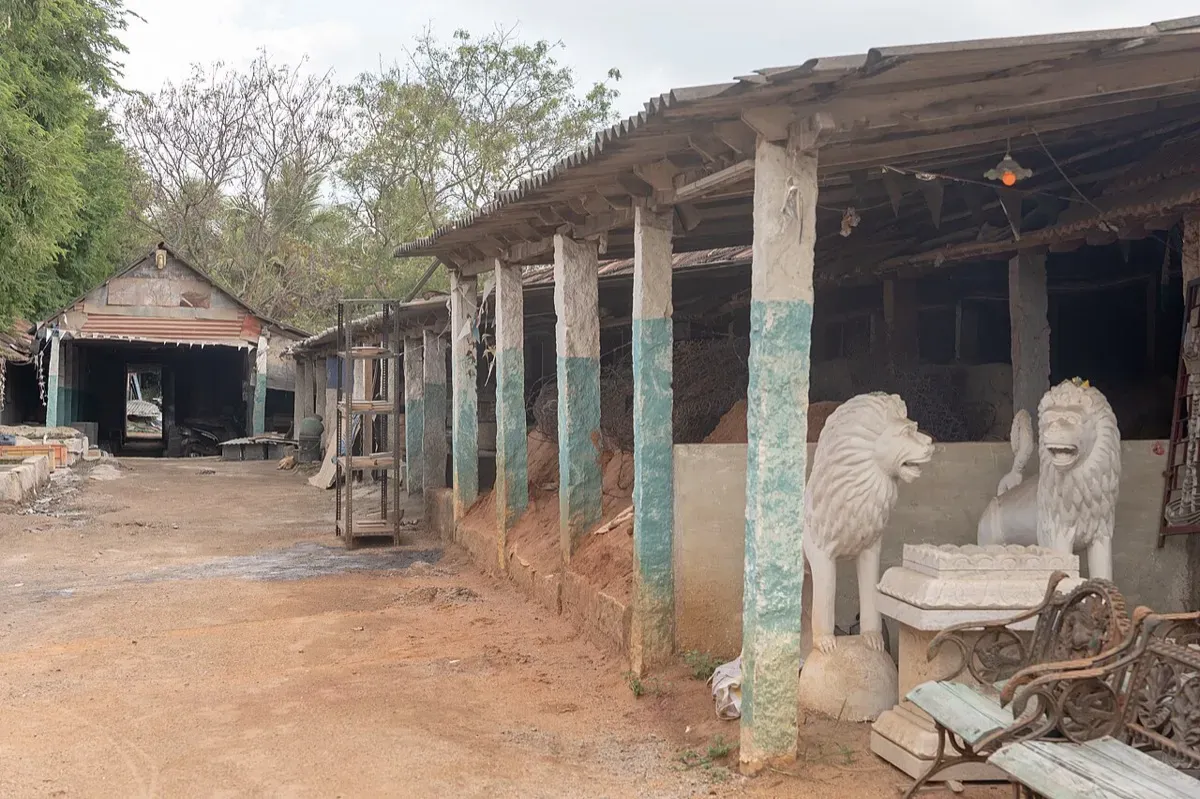
- “Chettinad-Manufacturing Athangudi Tiles-WUS-04325” by Rainer Halama, 2025, licensed under CC BY-SA 4.0 (https://creativecommons.org/licenses/by-sa/4.0), via Wikimedia Commons: https://commons.wikimedia.org/wiki/File:Chettinad-Manufacturing_Athangudi_Tiles-WUS-04325.jpg