The problem
Since the 19th century, almost all textile colour has come from synthetic, oil-derived dyes. They are cheap and reliable, but making and fixing them uses many chemicals and repeated rinses. Fabric dyeing consumes about five trillion litres of water a year, according to the Earthshot Prize (Earthshot Prize).
Yarkoni told Euronews that the industry uses “upward of 70 highly toxic chemicals” in dyeing, counting dyes plus the auxiliaries that bind colour to fabric, and that more than 30 cannot be removed from wastewater (Euronews). Much dyeing happens in Asia, where effluent controls vary.
Natural dyes from plants have made a small comeback, but they need land, give uneven results and often still rely on metal salts called mordants to fix the colour. What the industry lacks is a colour source that is renewable, consistent at industrial scale and able to run on the machines mills already own.
The product
Colorifix sells a biological dyeing process to mills and dye houses, plus the dyes it produces. The company says its technology works on cotton, wool, silk, polyester, nylon and lyocell, and runs on existing mill equipment (Textile Today).
Recent products include:
- Colorifix Concentrated Dyes (May 2026): dyes delivered ready to use with only water added, so mills no longer need to install a fermenter (Colorifix on LinkedIn).
- Sunlit Clay (29 September 2026): a warm, earthy shade for wool yarn and fabric, inspired by bacteria in soil and deep-sea sediments.
- Solar Glow and Blushing Rose: shades used in a Parley for the Oceans vest shown during London Climate Action Week 2026 and in a knitted sneaker upper with Nettle Circle and CosmiKnit.
How it works
- Find a colour: the team picks a pigment made by a plant, animal, insect or microbe.
- Read the code: using online DNA databases, never a physical specimen, it identifies the genes that make that pigment.
- Engineer a microbe: the DNA is built and inserted into a Colorifix bacterium or yeast, which becomes a tiny pigment factory.
- Brew: the microbes grow in fermenters on non-hazardous ingredients, which could include agricultural by-products rich in sugars and salts.
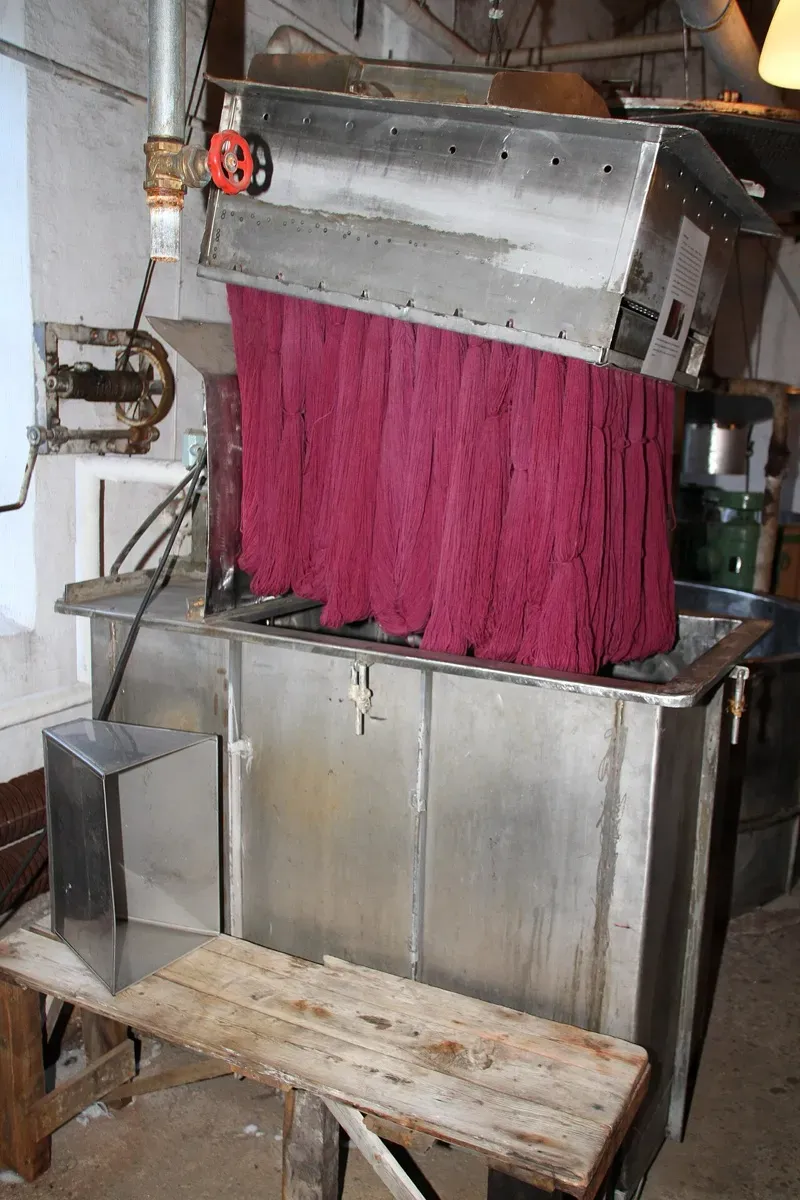
- Dye: the whole broth goes into a standard dye machine with the yarn, fabric or garment, where the pigment is deposited and fixed (Colorifix).
Colorifix says it tests each dye for cytotoxicity, skin irritation and allergenicity. As Yarkoni put it, “natural does not mean non-toxic”.
Timeline
| Date | Milestone |
|---|---|
| 2016 | Colorifix founded at Norwich Research Park |
| 2021 | First commercial product launched with H&M and Pangaia, dyed at RDD (Valérius Group), Portugal |
| 1 Jun 2022 | GBP 18 million Series B led by H&M CO:LAB |
| 2023 | Earthshot Prize finalist (“Build a Waste-free World”) |
| May 2026 | Colorifix Concentrated Dyes launched |
| Jul 2026 | Parley for the Oceans vest previewed at the Earthshot Prize Impact Assembly |
| 29 Sep 2026 | Sunlit Clay wool dye launched |
Impact and numbers
- LCA (company-commissioned, third-party verified): for dyeing and final washing of knitted jersey made from recycled cotton and polyester, 80% less chemical use, 77% less water, 71% less natural gas, 53% less electricity and 31% lower CO2 emissions than conventional dyeing (Textile Today).
- Palette: “hundreds of colours” developed; a full range for synthetics such as polyester and a “more limited but growing” range for cotton and cellulosics (Euronews).
- Ambition: to dye 15% of the world’s clothes by 2030 (Earthshot Prize).
- Funding: the Series B was led by H&M CO:LAB with Sagana, Cambridge Enterprise, Bombyx, PDS Ventures, Regeneration.VC and SynBioVen (Norwich Research Park).
Honest caveats. The headline savings come from one LCA on one fabric type, and Colorifix has not published separate data for wool or for its new concentrates. Figures also vary by source: in Euronews, Yarkoni cited 51% energy savings for polycotton, while the LCA summary lists 71% less gas and 53% less electricity. Shipping concentrates removes the need for on-site fermenters, but adds production and transport steps whose footprint is not yet published. The 15% by 2030 goal is an ambition; Colorifix is a small company and has not disclosed the volume of fabric it dyes. Using genetically engineered microbes may raise regulatory or consumer questions in some markets, even though the microbes stay in the dye process. Cellulose colours are still limited, and cotton is the world’s main natural fibre.
What’s next
Colorifix is pushing concentrates to make adoption as easy as swapping a dye drum, and expanding into wool and luxury fabrics. Its staff are spread across the UK, Portugal and other markets, and Earthshot exposure has brought enquiries “from all over the world”, according to Yarkoni. The company’s direct customers are mills and dye houses, while fashion brands act as the main drivers of change by nominating Colorifix colours in their orders.
Why it matters for Europe / green buyers
The EU Strategy for Sustainable and Circular Textiles sets a 2030 vision of textiles that are long-lived, recyclable, largely made of recycled fibres and “free of hazardous substances”. It notes concern about around 60 hazardous substances in textiles considered carcinogenic, mutagenic or toxic to reproduction, which the Commission is addressing under REACH, and links textile production to the revision of the Industrial Emissions Directive (EUR-Lex). For brands, a drop-in biological dye is one of the few ways to cut chemical load at the dye house without new machines. Ask for the LCA for your specific fibre and shade, and for colour-fastness test results.
India’s dyeing clusters show what is at stake. In January 2011, the Madras High Court ordered the closure of dyeing and bleaching units in Tiruppur, Tamil Nadu, that failed to meet zero liquid discharge orders after years of pollution of the Noyyal river (Down To Earth). Dye processes that need fewer chemicals and less water could ease the cost of meeting such rules in Indian mills.
Sources & image credits
- Colorifix, company website (technology): https://colorifix.com/
- Norwich Research Park, “GBP 18m Series B round raised to accelerate the adoption of Colorifix’s sustainable textile dyeing solution” (1 Jun 2022): https://www.norwichresearchpark.com/18m-series-b-round-raised-to-accelerate-the-adoption-of-colorifixs-sustainable-textile-dyeing-solution
- The Earthshot Prize, Colorifix, 2023 finalist: https://earthshotprize.org/winners-finalists/colorifix/
- Euronews, “Nature makes every colour in the world” (24 Aug 2026): https://www.euronews.com/2026/08/24/nature-makes-every-colour-in-the-world-meet-the-company-brewing-an-end-to-toxic-chemical-d
- Textile Today, “Colorifix launches bacteria-based dye for wool” (Oct 2026): https://textiletoday.com.bd/colorifix-launches-bacteria-based-dye-for-wool
- Colorifix on LinkedIn, Colorifix Concentrated Dyes (May 2026): https://www.linkedin.com/posts/colorifix_until-now-the-biggest-barrier-to-adopting-activity-7463218175539724288-fLBU
- EUR-Lex, EU Strategy for Sustainable and Circular Textiles, COM(2022) 141: https://eur-lex.europa.eu/legal-content/EN/TXT/HTML/?uri=CELEX%3A52022DC0141
- Down To Earth, “Tirupur dyeing units told to close” (2011): https://www.downtoearth.org.in/environment/tirupur-dyeing-units-told-to-close-33025
Images:
- “Sjöllingstad IMG 3188 dyeing machine” by Bjoertvedt, 2013, licensed under CC BY-SA 3.0 (https://creativecommons.org/licenses/by-sa/3.0), via Wikimedia Commons: https://commons.wikimedia.org/wiki/File:Sj%C3%B6llingstad_IMG_3188_dyeing_machine.JPG