The problem
In Indian cities, wet waste such as food scraps and garden trimmings is usually the largest share of household rubbish. Mixed with plastic and paper, it rots in landfills, produces methane and leachate, and makes the dry fraction hard to recycle. Bengaluru learned this the hard way in the 2010s, when protests at overflowing landfill sites left garbage piling up on city streets. As Kasturi puts it, food waste is about 70% water, so trucking it to landfills is “a terrible waste of the state’s resources” (The Hard Copy).
The fix is simple in theory: keep wet waste separate and turn it into compost close to where it is produced. In practice, most families in flats have no garden, little space and little patience for smelly bins. Composting needed a product that looked good, worked on a balcony and was easy to learn.
The product
The Khamba, Hindi for pillar, is a tower of stacked terracotta containers with lids, made by hand by potters. Kitchen waste goes into the top pot with a sprinkle of dry material; when it is full, the pots are rotated so the oldest, most finished compost sits at the bottom. Daily Dump’s shop lists (Daily Dump):
- Khamba 3 Tier Small at INR 2,999, 3 Tier Large at INR 3,499 and 4 Tier Large at INR 3,699;
- starter kits bundling a Khamba with compost aids and tools, from about INR 3,499 to INR 4,599;
- containers of roughly 10 or 15 litres each, depending on size.
Daily Dump says the Khamba handles up to about 1 kg of waste a day, suiting two to five people, and that compost can be harvested about 30 days after the last pot is filled. A family of four, producing 1 to 2 kg of kitchen waste a day, can expect around 7 to 10 kg of compost per cycle. Because the units are handmade and fragile, Khambas ship only within Bengaluru; other cities get plastic designs such as the Gobble.
How it works
- Separate: kitchen scraps go into a small caddy, kept apart from plastic and paper.
- Add: each day the scraps are tipped into the top pot.
- Balance: a handful of dry “browns”, such as Daily Dump’s compost aid, cocopeat or dry leaves, absorbs moisture and limits smells.
- Breathe: terracotta is porous and the pots have holes, so air reaches the waste and microbes break it down aerobically.
- Rotate: when the top pot is full, it moves down and an empty pot goes on top.
- Harvest: after about a month of curing, the bottom pot yields compost for pots and gardens.
Timeline
| Date | Milestone |
|---|---|
| 2006 | Poonam Bir Kasturi starts Daily Dump from her garage; Khamba designed |
| 2010s | Range grows to plastic composters, compost aids and community composting |
| FY 2021-22 | Revenue of INR 3.75 crore |
| 2022 | Shark Tank India appearance; Terrabite launched, with a patent application |
| 27 Jan 2026 | Solid Waste Management Rules 2026 notified |
| 1 Apr 2026 | New rules in force |
Impact and numbers
- Business: revenue of INR 3.75 crore in FY 2021-22; on Shark Tank India, Namita Thapar’s offer valued the company at INR 7.5 crore (The Hard Copy).
- Range: in answer to demand for lighter, unbreakable composters, Daily Dump added the Gobble and then the Terrabite, both in LDPE plastic. The Terrabite, a double-walled balcony composter with a leachate tap, launched at INR 20,000 (now listed at INR 18,499), has sold more than 500 units and is the first product for which Kasturi has applied for a patent (The Hard Copy). Only 60% of FY 2021-22 revenue came from community composters.
- Open design: Daily Dump says the Khamba is covered by a Creative Commons Attribution NonCommercial ShareAlike licence (Daily Dump). Kasturi says the company’s contribution was to open the door to decentralised waste management, so that others now follow (Steelcase).
Honest caveats. Home composting is not automatically climate-neutral. A Danish life cycle study found that home composting emits methane and nitrous oxide, with emissions depending strongly on moisture, aeration and how the heap is managed (DTU); a soggy, overfilled Khamba risks the same. The product also depends on behaviour: compost needs daily attention, and some buyers give up after the first smelly week. Kasturi told The Hard Copy that selling to apartment complexes has been an uphill battle despite hundreds of presentations: even when builders set aside space, resident welfare associations often reject composters as too expensive and not essential. Daily Dump’s figures on compost yield and waste capacity are its own. Terracotta is heavy and breakable, which limits shipping beyond Bengaluru. And household composting cannot handle meat, bones or large volumes, so cities still need collection and central processing.
What’s next
India’s Solid Waste Management Rules 2026 strengthen the case for products like the Khamba. They require segregation at source into four streams, including wet waste, and put extra duties on bulk generators, defined by thresholds such as 20,000 m2 of floor area, 40,000 litres of water use a day or 100 kg of waste a day, who must process wet waste on site where possible (PIB). That opens a market for community and apartment-scale composters, alongside household Khambas and Terrabites.
Why it matters for Europe / green buyers
In the EU, member states have had to collect bio-waste separately or recycle it at source since 31 December 2023 under the revised Waste Framework Directive (EUR-Lex), and home composting counts towards that goal. Daily Dump shows that compost hardware can be a design object, not just a plastic bin, and that open, locally made designs can spread without a big factory. European cities promoting balcony composting could learn from its training-first approach.
For India, the Khamba is a case study in designing for the user: a familiar material, a local craft supply chain and a price under INR 4,000 for most households. As the 2026 rules push wet waste segregation, products that make it easy at home will matter as much as municipal plants.
Sources & image credits
- Daily Dump, “Composters”: https://www.dailydump.org/collections/composters-all
- The Hard Copy, “Daily Dump: sustainable brand case study”: https://thehardcopy.co/daily-dumps-sustainable-brand-case-study/
- Steelcase, “Conversations: Poonam Bir Kasturi”: https://www.steelcase.com/eu-en/research/articles/topics/people-planet/conversations-poonam-bir-kasturi/
- PIB, Solid Waste Management Rules 2026: https://www.pib.gov.in/PressReleasePage.aspx?PRID=2219676&lang=1®=3
- Andersen, Boldrin, Christensen and Scheutz, “Home composting as an alternative treatment option for organic household waste in Denmark: an environmental assessment using life cycle assessment-modelling”, Waste Management (2012), DTU self-archived manuscript: https://backend.orbit.dtu.dk/ws/files/118476994/11_Home_composting_revised_manuscript_Self_archive.pdf
- EUR-Lex, Directive (EU) 2018/851 amending the Waste Framework Directive: https://eur-lex.europa.eu/eli/dir/2018/851/oj/eng
- Daily Dump, “Khamba Composter”: https://www.dailydump.org/products/khamba-composter-terracotta-stack-home-compost-bin
Images:
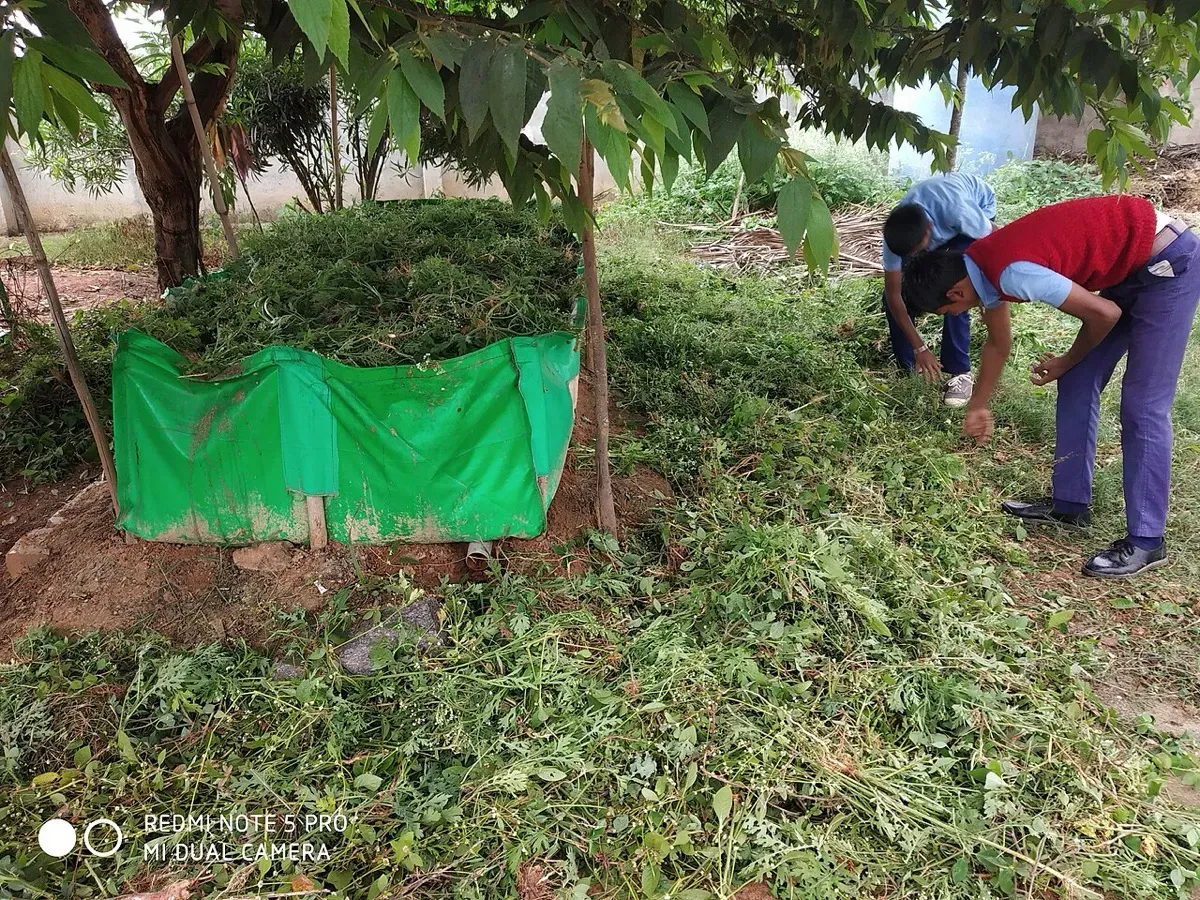
- “Simple vermicomposting in a polyethene bag” by GHS Doddabanahalli, licensed under CC BY-SA 4.0 (https://creativecommons.org/licenses/by-sa/4.0), via Wikimedia Commons: https://commons.wikimedia.org/wiki/File:Simple_vermicomposting_in_a_polyethene_bag.jpg