The problem
Fresh water is only about 1% of the water on the planet, and demand is rising fastest in hot, dry coastal regions that already depend on the sea. Desalination fills the gap, but the dominant technology, reverse osmosis, has well-known drawbacks. It typically runs on grid electricity generated from fossil fuels, uses chemicals to pre-treat water and clean membranes, and returns a concentrated, chemically laden brine to the ocean (EIB, 27 October 2023).
In the Gulf, where desalination supplies most drinking water, brine discharge is a growing concern for marine ecosystems. Inland, farmers in desert regions pump brackish groundwater that is too salty for crops. Both problems call for desalination that runs on renewable energy and leaves no brine behind.
The product
William Janssen, a Dutch engineer, was overseeing construction of the Ferrari World theme park in Abu Dhabi in 2010 when he noticed that rooftop solar water heaters, common around the Mediterranean, could be pushed one step further: to boil salt water and collect the steam as distilled water. He found no existing patents, proved the principle, filed his first patent in 2013 and founded Desolenator the same year. In 2016 the company won second prize in the EU’s Climate Launchpad competition and reached the finals of the EIB Institute’s Social Innovation Tournament (EIB).
Today’s Desolenator unit is a modular industrial plant. Each produces 40 m³ of water per hour from seawater or saline groundwater, using solar thermal energy or low-grade industrial waste heat. The company says its design has been validated for 1,000 m³ a day and delivers ultrapure water at about US$1 per 1,000 litres, with no chemical inputs, no membranes to replace and no toxic brine (Desolenator, XPRIZE).
How it works
The process mimics the natural water cycle. Solar collectors heat saline water until it evaporates, leaving salts and contaminants behind. The vapour condenses on cooler surfaces as pure water, which is then remineralised to suit its end use: drinking, irrigation or industrial processes. In a multi-effect arrangement, the heat released when vapour condenses in one stage is used to evaporate water in the next, so each unit of solar heat produces several units of distilled water.
The remaining concentrate is not discharged. Desolenator runs it to zero liquid discharge, drying it into solid salt, which can be processed to recover minerals such as calcium, magnesium and even lithium. Thermal storage charged by day keeps the plant running at night, and lithium-ion batteries provide backup during power interruptions (EIB).
Timeline
| Date | Milestone |
|---|---|
| 2010 | Idea conceived in Abu Dhabi |
| 2013 | First patent filed; company founded |
| 2016 | Second prize, EU Climate Launchpad |
| 20 Sep 2022 | Partnership with DEWA for a pilot plant in Dubai producing at least 1,000 litres a day |
| 2023 | Second contract, with Silal, for irrigation water in Al Ain |
| 3 Mar 2026 | Wins the BlueInvest Award 2026 (Ocean Resilience) in Brussels |
| May 2026 | Named one of 20 XPRIZE Water Scarcity semi-finalists |
Impact and numbers
- DEWA, Dubai: the 2022 partnership covered a pilot plant producing a minimum of 1,000 litres of water a day (DEWA, 20 September 2022), and the Dutch Water Sector reported that the plant was envisaged to scale to up to 20,000 litres a day (Dutch Water Sector).
- Silal, Al Ain: a trial with the Abu Dhabi agri-food company Silal treated saline groundwater for precision agriculture, producing 25 m³ a day plus 500 kWh of cooling, with zero liquid discharge and up to 85% lower emissions than fossil-powered reverse osmosis (Isle Utilities).
- XPRIZE: during qualification testing the system produced ultrapure water from high-salinity Gulf seawater while converting groundwater into irrigation water at Silal’s Innovation Oasis (HortiDaily). The competition, sponsored by the Mohamed bin Zayed Water Initiative, targets 1,000 m³ a day to WHO drinking water standards.
- EU recognition: BlueInvest Award 2026 winner in the Ocean Resilience category (Desolenator).
- Leadership: CEO Adri Pols; chairman Paddy Padmanathan, former president and CEO of ACWA Power.
Honest caveats. Thermal desalination needs much more energy per litre than modern reverse osmosis; it works only when that energy is free or cheap, such as abundant sunshine or waste heat. Solar collectors need a large land area, which is easier to find in deserts than in crowded coastal cities. Desolenator’s operating plants are still small, tens of cubic metres a day against the hundreds of thousands produced by big Gulf reverse osmosis plants, and the US$1 per 1,000 litres cost and 1,000 m³ a day validation are company figures that the XPRIZE process will test independently. Its emission comparisons are made against fossil-powered reverse osmosis, not against reverse osmosis running on solar electricity.
What’s next
The next XPRIZE phase requires teams to prove performance at scale, measured independently on cost, quality and volume. For customers that cannot fund a plant upfront, Desolenator offers to install, finance and operate it, billing monthly for water and transferring ownership after 15 years (EIB).
Why it matters for Europe / green buyers
Southern Europe already relies on desalination, from Spain’s Mediterranean coast to Cyprus, Malta and the Greek islands, and drought is pushing demand higher. A desalination system that runs on sunshine and produces no brine addresses two of the sector’s biggest environmental objections at once. It is also a European technology finding its first market in the Gulf, where the sun is strong and water is scarce. For utilities, island authorities, greenhouse growers, food processors and industrial sites with waste heat, Desolenator is a product to watch. Buyers should compare total lifetime cost and land use with solar-powered reverse osmosis and ask for independently measured data from the XPRIZE trials.
The opportunity is also large in India’s coastal states and islands, in North Africa and in Australia, wherever strong sunshine meets salty groundwater or the sea. Inland, where brine disposal is the biggest barrier to treating brackish groundwater, zero liquid discharge may matter even more than the energy source.
Sources & image credits
- European Investment Bank, “World’s first circular, solar-powered thermal desalination system”, 27 October 2023: https://www.eib.org/en/stories/saltwater-drinkable-water-desalination
- Dubai Electricity and Water Authority, “DEWA signs a partnership agreement with Desolenator”, 20 September 2022: https://www.dewa.gov.ae/en/about-us/media-publications/latest-news/2022/09/dewa-signs-a-partnership
- Dutch Water Sector, “The world’s first solar thermal desalination plant has a Dutch touch”: https://www.dutchwatersector.com/news/the-worlds-first-solar-thermal-desalination-plant-has-a-dutch-touch
- Isle Utilities, “Solar-powered desalination trial demonstrates a route to net zero farming in the desert”: https://isleutilities.com/case-study/solar-powered-desalination-trial-demonstrates-a-route-to-net-zero-farming-in-the-desert/
- Desolenator, “XPRIZE Semi-finalist 2026”: https://water.desolenator.com/xprize
- HortiDaily, “Desolenator and Silal Group’s Innovation Oasis advance to XPRIZE Water Scarcity semifinals”, 2026: https://www.hortidaily.com/article/9837324/desolenator-and-silal-group-s-innovation-oasis-advance-to-xprize-water-scarcity-semifinals/
- Desolenator, “Winner BlueInvest Awards 2026”: https://www.desolenator.com/blog-post/%20winner-blueinvest-awards-2026
- Solar Impulse Foundation, “Desolenator” company profile: https://solarimpulse.com/companies/desolenator
Images:
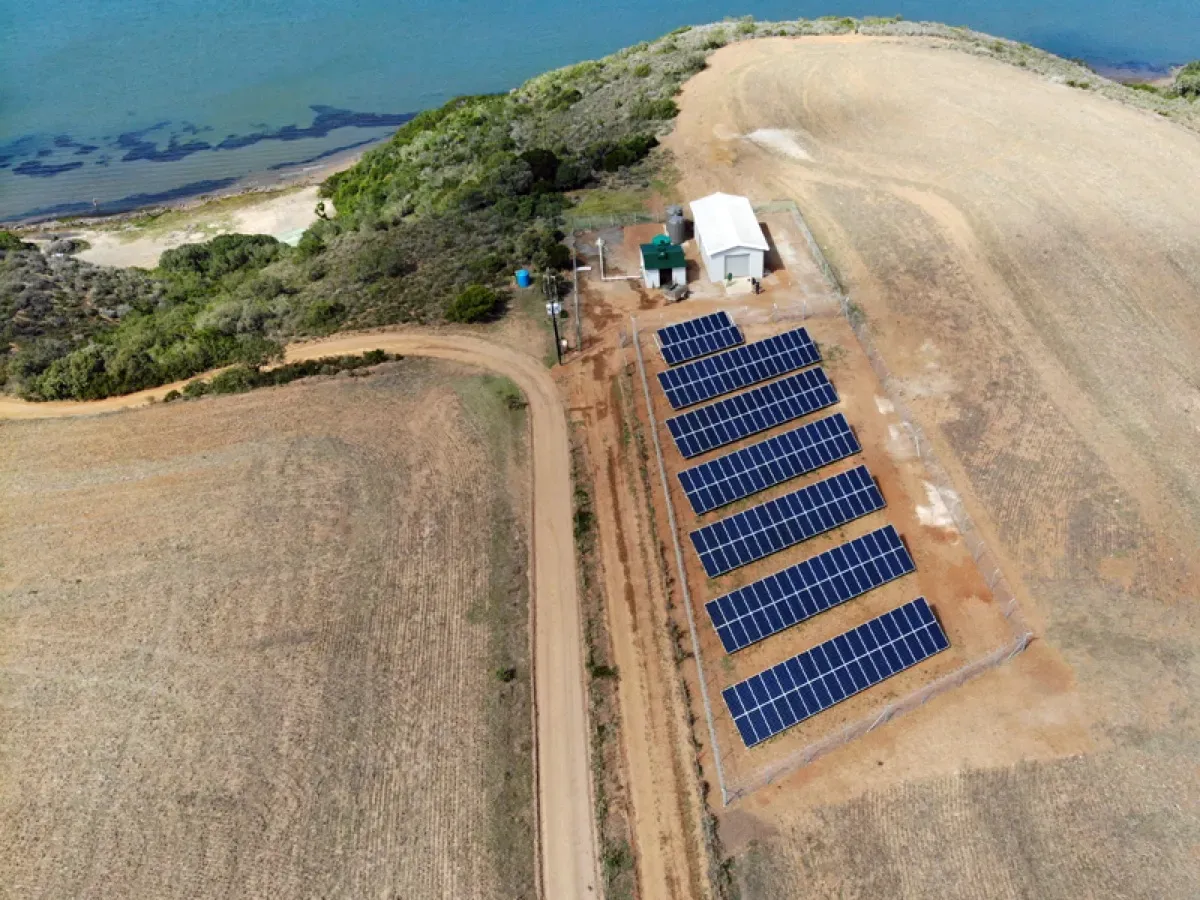
- “Witsand Solar Desalination Plant” by edp, CC0 1.0 public domain dedication (https://creativecommons.org/publicdomain/zero/1.0/), via Wikimedia Commons: https://commons.wikimedia.org/wiki/File:Witsand_Solar_Desalination_Plant.jpg