
The problem
Chainsaws are still the most common forest tool in the world. Even in highly mechanised Nordic forestry, they are used for thinning young stands, clearing undergrowth, felling trees too big or awkward for a harvester, and arborist work in towns. Petrol saws are loud, at around 105 decibels, vibrate hard enough to damage nerves and blood vessels in the hands over years, and expose the user to exhaust fumes all day.
Battery saws have existed for a long time, but most were seen as garden tools. Professionals worried about power, run time, and what happens when the chain jams in a pinched cut. On a petrol saw a centrifugal clutch lets the chain stop while the engine keeps turning. Early battery saws had no clutch, so a stuck chain could stress the motor and electronics.
The product
Husqvarna, the Swedish group that also owns the garden brand Gardena, launched the 542i XP and its top-handle version, the T542i XP, on 2 April 2024. It called them the world’s first battery chainsaws with a clutch.
According to Husqvarna’s specifications, the 542i XP:
- offers power comparable with a 40cc petrol saw, with up to 10% more cutting capacity than the earlier 540i XP;
- runs a chain at up to 24 m/s on Husqvarna’s 40-volt BLi-X batteries, with about 2.4 hp of output;
- weighs about 3.1 kg without battery;
- has a measured sound power of around 104 dB(A), with IPX4 protection against rain and splashes;
- includes a savE mode that trades a little speed for longer battery life.
The saw won an award for outdoor power equipment in the US, and at the APF forestry show in the UK in 2024 it drew attention as a world-first battery saw for professionals. In the US it was priced at about $710 for the tool alone.
How it works
- Battery. A 40-volt lithium-ion battery slides into the body. Several batteries rotate through the day, charged at a vehicle or depot.
- Motor. A brushless electric motor drives the chain directly, with full torque from standstill.
- Clutch. A mechanical clutch sits between motor and chain. If the chain is pinched in a cut, the clutch slips, protecting the drivetrain.
- Modes. The operator can choose full power for felling and bucking, or savE mode for lighter work.
- Silence between cuts. Unlike a petrol saw, the motor stops when the trigger is released, so there is no idle noise or fumes.
Timeline
| Date | Milestone |
|---|---|
| Before 2024 | Husqvarna sells the 540i XP and other battery saws for professional users |
| 2 Apr 2024 | 542i XP and T542i XP launched as the first battery chainsaws with a clutch |
| Sep 2024 | Saw featured at APF 2024, the UK’s biggest forestry show |
| 26 Mar 2026 | Husqvarna’s 2025 annual report: net sales of SEK 46.6 billion and about 11,900 employees |
Impact and numbers
The benefit of a battery saw for workers is now well studied. A 2023 study in the journal Forests compared a professional battery saw with a similar petrol saw. The battery model cut hand vibration by about 51%, and its noise was about 93 dB(A) compared with 105 dB(A) for the petrol saw. Because the decibel scale is logarithmic, that is a large drop. But 93 dB(A) is still above the 85 dB(A) level at which European rules require hearing protection.
A 2026 field study in the Croatian Journal of Forest Engineering, by Bartłomiej Naskrent and colleagues, compared a 58-volt battery saw from another brand with a petrol saw during late thinning in a 14-year-old pine stand. All measured noise parameters were significantly higher for the petrol saw. The battery saw achieved about 0.15 hectares an hour, against 0.16 for the petrol saw, nearly the same. One battery lasted about 41 minutes, compared with 42 minutes for a tank of fuel. But a full shift needed about eight batteries, and professional batteries can cost up to about EUR 500 each, so the upfront cost of a full kit is high. The authors concluded that with enough batteries, a battery saw can replace a petrol saw in tending young forests while cutting noise, vibration and exhaust exposure for the operator.
For the climate, battery saws remove direct exhaust and the petrol supply chain. Their full footprint depends on how the electricity is generated and how the batteries are made and recycled.
Honest caveats
Still loud. Battery saws are much quieter but still need hearing protection when cutting.
Battery count. Forest crews need many batteries, chargers and a way to charge them in the field, often from a vehicle or a generator, which can cut the climate benefit.
Not for the biggest trees. A 40cc-class saw suits thinning, limbing and medium felling. Large trees still need bigger petrol saws or machines.
Upfront cost. The tool plus enough batteries costs more than a petrol saw. Savings come over time through fuel, maintenance and health.
Company claims. The “first with a clutch” and the 10% capacity figures come from Husqvarna. No independent test of the 542i XP itself was found; the studies above cover battery saws in general.
What’s next
Battery tools are a growing part of Husqvarna’s business, and the next steps are higher-capacity batteries, faster charging and better solutions for charging in the forest, such as solar trailers and vehicle systems. As more public landowners and city tree departments set noise and emission rules, professional battery saws are likely to become standard for many jobs.
Why it matters for Europe and green buyers
For Europe, the saw meets two pressures at once: worker health rules on noise and vibration, and public buyers who want low-emission tools in parks, cemeteries and urban forests. Thinning crews in Sweden, Finland and Germany can do much of their work with battery saws, cutting exhaust exposure. Public tenders can now ask for battery equipment for many tasks.
For India, chainsaws are used in plantation forestry, tree surgery in cities and disaster clean-up after cyclones. Battery saws could improve safety and comfort for workers and reduce noise in towns, but the cost of batteries and charging in remote areas is a real barrier. Urban tree departments and companies with solar charging could be the first users.
Sources & image credits
- PR Newswire, “Husqvarna launches another game-changing innovation in chainsaws” (2 Apr 2024). https://www.prnewswire.com/news-releases/husqvarna-launches-another-game-changing-innovation-in-chainsaws-302104823.html
- Husqvarna, 542i XP product page and specifications. https://www.husqvarna.com/us/chainsaws/542i-xp-tool-only/
- Forestry Journal, “APF 2024: Husqvarna’s 542i XP world-first battery saw”. https://www.forestryjournal.co.uk/features/forestry-journal-features/24629810.apf-2024-husqvarnas-542i-xp-world-first-battery-saw/
- Husqvarna Group, Annual Report 2025 (26 Mar 2026). https://www.husqvarnagroup.com/en/report/husqvarna-groups-annual-report-2025
- Neri, F. et al. (2023), battery versus petrol chainsaw noise and vibration, Forests 14(5): 898. https://www.mdpi.com/1999-4907/14/5/898
- Naskrent, B. et al., “Battery-powered chainsaw can be efficiently used for commercial thinning in young pine stands”, Croatian Journal of Forest Engineering 47(2). https://crojfe.com/archive/volume-47-no-2/battery-powered-chainsaw-can-be-efficiently-used-for-commercial-thinning-in-young-pine-stands/
- Wikimedia Commons, “Chainsaw (54188793224).jpg”. https://commons.wikimedia.org/wiki/File:Chainsaw_(54188793224).jpg
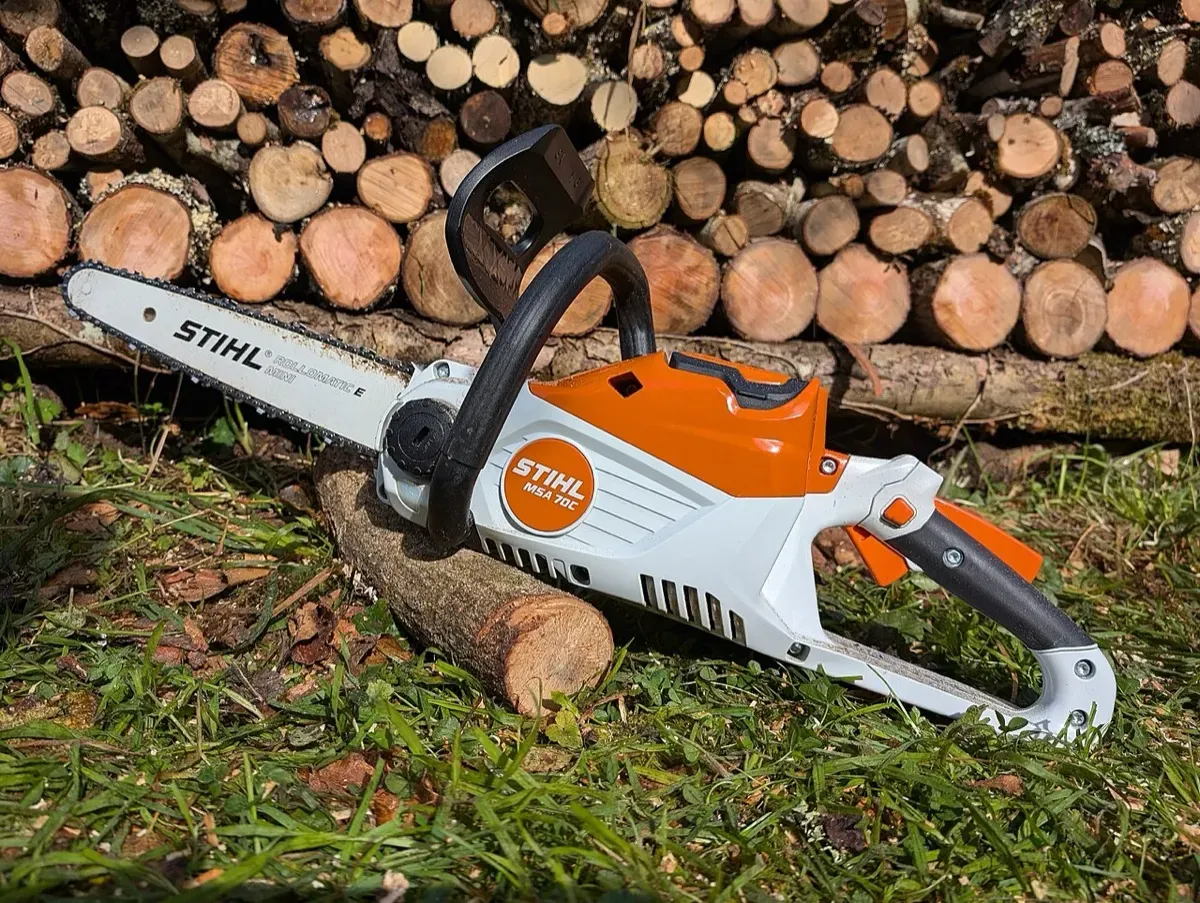
Images: “Chainsaw”, Neil Cummings, 16 November 2024, CC BY-SA 2.0, via Wikimedia Commons. Illustrative: a battery chainsaw charged from solar, not necessarily the 542i XP.
.jpg)