The problem
Most discarded clothes are burned, landfilled or downcycled into rags and insulation. Cotton is the most common natural fibre in that waste. Mechanical recycling shreds it, but the fibres get shorter each time, so recycled cotton usually needs to be blended with new fibre.
At the same time, man-made cellulosic fibres, such as viscose and lyocell, depend on dissolving pulp made from trees. If some of that pulp could come from old cotton, producers would need less wood and fewer garments would be wasted.
The catch is quality. Lyocell and viscose lines need a very pure, consistent pulp. Old clothes contain dyes, finishes, elastane, polyester threads, buttons and zips, and every batch is different. Turning that mix into a pulp as clean as wood pulp takes careful sorting and chemical treatment, and few companies in the world can do it at industrial scale. That bottleneck has shaped REFIBRA’s whole history.
The product
REFIBRA is not a separate fibre but a technology label. Lenzing turns cotton waste into pulp (or buys recycled pulp from partners), mixes it with wood pulp and runs it through its normal fibre lines.
- TENCEL Lyocell with REFIBRA, launched in 2017, was described by Lenzing as the first commercially available cellulosic fibre with recycled content. Recycled cotton content grew over time to up to 30% (TEXINTEL). Early brand partners included Levi’s, Kings of Indigo and Closed, and denim became the main use, where lyocell adds strength to recycled cotton blends.
- LENZING ECOVERO with REFIBRA, launched on 28 August 2023 at Intertextile Shanghai, is a viscose with up to 20% post-consumer textile waste, including cellulose-rich and polyester-cotton blends (Lenzing).
Because the recycling is chemical, the fibre has the same quality as fibre made from wood alone, and it is identifiable along the supply chain so brands can check claims.
How it works
- Collect: cotton cutting scraps from garment factories and post-consumer clothes are gathered and sorted.
- Pulp: the waste is cleaned, de-coloured and turned into dissolving pulp, either by Lenzing or by a recycling partner such as Circ.
- Blend: recycled pulp is mixed with wood pulp from certified or controlled sources.
- Spin: for lyocell, the pulp is dissolved in a solvent that Lenzing says is recovered and reused at more than 99%; for viscose, it follows the ECOVERO process.
- Trace: the fibre carries an identification so it can be verified in fabrics and garments.
Timeline
| Date | Milestone |
|---|---|
| Feb 2017 | TENCEL Lyocell with REFIBRA launched in Paris |
| 2022 | Five-year mark; recycled content up to 30% |
| 28 Aug 2023 | LENZING ECOVERO with REFIBRA launched at Intertextile Shanghai |
| 2024 | Production of TENCEL Lyocell with REFIBRA paused after supply of recycled pulp halted |
| Oct 2025 | Circ and Lenzing announce a textile-to-textile pilot |
| 20 Jul 2026 | TENCEL x Circ with REFIBRA denim goes on sale at H&M |
| 27 Jul 2026 | Lenzing plans to phase out fibre production at Heiligenkreuz (end 2026) and Grimsby (end 2027) |
Impact and numbers
- Recycled content: up to 30% in TENCEL Lyocell with REFIBRA; up to 20% in ECOVERO with REFIBRA, with the aim of raising the ratio later.
- H&M denim: each garment contains TENCEL Limited Edition lyocell made with 30% Circ pulp from polycotton textile waste. Two styles are sold in the UK, Scandinavia, much of Europe, Turkey, North America and the Middle East (Circ).
- Company scale (H1 2026): revenue EUR 1.27 billion, EBITDA EUR 239.2 million, net profit EUR 35.6 million (up from EUR 15.2 million), net financial debt EUR 1.36 billion (Lenzing).
- Restructuring: a strategy called “Grow Nonwovens, Reset Textiles”, savings of EUR 120 million targeted versus 2025 costs, and a rights issue of up to EUR 300 million backed by core shareholders B&C and Suzano (Ecotextile News).
Honest caveats. REFIBRA shows how hard textile recycling is to scale. In 2024, Lenzing paused production of TENCEL Lyocell with REFIBRA because a recycled-pulp supplier stopped deliveries, and because there had been a wider shortage of pulp that met its lyocell specifications. Lenzing said this was separate from the Renewcell bankruptcy (ECOVERO). In 2022, Lenzing aimed for 50% post-consumer cotton by 2025; current products still top out at 30% recycled content, so most of each fibre is still wood. The H&M fibre is a “Limited Edition” made at pilot scale, not regular production. Lenzing does not publish REFIBRA volumes, so its share of Lenzing’s output is unknown. The company is also closing two historic lyocell sites and moving away from standard textile fibres, which may shift priorities toward nonwovens. ECOVERO with REFIBRA has kept running because its recycled pulp comes from different suppliers.
What’s next
Lenzing says it will keep working with recyclers to bring new TENCEL fibres to market through pilot-scale production, while focusing its textile business on premium segments. Circ is building its first industrial-scale plant in France, which could supply more recycled pulp to European fibre makers. Production of premium fibres is being concentrated at core sites, including Lenzing itself (EQS).
Why it matters for Europe / green buyers
Under Directive (EU) 2025/1892, every EU country must run textile EPR schemes by April 2028, with producers paying for collection, sorting, reuse and recycling of used textiles (EUR-Lex). Fibres that verifiably contain recycled textile pulp help brands show they are closing the loop rather than just exporting used clothes. For buyers, REFIBRA products carry the TENCEL or ECOVERO brand plus an identification system, so a claim can be checked. But availability varies: ask which REFIBRA fibre is in stock, what share of the garment it makes up, and whether the recycled pulp came from pre-consumer scraps or worn clothes.
India, which generates about 7,793 kilotonnes of textile waste a year according to Fashion for Good, has large volumes of pre-consumer cotton scrap from garment factories (Fashion for Good). That is the kind of clean, sorted feedstock REFIBRA-type processes need, so Indian sorting and recycling hubs could become suppliers to European fibre makers.
Sources & image credits
- TEXINTEL, “Lenzing’s recycled cellulose fibre REFIBRA marks 5-year anniversary on the market”: https://www.texintel.com/eco-news/lenzings-recycled-cellulose-fibre-refibra-marks-5-year-anniversary-on-the-market
- Lenzing, “Lenzing expands REFIBRA technology to LENZING ECOVERO” (28 Aug 2023): https://www.lenzing.com/newsroom/news-events/lenzing-expands-refibratm-technology-to-lenzingtm-ecoverotm-setting-new-responsible-viscose-standards-for-textile-circularity/
- LENZING ECOVERO, “Lenzing’s perspective on the future of circularity and recent industry setback” (2024): https://www.ecovero.com/newsroom/lenzings-perspective-on-the-future-of-circularity-and-recent-industry-setback
- Circ, “Circ launches first denim collection with H&M featuring TENCEL x Circ with REFIBRA technology” (20 Jul 2026): https://circ.earth/press/circ-tencelcircwithrefibra-hm/
- Lenzing, “Lenzing reports strongly improved half-year results” (5 Aug 2026): https://www.lenzing.com/newsroom/news-events/lenzing-reports-strongly-improved-half-year-results-and-accelerates-strategic-transformation-agenda/
- Ecotextile News, “Lenzing to close famous UK and Austria lyocell plants” (27 Jul 2026): https://www.ecotextile.com/2026072764418/news/shows-events/lenzing-to-close-famous-uk-and-austria-lyocell-plants/
- EQS News, “Lenzing Group advances strategic transformation” (27 Jul 2026): https://www.eqs-news.com/news/corporate/lenzing-group-advances-strategic-transformation/a548cbe4-5361-4940-bce7-9be541a86235_en
- EUR-Lex, Directive (EU) 2025/1892 amending the Waste Framework Directive: https://eur-lex.europa.eu/eli/dir/2025/1892/oj/eng
- Fashion for Good, “Wealth in Waste”: https://www.fashionforgood.com/report/wealth-in-waste/
Images:
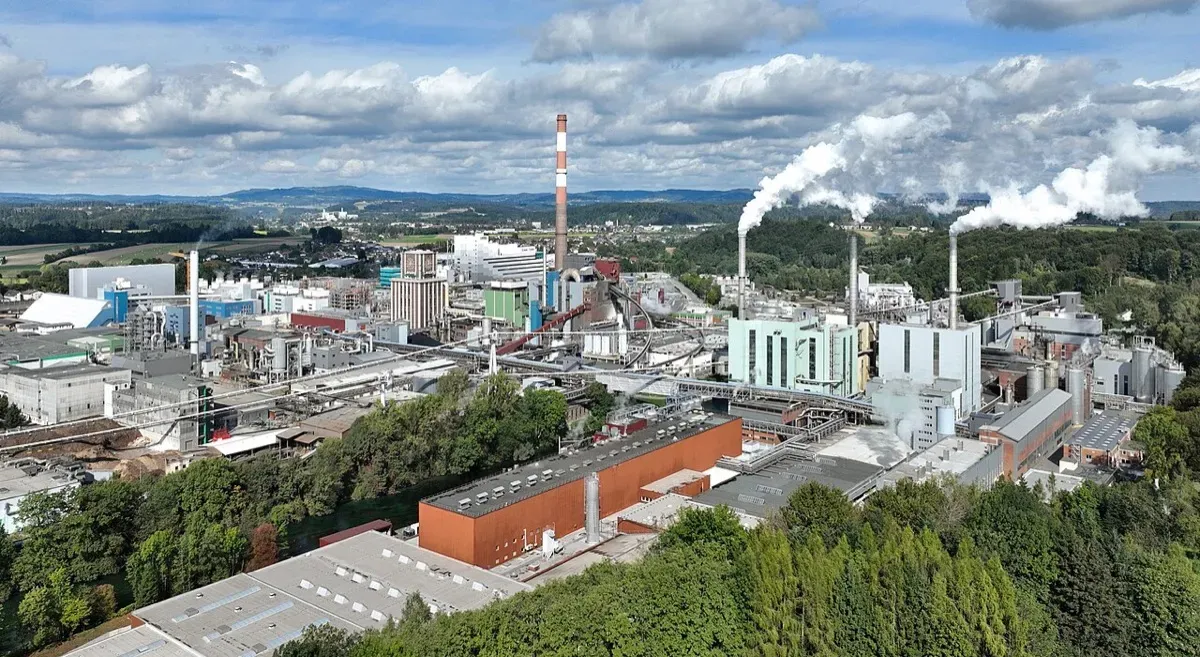
- “Lenzing - Werk Lenzing AG” by C.Stadler/Bwag, 2023, licensed under CC BY-SA 4.0 (https://creativecommons.org/licenses/by-sa/4.0), via Wikimedia Commons: https://commons.wikimedia.org/wiki/File:Lenzing_-_Werk_Lenzing_AG.JPG