
The problem
Tidal energy has a rare quality among renewables: it is predictable years in advance. That makes it valuable for island grids that otherwise lean on diesel, or that need firm power to balance wind and solar. The catch is economics. Power from a moving fluid rises with the cube of its speed, so classic tidal turbines need very fast currents, which exist at only a few sites, and heavy foundations to hold them in place.
Europe has set clear goals. The EU Offshore Renewable Energy Strategy aims for at least 1 GW of ocean energy, including tidal and wave, by 2030 and 40 GW by 2050 (European Commission, 2020). Reaching them requires technologies that can work in slower, more widely available currents. Installation and maintenance at sea are the other big cost drivers. Large jack-up barges and heavy-lift ships are expensive to charter and often unavailable on remote coasts, so a design that can be handled with small local boats has a structural advantage.
The product
Minesto’s answer is to make the turbine fly. Dragon 12 is a wing with a turbine and generator mounted beneath it, held by a tether to a foundation on the seabed. Just as a kite on a beach moves much faster than the wind when flown sideways, the subsea kite moves across the tidal flow at a speed several times higher than the current itself (Minesto). Because water is nearly a thousand times denser than air, the energy available is concentrated, and the faster relative flow lets a small turbine generate a lot of power.
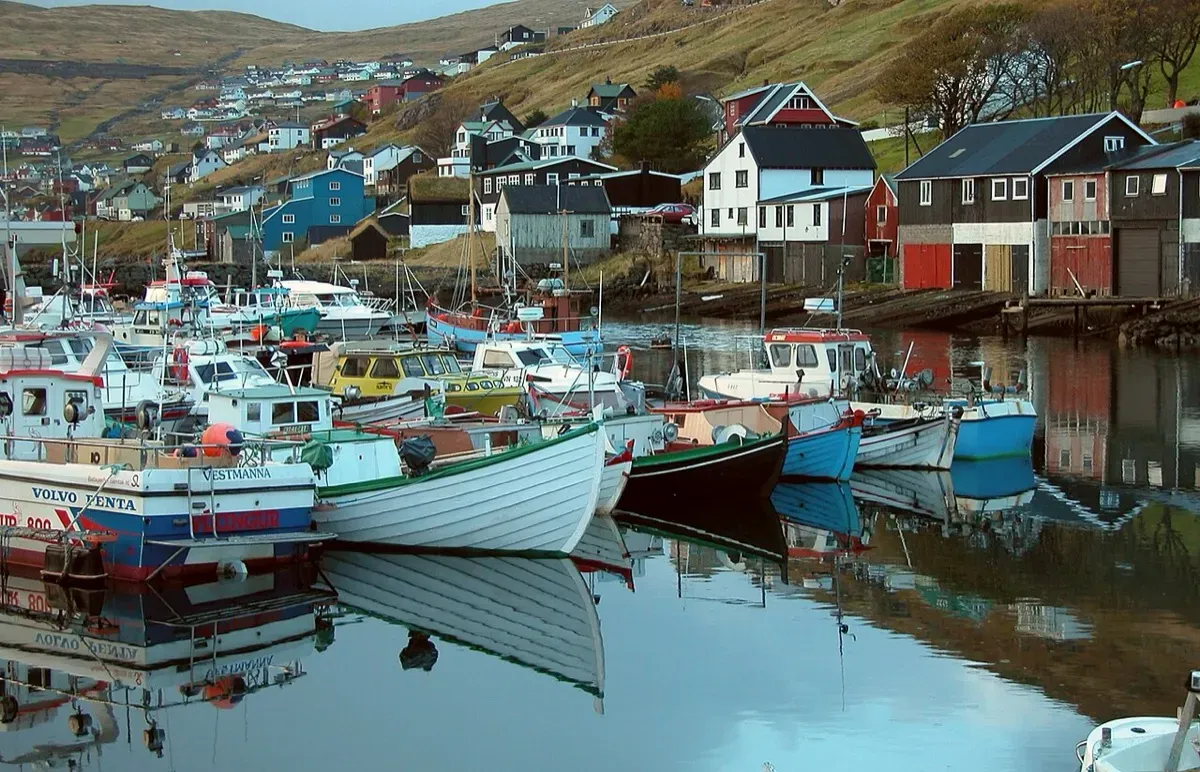
Dragon 12 is Minesto’s first megawatt-scale unit, a tenfold scale-up from the 100 kW Dragon 4. On 9 February 2024 it was commissioned in Vestmannasund and delivered its first electricity to the Faroese national grid (Minesto, 9 February 2024).
How it works
The wing generates hydrodynamic lift from the passing current. An onboard control system moves rudders and elevators at the rear of the kite and steers it autonomously in a figure-of-eight trajectory. This pulls the turbine through the water at a flow speed several times faster than the tide. The turbine shaft drives a generator in a nacelle, and electricity travels through cables inside the tether, then via a seabed umbilical to the shore.
The tether attaches to the foundation with a connector that can be latched and unlatched, so the kite can be towed to harbour for maintenance with local work boats instead of large offshore vessels. Minesto says it holds 92 patents across 12 patent portfolios. Tether length matters: after Dragon 12 was refitted with a tether 10 m longer in May 2025, Minesto reported a power increase of around 25%, in line with simulations (Minesto, 12 June 2025).
Timeline
| Date | Milestone |
|---|---|
| 2007 | Minesto founded as a spin-off from Saab |
| 2019 | First electricity from a first-generation kite |
| 2020 | First electricity to the grid with a second-generation system |
| 2022 | First grid electricity from the Dragon Class |
| 9 February 2024 | Dragon 12 (1.2 MW) delivers first electricity to the Faroese grid |
| May 2025 | Dragon 12 reinstalled with a 10 m longer tether; about 25% more power |
| 25 February 2026 | Dragon 12 placed in park mode after nine months grid-connected; Dragon 4 upgraded from 100 kW to 185 kW |
| 10 August 2026 | Upgraded Dragon 4 reports record electricity production over the summer |
Impact and numbers
- Scale: 1.2 MW rated power from a 12 m, 28-tonne kite.
- Operation: grid-connected for nine months from May 2025, providing production and operating data that Minesto says showed robustness beyond commercial service intervals (Minesto, 25 February 2026).
- Upgrades: a power take-off upgrade raised Dragon 4’s rating from 100 kW to 185 kW, which Minesto says can harvest up to twice as much energy at the test site; it then delivered record output in the second and third quarters of 2026 (Minesto, 10 August 2026).
- Microgrid: a 56 MSEK demonstration project is building what Minesto calls the world’s first tidal energy microgrid with integrated battery storage in Vestmanna.
Honest caveats. Minesto has not published annual energy production or capacity factor figures for Dragon 12. Since early 2026 the flagship unit has been parked because a local service vessel was unavailable, and the company chose not to pay for a foreign vessel. Finances are tight: the half-year report for 2026 showed zero net sales, an operating loss of SEK 15.4 million in the first half and cash of SEK 38.4 million at the end of June (Minesto H1 2026). Commercial Dragon farms still need investors and offtakers.
What’s next
Minesto’s near-term focus is the Vestmanna microgrid, powered by base-load tidal electricity from upgraded Dragon 4 units and a battery storage system, followed by recovery and service of Dragon 12 when the local vessel returns. The longer-term plan is the first “Dragon Farm”, an array of kites in the Faroe Islands, backed by the SEV power purchase agreement, with further site development in Holyhead Deep off Wales and in Taiwan. Under CEO Martin Edlund, the company also gained global attention in 2026 when its Faroe Islands campaign with SKF won a Grand Prix at the Cannes Lions festival.
Why it matters for Europe / green buyers
Minesto is a European company working in European waters on a technology that could open up far more coastline to tidal power. Slower currents are common around the Atlantic edge of Europe, and a kite that multiplies the effective flow speed could make them usable. For island systems such as the Faroes, firm renewable power reduces dependence on imported fuel.
For investors and utilities, the right lens is milestones and runway. Dragon 12 proved that a megawatt-scale kite can export to a national grid. The next proof points are published annual yields, availability and a funded multi-unit farm. Buyers of renewable power and climate investors in the Nordics and the UK should watch whether the Vestmanna microgrid delivers steady base-load output. Until then, Minesto is a high-potential, high-risk bet on the predictability of the tides.
Sources & image credits
- Minesto, “Our technology”: https://www.minesto.com/our-technology/
- Minesto, “Minesto reaches historic milestone: first electricity to grid with tidal powerplant Dragon 12 (1.2 MW)”, 9 February 2024: https://www.prnewswire.com/apac/news-releases/minesto-reaches-historic-milestone--first-electricity-to-grid-with-tidal-powerplant-dragon-12-1-2-mw-302058465.html
- Minesto, “Minesto’s tidal power plant Dragon 12 in operation reaching key production performance milestone”, 12 June 2025: https://www.minesto.com/news/minestos-tidal-power-plant-dragon-12-in-operation-reaching-key-production-performance-milestone/
- Minesto, “Project update on Minesto Dragons and infrastructure in Vestmanna, Faroe Islands”, 25 February 2026: https://www.prnewswire.com/news-releases/project-update-on-minesto-dragons-and-infrastructure-in-vestmanna-faroe-islands-302697270.html
- Minesto, “Dragon Power unleashed: Minesto’s tidal energy power plant sets electricity production record over summer”, 10 August 2026: https://www.minesto.com/news/dragon-power-unleashed-minestos-tidal-energy-power-plant-sets-electricity-production-record-over-summer/
- Minesto, “Minesto publishes Half-Year Report 2026”, 20 August 2026: https://www.inderes.fi/en/releases/minesto-ab-minesto-publishes-half-year-report-2026
- European Commission, “An EU Strategy to harness the potential of offshore renewable energy for a climate neutral future”, COM(2020) 741: https://eur-lex.europa.eu/legal-content/EN/TXT/?uri=CELEX%3A52020DC0741
Images:
- “Vestmanna, Faroe Islands (7)” by Erik Christensen, Porkeri, licensed CC BY-SA 3.0 (https://creativecommons.org/licenses/by-sa/3.0), via Wikimedia Commons: https://commons.wikimedia.org/wiki/File:Vestmanna,_Faroe_Islands_(7).JPG
.JPG)