The problem
India’s electricity demand is rising fast, and coal still provides most of its power. Solar and wind are growing quickly, but India also needs firm, low-carbon power for industry, cities and, increasingly, data centres. Nuclear power supplies only about 3% of India’s electricity today.
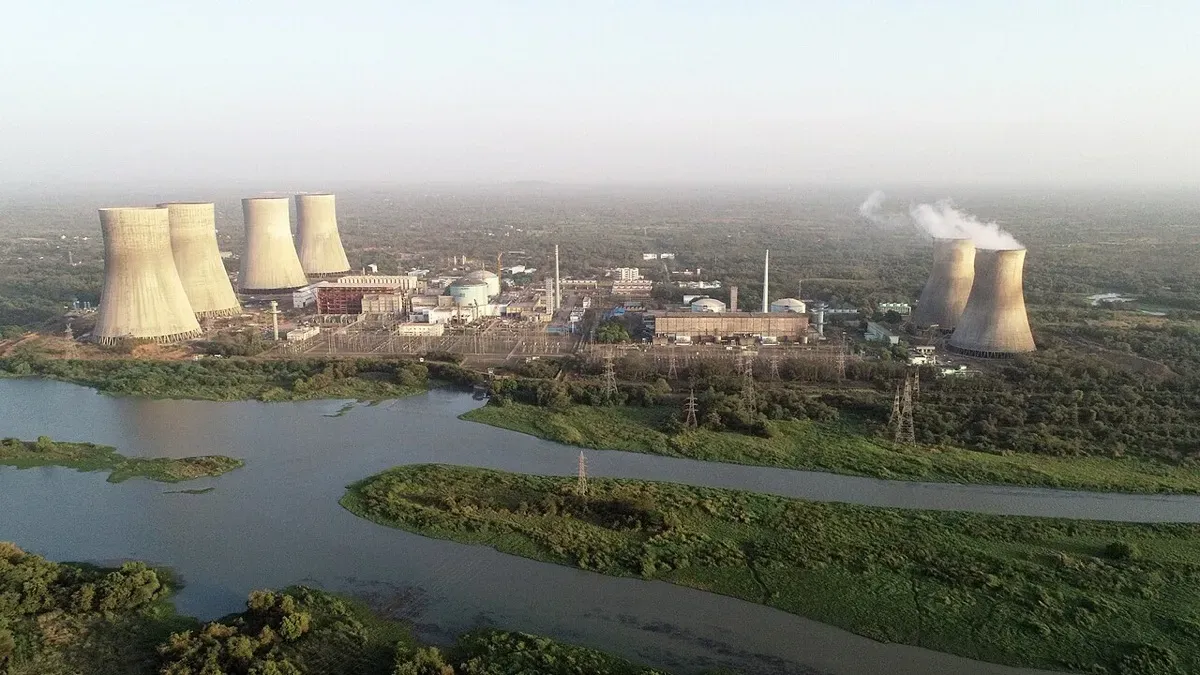
For decades, India was cut off from most of the international nuclear trade, so it developed its own reactor line, based on Canadian CANDU technology from the 1960s. These pressurised heavy water reactors (PHWRs) run on natural uranium, so they do not need enriched fuel. The first of them, Rajasthan 1 at Rawatbhata, started operating in 1973, at the same site where the newest 700 MWe units now stand. The problem was scale: most Indian units were only 220 MW, which made each project small and slow relative to India’s needs.
The product
The IPHWR-700 more than triples the unit size. Each reactor produces 2,166 MW of heat and 700 MW of electricity. Its core has 392 coolant channels made of a zirconium-niobium alloy, holding 4,704 fuel bundles of natural uranium (0.7% uranium-235). Unlike earlier Indian PHWRs, it allows a small amount of boiling (up to 3% steam quality) at the coolant channel exit, which increases output from the same size of core (NPCIL safety document).
The reactor sits inside a double containment: a prestressed concrete inner wall with a steel liner, and an outer wall of reinforced concrete. In a station blackout, a passive decay heat removal system can cool the reactor through the steam generators without pumps or power for several hours. Other safety features include passive hydrogen recombiners and containment spray.
How it works
- Fuel: natural uranium dioxide pellets are packed in short fuel bundles that sit in horizontal pressure tubes.
- Moderator: a large tank (calandria) of cool heavy water surrounds the tubes and slows down neutrons, which lets natural uranium sustain a chain reaction.
- Coolant: pressurised heavy water flows through the tubes, picks up heat and runs to four steam generators in two loops.
- Steam and power: in the steam generators, ordinary water boils into steam that drives the turbine.
- Online refuelling: fuelling machines add new bundles and remove spent ones while the reactor runs, so there is no need to shut down to refuel.
- Safety: shutdown systems, emergency core cooling, double containment and passive decay heat removal protect against accidents.
Timeline
| Date | Milestone |
|---|---|
| 20 Nov 2010 | First concrete for Kakrapar 3 and 4 |
| Jul 2020 | Kakrapar 3 reaches first criticality |
| Jan 2021 | Kakrapar 3 connected to the grid |
| 30 Jun 2023 | Kakrapar 3 enters commercial operation |
| Mar 2024 | Kakrapar 4 enters commercial operation |
| Sep 2024 | Rajasthan 7 reaches first criticality |
| Mar 2025 | Rajasthan 7 connected to the grid |
| 15 Apr 2025 | Rajasthan 7 enters commercial operation |
| 20 Dec 2025 | SHANTI Act opens nuclear power to limited private participation |
| 10 Feb 2026 | Rajasthan 7 reaches full rated power of 700 MW |
| 19 Sep 2026 | Fuel loading begins at Rajasthan 8 |
Impact and numbers
- Scale: three 700 MWe units now operate, with Rajasthan 8 next. NPCIL plans 16 such reactors, including ten sanctioned in fleet mode at Gorakhpur (Haryana), Chutka (Madhya Pradesh), Mahi Banswara (Rajasthan) and Kaiga (Karnataka) (WNN).
- Speed is improving: Rajasthan 7 went from first criticality to full power in about 17 months, and Kakrapar 4 reached commercial operation about three months after first criticality.
- Self-reliance: the design, reactor components and construction are Indian, and NPCIL says the RAPP 7 milestone “establishes the robustness” of the design and of Indian industry.
- Fleet context: India has 24 operable reactors with 7,943 MW of capacity, according to World Nuclear Association data (WNN).
- New units: geotechnical studies started in September 2026 for Rajasthan 9 and 10, two more 700 MWe units.
Honest caveats. The first units were slow: Kakrapar 3 took more than twelve years from first concrete to commercial operation. PHWRs need large quantities of expensive heavy water, and they produce more spent fuel per unit of energy than enriched-uranium reactors. The online refuelling and heavy water also bring more tritium releases, which need careful monitoring. Older Indian PHWRs have had coolant channel problems, which require costly refurbishment after about 25 years; Kaiga 1 was shut down on 1 April 2025 for exactly this work and only began refuelling in September 2026 (WNN). Even with 16 units, the 700 MWe fleet would supply about 11 GW, a fraction of India’s 100 GW target, so much more capacity is needed. India has no deep geological repository for high-level waste. Finally, India’s nuclear regulator, the AERB, gained statutory status only with the 2025 SHANTI Act, after long criticism about its independence.
What’s next
NPCIL’s next milestones are first criticality and grid connection of Rajasthan 8, then construction of the fleet units at Gorakhpur and the other sites. The SHANTI Act, which received presidential assent on 20 December 2025, lets licensed Indian private companies build and operate nuclear plants under regulatory oversight, while some sensitive activities stay with the state (SHANTI Act). NPCIL aims to supply more than half of India’s 100 GW target itself, with 700 MWe PHWRs, larger imported reactors and new 220 MW Bharat Small Reactors.
Why it matters for Europe / green buyers
The 700 MWe PHWR shows how a standardised domestic design, built in a series, can rebuild a nuclear programme. That is the same lesson Europe is now trying to apply with SMRs and fleets of EPR2 reactors. Europe also has heavy water reactors of the same family: Romania’s Cernavodă plant runs CANDU units, and Romania plans to complete two more, so Indian and European operators face similar fuel, heavy water and refurbishment questions. For European suppliers and investors, the SHANTI Act opens a large new market, though only Indian companies can apply for licences.
For India, the fleet matters most as firm, clean power alongside a fast-growing solar sector. Indian industrial buyers and data centre operators looking for round-the-clock clean electricity will watch how quickly the next 700 MWe units come online.
Sources & image credits
- World Nuclear News, “India’s Rajasthan unit 7 reaches full power”, 11 February 2026: https://www.world-nuclear-news.org/articles/indias-rajasthan-unit-7-reaches-full-power
- World Nuclear News, “Indian plants celebrate fuel loading milestones”, 21 September 2026: https://world-nuclear-news.org/articles/indian-plants-celebrate-fuel-loading-milestones
- ThePrint / PTI, “India’s first domestically built 700 MW nuclear reactor starts commercial operations in Gujarat”, 30 June 2023: https://theprint.in/india/indias-first-domestically-built-700-mw-nuclear-reactor-starts-commercial-operations-in-gujarat/1649731/
- NPCIL, “Indian PHWRs at KAPP-3,4 and RAPP-7,8” (safety and design document): https://www.npcil.nic.in/WriteReadData/userfiles/file/Safety_A6.pdf
- NPCIL, “RAPP-7&8” project factsheet, 2024: https://npcil.nic.in/writereaddata/CMS/202405141058097640439RAPP_7_8_english.pdf
- World Nuclear News, “India’s nuclear-focused SHANTI Bill completes legislative process”, 22 December 2025: https://www.world-nuclear-news.org/articles/indias-shanti-bill-completes-legislative-process
- NPCIL, “All plants”: https://www.npcil.nic.in/content/302_1_AllPlants.aspx
- Government of India, “The Sustainable Harnessing and Advancement of Nuclear Energy for Transforming India (SHANTI) Act, 2025” (via PRS India): https://prsindia.org/files/bills_acts/acts_parliament/2025/The_SHANTI_Act_2025.pdf
Images:
- “Kakrapar Atomic Power Plant” by the Department of Atomic Energy, Government of India, licensed under the Government Open Data License India (GODL-India), via Wikimedia Commons: https://commons.wikimedia.org/wiki/File:Kakrapar_Atomic_Power_Plant.jpg