The problem
Spent nuclear fuel is the most radioactive waste of the nuclear industry. Its radioactivity falls quickly in the first years, but it stays hazardous for many thousands of years. According to the IAEA, reactors worldwide have produced about 430,000 tonnes of spent fuel; about 30% has been reprocessed, and the rest sits in pools and dry casks waiting for a permanent home (POWER).
Deep geological disposal is the internationally accepted solution, but almost no country has managed to build a repository. In the US, the Yucca Mountain project stalled, and spent fuel is stranded at reactor sites. Finland decided early that the generation that uses nuclear power should also deal with its waste, and it banned the import and export of nuclear waste.
The product
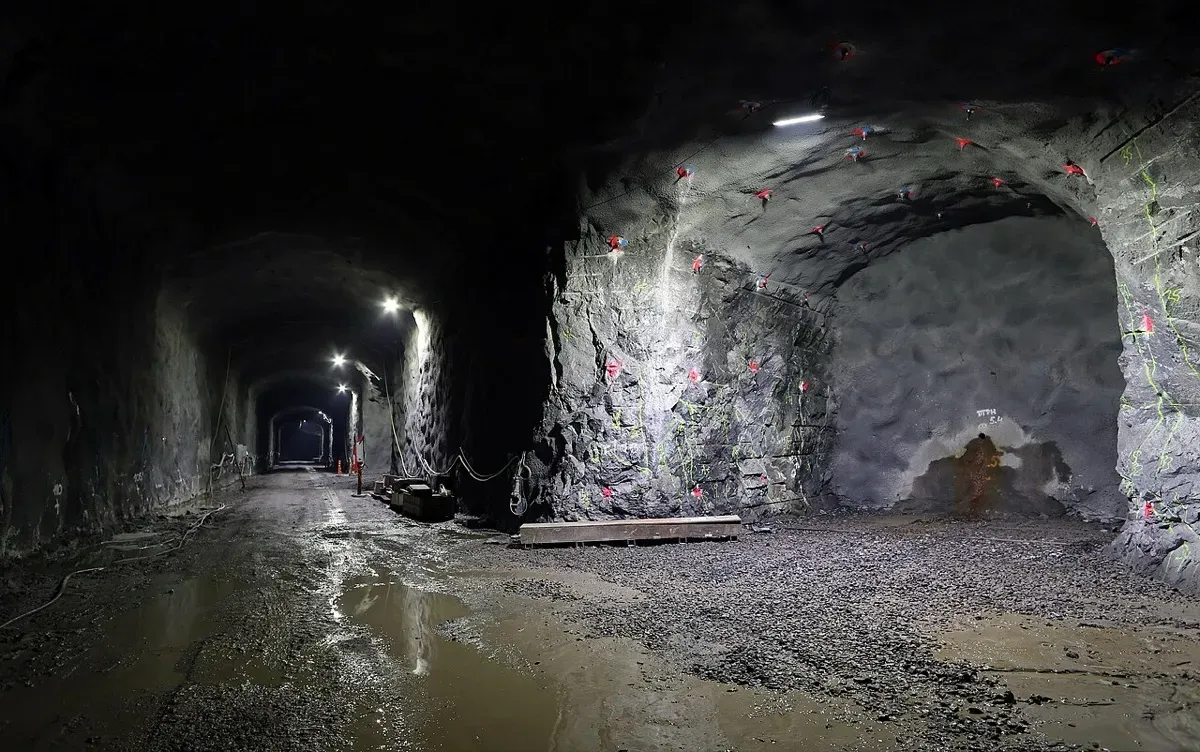
ONKALO covers both an above-ground encapsulation plant and the underground repository. It reaches a depth of about 450 metres, with the disposal tunnels at 400 to 430 metres. It has a spiral access tunnel, four vertical shafts, central tunnels and an underground canister store. So far, about ten kilometres of tunnels have been dug; some 40 kilometres more will be added over the next hundred years (Posiva, 2024).
The facility is designed for 6,500 tonnes of uranium from TVO’s Olkiluoto reactors and Fortum’s Loviisa plant, in about 3,250 canisters. Each disposal tunnel holds 30 to 40 deposition holes. On 26 August 2026, Posiva began drilling the first hole meant for real disposal, using a 78-tonne boring machine made by Herrenknecht in Germany. Each hole is 8.4 metres deep and 1.75 metres wide, and its centre may not deviate from vertical by more than 25 millimetres (Posiva, Aug 2026).
How it works
- Cooling: spent fuel cools for several decades in interim storage at the power plants.
- Encapsulation: in a shielded hot cell with concrete walls about 1.3 metres thick, fuel assemblies are loaded into a cast-iron insert inside a copper canister. The canister is filled with argon, closed with a steel lid and sealed with a copper lid by friction stir welding, then inspected.
- Transfer: a lift lowers the canister about 430 metres into the bedrock, and a remote-controlled vehicle carries it to a disposal tunnel.
- Emplacement: the canister goes into a deposition hole surrounded by blocks of bentonite clay, which swells when wet and seals the gap.
- Backfill and seal: each full tunnel is backfilled with swelling clay and sealed with a concrete plug.
- Multiple barriers: the fuel itself, the canister, the bentonite, the backfill and the bedrock form redundant barriers that must isolate the waste until its radioactivity has fallen to harmless levels.
Timeline
| Date | Milestone |
|---|---|
| 2000 | Finnish government decision in principle for a repository at Olkiluoto |
| 2004 | Excavation of the ONKALO underground research facility begins |
| Nov 2015 | Construction licence granted |
| Dec 2016 | Construction of the repository begins |
| Dec 2021 | Posiva applies for an operating licence |
| 30 Aug 2024 | Trial run of final disposal begins, with non-radioactive dummy fuel |
| Mar 2025 | Backfill test reaches its goal in a 50-metre trial tunnel |
| Jun 2026 | First full-scale underground test of a dummy canister in a deposition hole |
| 4 Aug 2026 | STUK says the safety requirements for a licence are met |
| 26 Aug 2026 | Drilling of the first real deposition hole begins |
| Autumn 2026 | Ministry expects to present the licence decision to the government |
Impact and numbers
- World first: STUK says this is the first time in the world that a geological repository for spent fuel has reached the operating licence stage (STUK).
- Licence term: Posiva has applied for a licence valid until the end of 2070; the full disposal programme is planned to last about 100 years before the repository is closed (WNN).
- Testing: the trial run encapsulated five test canisters and tested the retrieval of a damaged canister. The 2025 backfill test aimed for a backfill degree of at least 98%, and Posiva reported that preliminary analyses exceeded it.
- Footprint: the repository covers about two square kilometres underground and requires about two million cubic metres of rock to be excavated.
Honest caveats. ONKALO is not yet operating. The government still has to grant the licence, and STUK must then inspect the facility before any spent fuel goes underground (MEAE). The start date has slipped repeatedly, from “mid-2020s” to Posiva’s current “ambitious goal” of readiness by the end of 2026, and the underground parts of the trial run were still being tested in 2026. Safety over thousands of years rests on models and experiments, not experience. In Sweden, an environmental court asked for more evidence on copper canister corrosion in 2018 before the government approved a similar repository. STUK also wants Posiva to update its long-term safety case within ten years of the licence. ONKALO only takes Finnish spent fuel, and it is not a solution for countries that lack suitable rock or public consent.
What’s next
After the government’s decision, Posiva must finish commissioning and testing, especially underground, and pass STUK’s inspection. The first real canisters could then be emplaced. Posiva also needs to build a separate facility for low and intermediate-level waste from encapsulation. Sweden’s SKB, which co-developed the method, began building its own repository at Forsmark in January 2025, with disposal expected in the 2030s (SKB).
Why it matters for Europe / green buyers
Waste is often the deciding question for public support of nuclear power, and for EU taxonomy rules, which require a plan for disposal of high-level waste. ONKALO shows that the back end of the fuel cycle can be solved with today’s technology, if a country starts early and builds trust. France (Cigéo), Switzerland, Germany and the UK are all at earlier stages of site selection or licensing and will learn from Finland’s licensing record. For investors in new reactors, including the SMRs now planned across Europe, a working repository lowers long-term liability risk.
India follows a closed fuel cycle, reprocessing spent fuel and turning high-level waste into glass, but has not yet chosen a site for a deep repository. As India scales nuclear capacity towards its 2047 targets, Finland’s step-by-step, regulator-led approach is a useful model.
Sources & image credits
- Posiva, “STUK’s safety assessment takes the world’s first final disposal facility closer to an operating licence”, 4 August 2026: https://www.posiva.fi/en/index/news/pressreleasesstockexchangereleases/2026/stuk8217ssafetyassessmenttakestheworld8217sfirstfinaldisposalfacilityclosertoanoperatinglicence.html
- STUK, “The Radiation and Nuclear Safety Authority supports the licence for a spent nuclear fuel final disposal facility”, 4 August 2026: https://stuk.fi/en/-/the-radiation-and-nuclear-safety-authority-supports-the-licence-for-a-spent-nuclear-fuel-final-disposal-facility
- Ministry of Economic Affairs and Employment of Finland, “MEAE to prepare operating licence for spent nuclear fuel disposal facility of Posiva”, August 2026: https://tem.fi/en/-/meae-to-prepare-operating-licence-for-spent-nuclear-fuel-disposal-facility-of-posiva-taking-into-account-radiation-and-nuclear-safety-authority-s-safety-assessment
- Posiva, “Introducing ONKALO and its principle of operation”, 3 July 2024: https://www.posiva.fi/en/index/news/pressreleasesstockexchangereleases/2024/thisisonkaloandthisishowitworks.html
- POWER, “Trial Run at Finland’s Onkalo Repository Sets Stage for World’s First Spent Nuclear Fuel Disposal”, 2 December 2024: https://www.powermag.com/trial-run-at-finlands-onkalo-repository-sets-stage-for-worlds-first-spent-nuclear-fuel-disposal/
- World Nuclear News, “Posiva completes backfilling trial run at repository”, 14 March 2025: https://www.world-nuclear-news.org/articles/posiva-completes-backfilling-trial-run-at-repository
- Posiva, “Boring machine put to work: the drilling of actual final disposal deposition holes starts deep down in ONKALO”, 27 August 2026: https://www.posiva.fi/en/index/news/pressreleasesstockexchangereleases/2026/boringmachineputtowork-thedrillingofactualfinaldisposaldepositionholesstartsdeepdowninonkalo.html
- Posiva, “Significant accomplishments for Posiva: successful week of testing moves final disposal forward”, June 2026: https://www.posiva.fi/en/index/news/pressreleasesstockexchangereleases/2026/significantaccomplishmentsforposiva-successfulweekoftestingmovesfinaldisposalforward.html
- SKB, “Construction begins on Swedish Spent Fuel Repository”, 15 January 2025: https://skb.com/nyhet/construction-begins-on-swedish-spent-fuel-repository/
Images:
- “Onkalo spent nuclear fuel repository” by kallerna, licensed under CC BY-SA 4.0 (https://creativecommons.org/licenses/by-sa/4.0), via Wikimedia Commons: https://commons.wikimedia.org/wiki/File:Onkalo_spent_nuclear_fuel_repository.jpg