The problem
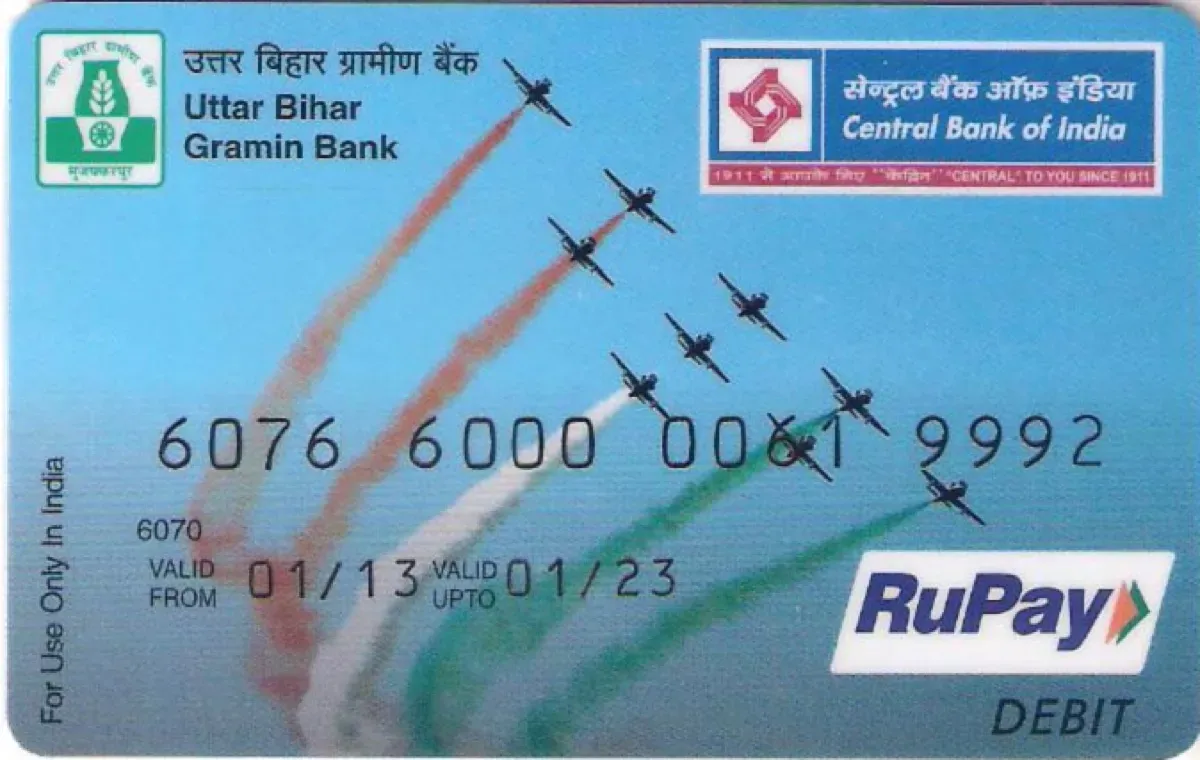
India’s card base is enormous and still growing. The Reserve Bank of India’s Payment System Report for December 2025 lists 1,157.84 lakh credit cards and 10,343.46 lakh debit cards outstanding at the end of 2025, or about 11.6 crore and 103.4 crore respectively (RBI). Debit card numbers swelled after financial inclusion drives such as the Pradhan Mantri Jan Dhan Yojana opened hundreds of millions of basic bank accounts, many of them with a RuPay debit card.
Even as UPI payments on phones have exploded, banks keep issuing and reissuing physical cards for ATM access, contactless payments and international use. Nearly all of them are made from first-use PVC. India’s plastic waste rules focus on packaging and single-use items, so there is little regulatory pull on card materials. Any shift therefore depends on banks, card networks and manufacturers choosing to act.
The product
Seshaasai, founded in Mumbai in 1993 as a security printer, has grown into one of India’s largest makers of payment instruments. Its FY2025-26 annual report lists dual-interface contactless cards, PVC cards, Made in India metal cards, biometric cards, dynamic CVV cards, LED cards, wood cards and recycled PVC cards among its products (Seshaasai Annual Report FY2025-26).
Two products carry its sustainability push:
- rPVC cards: the company says it is working with banks and payment network partners to promote recycled PVC as an alternative to conventional plastic, and that customer programmes have already begun migrating to rPVC.
- Wood cards: in a July 2025 post, Seshaasai described FSC-certified wood cards with a card body over 95% biodegradable, dual-interface EMV chips and custom laser engraving, designed, engineered and produced in India. Its annual report adds that during the year it worked with a global partner to develop a 100% biodegradable wooden payment card, with commercial deployment expected alongside a leading banking customer.
The company states that it is certified under Mastercard’s Card Eco-Certification (CEC) scheme, which recognises environmentally responsible materials and manufacturing processes for payment cards, and that it is FSC certified for responsible sourcing of wood and paper (Seshaasai sustainability).
How it works
An rPVC card follows the same process as a standard card. Recycled PVC sheet replaces virgin PVC in the core, which is printed, laminated with overlays and fitted with a chip module and, for contactless cards, a copper antenna. Because the polymer is still PVC, the card behaves the same in ATMs and terminals and can be certified to the same standards.
A wood card replaces the plastic core with thin layers of certified wood veneer, bonded and finished so the card stays flat and durable. The antenna is embedded between layers and the chip is milled in, as with plastic cards. Seshaasai’s July 2025 description says its wood cards use copper wire antennas and biodegradable adhesives and packaging, with capacity of several million cards a month produced in-house. Wood cards are typically positioned as premium products, while rPVC is the practical option for mass-market debit cards.
Timeline
| Date | Milestone |
|---|---|
| 17 September 1993 | Seshaasai Business Forms incorporated in Mumbai |
| 1996 | Indian Banks’ Association permit for security printing |
| 2021 | Mastercard launches its Card Eco-Certification scheme |
| FY2023 to FY2025 | Payment cards supplied: 76.18 million (FY23), 110.33 million (FY24), 91.37 million (FY25) |
| July 2025 | Seshaasai promotes FSC-certified wood cards with dual-interface EMV chips |
| 23 to 25 September 2025 | IPO subscription period; shares listed on BSE and NSE |
| FY2025-26 | Annual report says customer programmes have begun migrating to rPVC and a 100% biodegradable wood card is ready for deployment with a leading bank |
Impact and numbers
- Market share: 31.9% of credit and debit card issuance in India in FY2025, up from 25.0% in FY2023, according to an industry report (“F&S Report”) cited in the IPO prospectus and summarised by Geojit Research (Geojit IPO note).
- Volume: 91.37 million payment cards supplied in FY2025, plus 1,188.81 million cheque leaves.
- Certifications: Mastercard CEC for card manufacturing and FSC for forest-based materials, as stated by the company.
- Leverage: at this volume, every 10% of output moved to rPVC would be roughly 9 million cards a year, an illustrative calculation based on FY2025 volumes.
Honest caveats. Seshaasai has not published how many rPVC or wood cards it has delivered, which customers use them, or what share of recycled content its rPVC cards contain. The “biodegradable” claims for wood cards apply to the card body, not to the chip and antenna, and biodegradation depends on conditions. Independent life-cycle data on these specific cards is not public. Until volumes and specifications are disclosed, buyers should treat this as an early-stage transition by a very large supplier rather than a proven mass shift.
What’s next
The company says it continues to evaluate bio-based and biodegradable materials and is expanding capacity after its IPO, with innovation centres in Bengaluru and Faridabad. The big lever is bank procurement. If one or two large Indian banks commit to rPVC for all new debit cards, a supplier with a third of the market could switch tens of millions of cards in a year. Card networks matter too: Mastercard’s CEC scheme offers a recognised badge, and NPCI’s RuPay network, the scheme behind the debit cards issued with basic Jan Dhan accounts, could set expectations for its issuers. For now, card materials are a voluntary choice in India, so progress depends on procurement teams asking for it.
Why it matters for Europe / green buyers
India is now one of the world’s largest card markets, and most of its cards are made domestically. That means greener European materials and standards only matter at global scale if Indian manufacturers adopt them too. Seshaasai’s shift towards rPVC and wood cards shows that the playbook pioneered by European card makers is spreading, and that Indian banks can now source certified sustainable cards locally.
For buyers and investors, the questions are the same as anywhere: what share of output is sustainable, which certification backs the claim, and what happens to cards at end of life. With a listed company now reporting annually, there is an opportunity to ask for those numbers every year.
Sources & image credits
- Seshaasai Technologies, Notice of 33rd AGM and Annual Report FY2025-26, August 2026: https://seshaasai.com/media-news/documents/2026/08/STYL%20Notice%20of%20AGM%20and%20Annual%20Report%20240826.pdf
- Geojit Research, Seshaasai Technologies IPO note, 23 September 2025 (citing the RHP and Frost & Sullivan report): https://images.moneycontrol.com/static-mcnews/2025/09/20250923091256_Seshaasai-Technologies-230925-geo.pdf
- Reserve Bank of India, Payment System Report, December 2025 (published 18 May 2026): https://www.rbi.org.in/Scripts/PublicationsView.aspx?id=23813
- Seshaasai, Sustainability page: https://seshaasai.com/about-us/sustainability
- Seshaasai on LinkedIn, FSC-certified wood cards post, 4 July 2025: https://www.linkedin.com/posts/smart-payment-wearables-form-factors_seshaasai-theartofsmarttechnologies-sustainablecards-activity-7346785862988222464-xb1U
- Seshaasai on LinkedIn, “Wood payment cards are the next premium frontier”, 5 August 2025: https://www.linkedin.com/posts/smart-payment-wearables-form-factors_woodcards-sustainabledesign-seshaasai-activity-7358346011812970498-lF5s
- Mastercard, sustainable card program overview (CEC launched 2021): https://www.mastercard.com/global/en/news-and-trends/Insights/2024/sustainable-card-program.html
Images:
- “Rupay Card Issued by Uttar Bihar Gramin Bank” by Vk40471, licensed CC BY-SA 3.0 (https://creativecommons.org/licenses/by-sa/3.0), via Wikimedia Commons: https://commons.wikimedia.org/wiki/File:Rupay_Card_Issued_by_Uttar_Bihar_Gramin_Bank.jpg