The problem
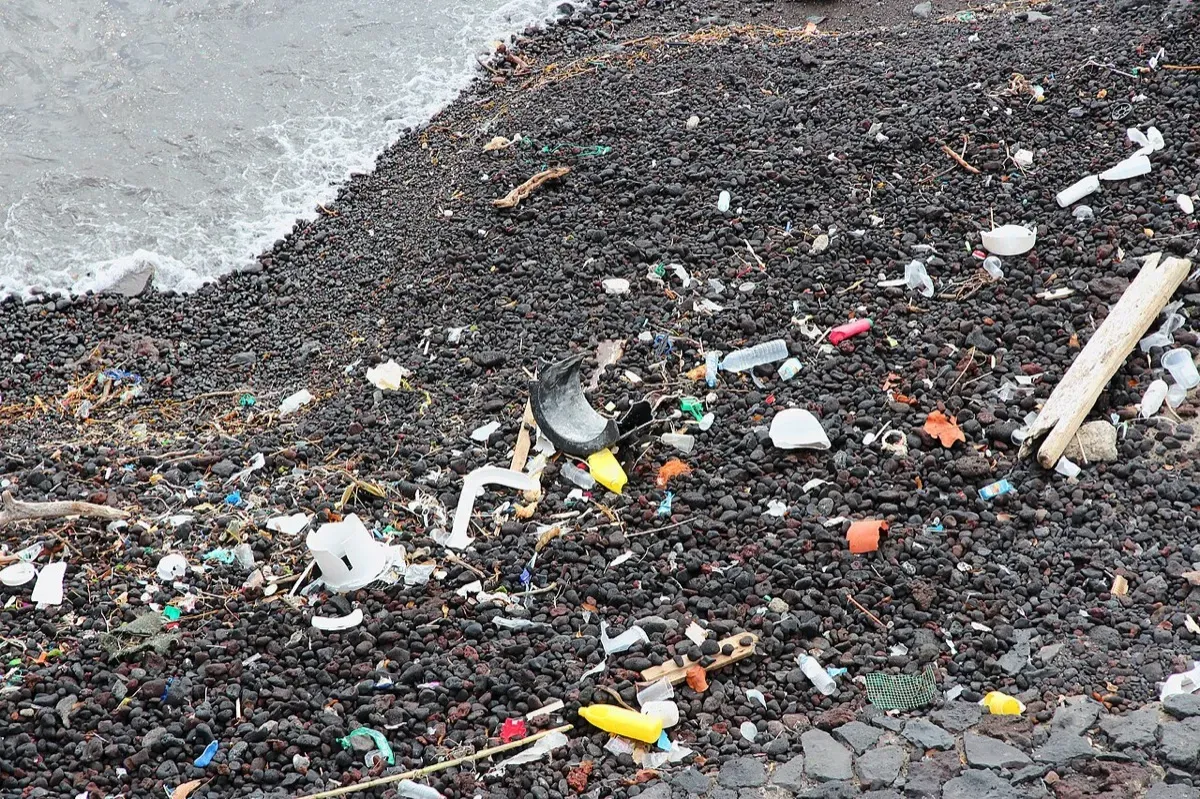
A payment card looks trivial, but the numbers add up. IDEMIA, citing the Nilson Report, puts global production at roughly 6 billion plastic payment cards a year. Thales itself compares the plastic used for cards each year to the weight of 125 Statues of Liberty. Cards carry an expiry date and are also reissued when lost or upgraded, so the flow never stops.
The default material is polyvinyl chloride (PVC). It is cheap, durable and easy to print, which is why it became the industry standard. It is also a fossil-based, chlorine-containing plastic that is hard to recycle once it is laminated with a chip, an antenna and a magnetic stripe. In November 2023 the European Chemicals Agency published an investigation into PVC and its additives and concluded that EU regulatory action is needed on certain additives and on releases of PVC microparticles, most likely through a restriction under the REACH regulation (ECHA). Payment cards are a small share of PVC use, but they are the plastic object almost every adult carries.
The product
Gemalto, then a Dutch-listed digital security company, developed a bio-sourced version of its Optelio card range. On 31 March 2015 it announced that Coop Bank Denmark, the bank of a retail cooperative owned by 1.4 million members, was deploying bio-sourced Optelio Contactless EMV cards, which Gemalto described as the first commercial rollout of its kind. Coop Bank had already issued a contact-only bio-sourced card, and the contactless version had been approved by the major international payment schemes (Gemalto press release via nova-Institute).
Thales completed its €4.8 billion acquisition of Gemalto on 2 April 2019 and turned it into the Digital Identity and Security division (Thales). The card kept the Gemalto brand. Today Thales sells it as the Thales Gemalto Bio-Sourced card, inside a wider sustainable range:
- Bio-Sourced (PLA) card: replaces more than 80% of the PVC with polylactic acid from non-edible corn, with bio-based content certified by UL Environmental Claim Validation. Thales says it was first to offer PLA bank cards and has delivered more than 70 million.
- Recycled PVC card: 100% recycled PVC from packaging and printing industry waste.
- PVC-free card: launched in May 2025 and made from 100% recycled PETG, removing chlorine from the card body.
- Ocean Plastic card: made with Ocean Plastic collected by Parley for the Oceans from coastal clean-ups.
- Wood card: a card body with no plastic.
How it works
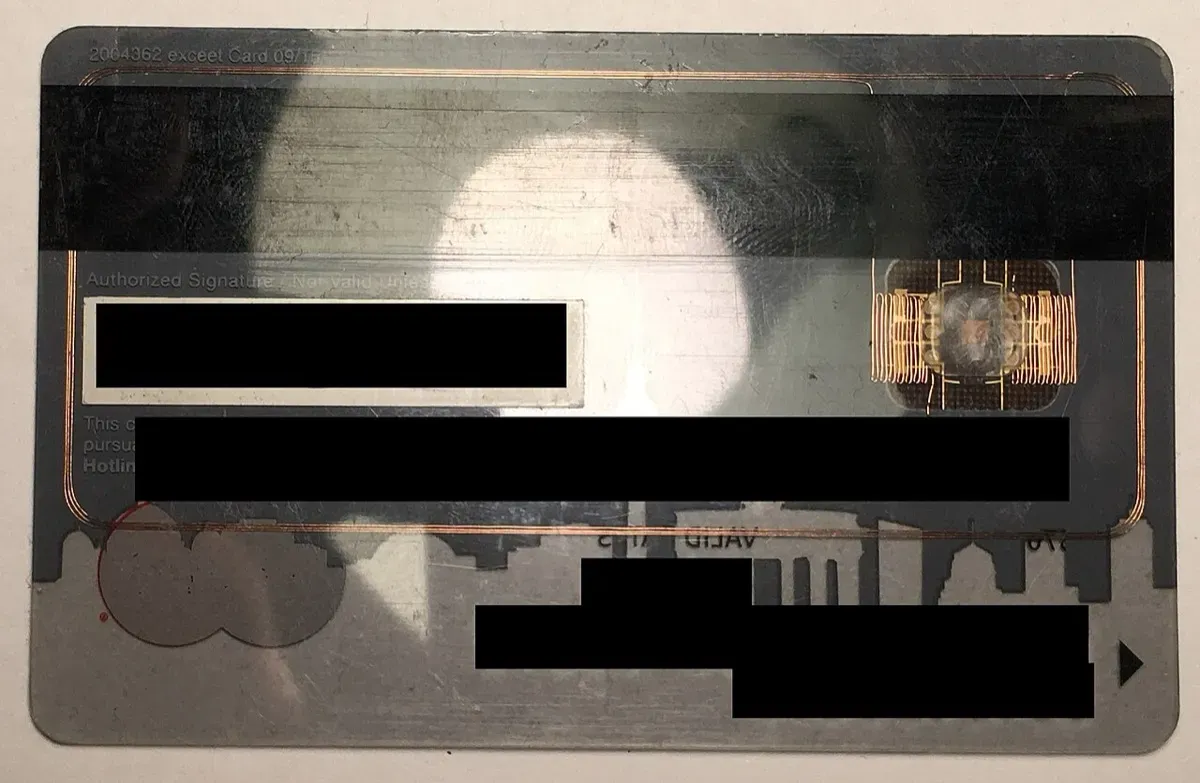
A payment card is a sandwich. A printed core is laminated between thin overlay sheets, then milled so that a contact chip module can be embedded. A contactless card also hides a copper wire antenna inside the core. In a standard card, every layer is PVC.
In the bio-sourced card, most of that PVC is replaced by PLA, a polyester made by fermenting plant sugars into lactic acid and polymerising it. PLA can be printed and laminated on existing card lines, which is why banks can switch without changing terminals, ATMs or personalisation equipment. The chip, antenna, magnetic stripe and hologram stay the same, so the card must pass the same ISO durability tests and payment scheme approvals as a PVC card. That is the hard engineering part: PLA softens at a lower temperature than PVC, so lamination and long-term durability had to be tuned before schemes would sign off.
 An opened contactless card showing the antenna that sits inside the card body. Whatever the body material, these components stay. Photo: AmarinderBrar, CC BY-SA 4.0, via Wikimedia Commons.
Timeline
| Date | Milestone |
|---|---|
| 31 March 2015 | Gemalto announces Coop Bank Denmark as first commercial rollout of bio-sourced Optelio Contactless EMV cards |
| 2018 | Mastercard launches the Greener Payments Partnership with Gemalto, Giesecke+Devrient and IDEMIA |
| 2 April 2019 | Thales completes its €4.8 billion acquisition of Gemalto |
| June 2021 | Mastercard announces a sustainable card badge and independent certification, later named Card Eco-Certification |
| 18 May 2022 | Thales says it has deployed 30 million eco-friendly cards, about 25 million in 2021 alone, with its portfolio certified under Mastercard’s programme |
| 24 January 2024 | Thales and Brazilian benefits company Caju announce recycled PVC cards for new customers |
| May 2025 | Thales launches the PVC-free card made from 100% recycled PETG |
Impact and numbers
- Volume: more than 70 million PLA cards delivered worldwide, according to Thales’s current product page (Thales).
- Momentum: in May 2022 Thales reported 30 million eco-friendly cards deployed to date, with about 25 million shipped in 2021 alone (Thales press release, 18 May 2022).
- Material share: more than 80% of the card body’s PVC is replaced by PLA in the bio-sourced card; the remaining materials include the chip and antenna.
- Certification: Thales says it was the first company to offer a full portfolio of cards with a worldwide manufacturing footprint certified by the Mastercard Sustainable Card Program.
- Bank demand: Findomestic, part of BNP Paribas Personal Finance in Italy, adopted Thales PLA cards in 2021 with the aim of removing PVC cards, as quoted in the 2022 release.
The honest caveats. Early marketing called PLA cards biodegradable and compostable. PLA generally needs industrial composting conditions to break down, and a finished card still contains a chip, copper and adhesives, so it should not go in a home compost bin. The bigger benefit is upstream: less fossil feedstock and no chlorine in most of the card body. Independent life-cycle comparisons between PLA, recycled PVC and recycled PETG cards are scarce in the public domain, so buyers should ask suppliers for their life-cycle assessments rather than rely on material labels alone.
What’s next
Thales is now pushing beyond PLA. The PVC-free card is aimed at mass-market programmes that want to remove chlorine entirely, and in late 2025 Thales introduced it in Latin America, producing it at plants it says run on renewable electricity. Card schemes are also tightening the rules on claims: Mastercard’s Card Eco-Certification scores cards on energy, material use, carbon footprint and waste, and its benchmarks rise each year (Mastercard). In the EU, the Empowering Consumers for the Green Transition Directive (EU) 2024/825 has applied since 27 September 2026 and bans generic claims such as “eco-friendly” or “biodegradable” unless they can be substantiated (EUR-Lex). That makes vague “eco card” marketing riskier and favours suppliers with certified, measurable data.
Why it matters for Europe / green buyers
Finance is a sector where most green action is invisible: portfolios, loans, disclosures. The card is the one physical touchpoint that every customer holds, and that makes it a useful test of whether a bank’s sustainability claims reach the product level. A European card maker proving that bio-based and recycled bodies can pass the same security and durability standards as PVC removed the main excuse for inaction.
For buyers, three questions matter. What share of the card body is replaced, and is it certified? Is the card a PLA, recycled PVC or PVC-free design, and which suits the programme’s volume and recycling options? And does the bank also cut the waste around the card, such as carriers, PIN letters and unnecessary reissues? The material is the visible part; the full footprint includes everything that ships with it.
Sources & image credits
- Gemalto, “Coop Bank Denmark first to deploy Gemalto’s unique bio-sourced contactless EMV cards”, 31 March 2015, republished by nova-Institute: https://renewable-carbon.eu/news/coop-bank-denmark-first-to-deploy-gemaltos-unique-bio-sourced-contactless-emv-cards/
- Thales, “Banks shift to eco-friendly solutions supported by innovative Thales cards, certified sustainable by Mastercard”, 18 May 2022: https://www.thalesgroup.com/en/worldwide/security/press_release/banks-shift-eco-friendly-solutions-supported-innovative-thales
- Thales, sustainable payment cards product page (accessed 6 October 2026): https://www.thalesgroup.com/en/solutions-catalogue/enterprise/financial-services/sustainable-payment-cards
- Thales, “Thales completes acquisition of Gemalto”, 2 April 2019: https://www.thalesgroup.com/en/news-centre/press-releases/thales-completes-acquisition-gemalto-become-global-leader-digital
- Mastercard, “Mastercard empowers consumers to choose a sustainable future with eco-friendly cards”, June 2021: https://newsroom.mastercard.com/news/press/2021/june/mastercard-empowers-consumers-to-choose-a-sustainable-future-with-eco-friendly-cards/
- Mastercard, sustainable card program overview (Greener Payments Partnership 2018, CEC 2021): https://www.mastercard.com/global/en/news-and-trends/Insights/2024/sustainable-card-program.html
- ECHA, “ECHA identifies risks from PVC additives and microparticle releases”, November 2023: https://echa.europa.eu/-/echa-identifies-risks-from-pvc-additives-and-microparticle-releases
- EuropaWire, “Thales and Caju join forces for sustainable payment solutions in Brazil”, 24 January 2024: https://news.europawire.eu/thales-and-caju-join-forces-for-sustainable-payment-solutions-in-brazil/eu-press-release/2024/01/24/14/10/47/128784/
- Directive (EU) 2024/825 on empowering consumers for the green transition: https://eur-lex.europa.eu/eli/dir/2024/825/oj
- Thales DIS on LinkedIn, launch of the PVC-Free card, May 2025: https://www.linkedin.com/posts/thalesdis_thales-gemalto-pvc-free-cardpdf-activity-7326577318624129037-s85h
Images:
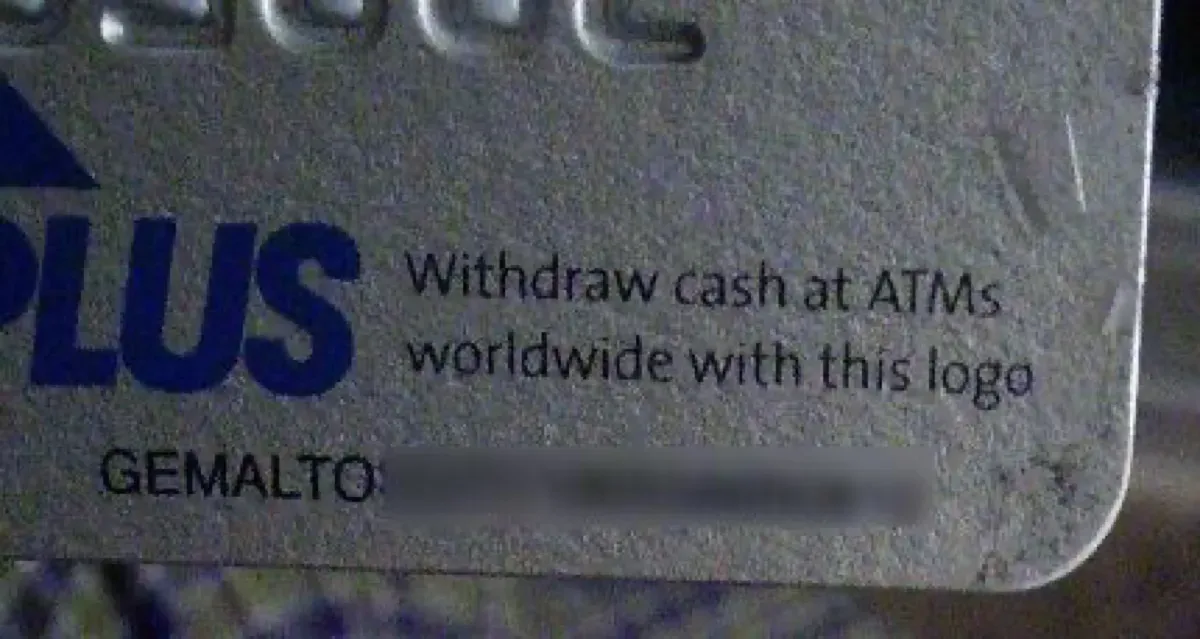
- “GemaltoATMCard” by HaEr48, CC0 1.0 public domain dedication (http://creativecommons.org/publicdomain/zero/1.0/deed.en), via Wikimedia Commons: https://commons.wikimedia.org/wiki/File:GemaltoATMCard.jpg
- “Contactless Payment Card opened to show RF antenna” by AmarinderBrar, licensed CC BY-SA 4.0 (https://creativecommons.org/licenses/by-sa/4.0), via Wikimedia Commons: https://commons.wikimedia.org/wiki/File:Contactless_Payment_Card_opened_to_show_RF_antenna.jpg