The problem
Most carbon storage today means pumping compressed CO2 into deep sandstone or depleted oil and gas reservoirs, where it stays as a fluid trapped under a cap rock. That needs suitable sedimentary basins and long-term monitoring and insurance, because the CO2 is buoyant and could in principle find a way out.
Countries without such basins, or companies that want stronger guarantees, need another option. Mineralisation offers one: turn the CO2 into solid carbonate rock so it cannot escape. Basalt works, as projects in Iceland have shown, but even more reactive rocks exist. Peridotite, a rock from the Earth’s mantle rich in magnesium, reacts with CO2 faster than almost anything else, but it usually lies 20 to 30 km underground.
The product
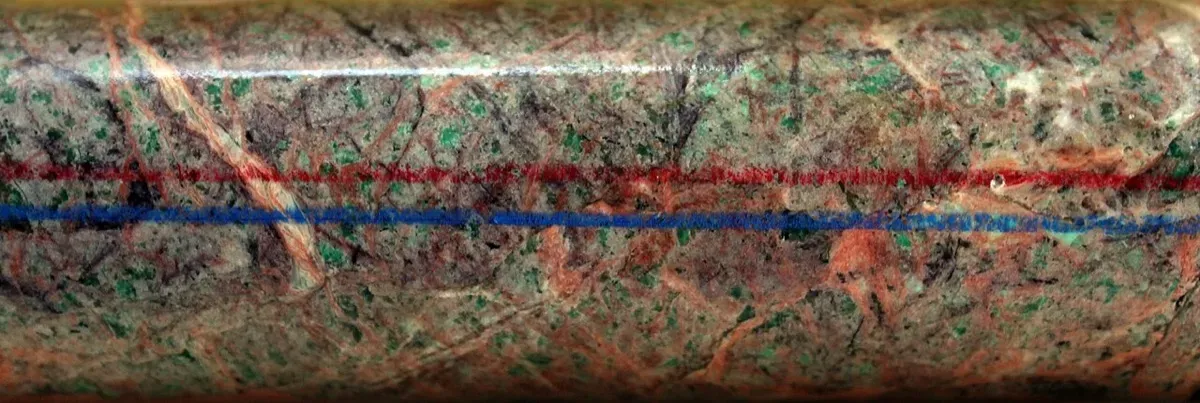
Oman is the exception. In the Samail ophiolite, a slab of ocean crust and upper mantle has been pushed up onto land, leaving peridotite exposed in the Hajar Mountains. White calcite veins in the rock show that rainwater carrying CO2 has been mineralising it naturally for ages, a process that usually takes decades.
44.01, founded by chief executive Talal Hasan, speeds that up. It takes CO2 captured from industry or directly from the air, dissolves it in water to make a kind of sparkling water and injects it into peridotite. Underground, the acidic fluid dissolves magnesium and calcium from minerals such as olivine and pyroxene, which then combine with the carbon to form carbonate minerals such as magnesite and calcite. The company says the process takes months rather than decades and has no adverse effect on the local environment, subsurface or water sources.
44.01 says it holds around 25 granted patents, with another 40 filed. Its investors include Breakthrough Energy, Apollo and Equinor, which led its Series A, with Air Liquide and Sumitomo as strategic backers.
How it works
- Capture. CO2 comes from an industrial source, such as a cement or ammonia plant, or from direct air capture.
- Dissolve. The CO2 is mixed with water, or seawater, to make a carbonated injection fluid.
- Inject. The fluid is pumped into peridotite through a well, at depths reported from 100 to 400 metres in the first pilot to around 1,000 metres in larger projects.
- React. The acidic fluid dissolves magnesium and calcium from the rock and spreads through fractures.
- Mineralise. The carbon precipitates as solid carbonate minerals.
- Monitor. Chemical and isotope sampling confirms how much CO2 has turned to rock.
Timeline
| Date | Milestone |
|---|---|
| Pilot | First injection of captured ammonia plant CO2 into peridotite at a site in Oman |
| 2023 | ADNOC demonstration in Fujairah: about 10 tonnes of CO2 injected over four weeks before COP28 |
| 2024 | Commercial-scale project at Al Qabil due to begin, under a concession from Oman’s Ministry of Energy and Minerals |
| Apr 2025 | Project Hajar, with Aircapture, wins a USD 1 million XPRIZE XFACTOR award |
| 2025 | Pilot results published in Communications Earth and Environment |
| Jul 2026 | Holcim Fujairah cement plant pilot begins full-time capture and mineralisation |
| 5 Oct 2026 | Fujairah pilot officially commissioned |
Impact and numbers
The science is peer-reviewed. In a 2025 paper led by Juerg Matter and co-authored with Peter Kelemen and the 44.01 team, CO2 captured from an ammonia plant was injected into peridotite in the Samail ophiolite. Mass balance calculations suggest about 88% of the CO2 was mineralised within 45 days.
Those results helped win a concession from Oman’s Ministry of Energy and Minerals for what it called the world’s first commercial-scale peridotite mineralisation project, at Al Qabil, using CO2 from direct air capture and Omani industry. In the UAE, ADNOC became the first paying customer for a Fujairah demonstration, built in nine months.
Industry is now joining. At Holcim’s Emirates Cement plant in Fujairah, CO2 from the kiln’s flue gas is captured, liquefied, trucked to a nearby injection site and mineralised. The pilot is designed for 4 to 4.5 tonnes of CO2 a day and has operated under live industrial conditions since July 2026. GeoExpro reports a borehole capacity of about 25,000 tonnes a year and a target of 20 tonnes a day.
Hasan says storage can also add commercial value: after one Omani producer’s captured CO2 was mineralised by 44.01, the firm received offers 30 to 40% higher for its product. In 2025, Project Hajar, a partnership between 44.01 and the US direct air capture company Aircapture, won a USD 1 million XFACTOR award in the XPRIZE Carbon Removal competition.
The company employs more than 65 people across five territories, about 35 of them in Oman, and is expanding into Norway and the Faroe Islands.
Honest caveats
Pilot scale. Daily volumes of a few tonnes are tiny compared with a single cement plant’s annual emissions.
Clogging or cracking. GeoExpro notes it is not yet known whether new minerals will clog the rock’s pathways or whether volume expansion will crack it and open new ones. Extra permeability enhancement, such as fracking, may be needed at industrial rates.
Water and energy. Dissolving CO2 needs large volumes of water, and capture, liquefaction and trucking all use energy.
Removal versus reduction. Storing cement plant CO2 cuts emissions; it only removes carbon when the CO2 comes from the air.
What’s next
44.01 aims to scale the Al Qabil project, grow Fujairah towards 20 tonnes a day and use partners’ geological data to find suitable rock abroad, starting with Norway and the Faroe Islands.
Why it matters for Europe and green buyers
For Europe, ultramafic and basaltic rocks occur in Norway, the Faroe Islands and elsewhere, and 44.01’s expansion with Equinor’s backing could add a mineral option alongside North Sea storage. Cement makers facing EU carbon prices, and buyers of permanent removals, gain another route to storage that cannot leak.
For India, Oman is a close neighbour and trade partner, and Indian cement, steel and fertiliser plants also need permanent storage. Ultramafic rocks occur in parts of India, and 44.01’s results from Oman offer a model that Indian geologists and industries could test closer to home.
Sources & image credits
- 44.01, company website. https://www.4401.earth/
- 44.01, “Rapid mineralisation of CO2 in peridotites” (Matter et al., Communications Earth and Environment, 2025). https://www.4401.earth/blog/rapid-mineralisation-of-carbon-dioxide-in-peridotites
- 44.01, “44.01 signs agreement with Oman’s Ministry of Energy and Minerals for a first of its kind carbon removal project”. https://www.4401.earth/blog/44-01-signs-agreement-with-oman-s-ministry-of-energy-and-minerals-for-a-first-of-its-kind-carbon-removal-project
- Oman Observer, “Oman’s 44.01 eyes global carbon storage growth”, 6 October 2026. https://www.omanobserver.om/article/1197339/business/economy/omans-4401-eyes-global-carbon-storage-growth
- Zawya (press release), “Holcim UAE and 44.01 mark official commissioning of the UAE’s first industrial carbon capture and mineralisation pilot”, 5 October 2026. https://www.zawya.com/en/press-release/companies-news/holcim-uae-and-44.01-mark-official-commissioning-of-the-uaes-first-industrial-carbon-capture-and-mineralisation-pilot-1509668
- GeoExpro, “Carbon capture and mineralisation pilots in the Middle East”. https://geoexpro.com/carbon-capture/
- Oman Ministry of Foreign Affairs, “The rock that promises a bright future for Oman”. https://www.fm.gov.om/en/9359/
- XPRIZE, “XPRIZE makes history, awards $100M prize for groundbreaking carbon removal solutions”, April 2025. https://www.xprize.org/news/xprize-makes-history-awards-100m-prize-for-groundbreaking-carbon-removal-solutions
- Wikimedia Commons, “Listwaenite drill core Oman.jpg”. https://commons.wikimedia.org/wiki/File:Listwaenite_drill_core_Oman.jpg
Images: “Listwaenite drill core Oman”, Diorit, Samail ophiolite, northern Oman, 18 March 2017, CC0, via Wikimedia Commons. Illustrative: shows naturally carbonated peridotite, not a 44.01 site.