The problem
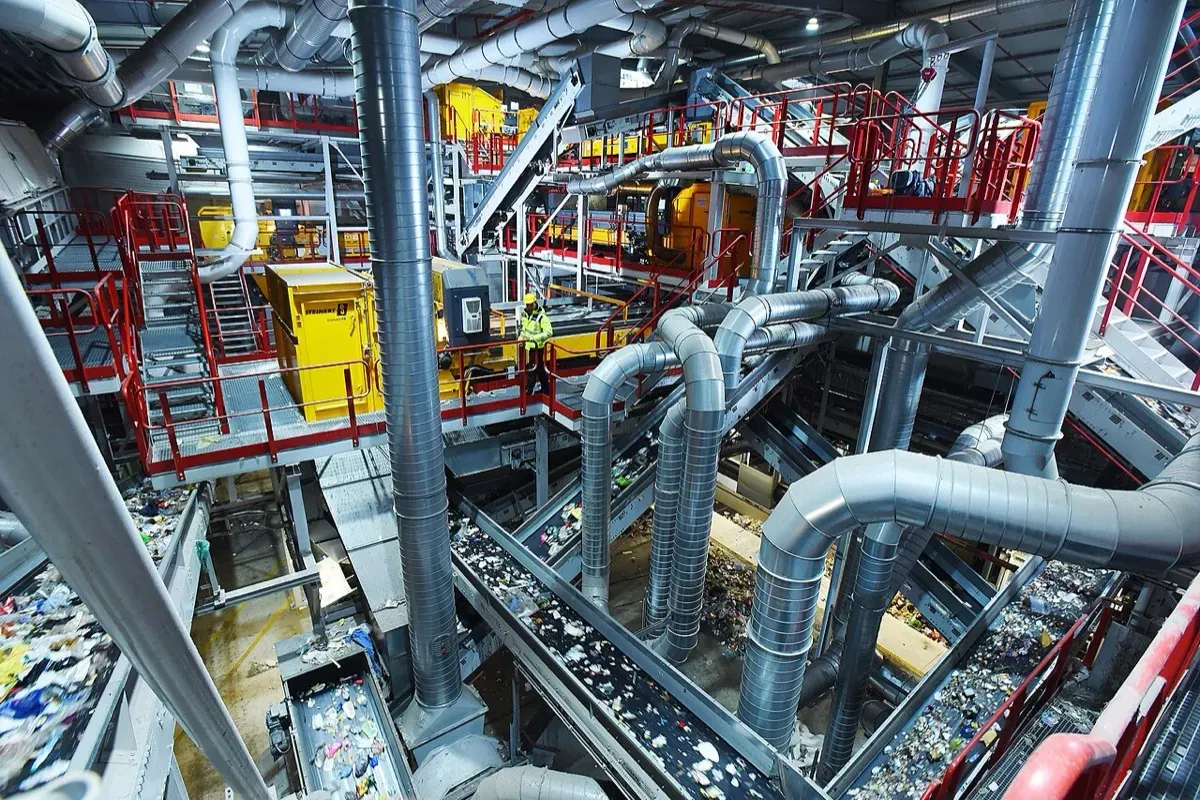
The United States generated 292.4 million tons of municipal solid waste in 2018, the latest national figures, and sent about 50% of it to landfill; only 32.1% was recycled or composted, and just 9% of plastics were recycled (US EPA). Food was the largest single material in landfills, at about 24%. Many households have no recycling service, and recycling bins themselves are often contaminated. Traditional recycling plants rely on large screens, magnets and human pickers, are expensive to build and struggle to adapt when the material changes.
Black-bag rubbish is even harder: it is wet, mixed and dirty. Few plants try to sort it, so cans, plastics, paper and food waste end up buried, where food releases methane.
The product
AMP ONE is a complete sorting facility designed around AI. Cameras and AI software identify materials on the belts, and robots and AI-guided air jets pick out the targets. AMP says the AI also monitors purity and spots jams or drops in performance, and adjusts the system in real time, replacing several of the screens used in conventional plants (AMP). Software updates can improve throughput over time.
AMP mainly sells the outcome rather than the machinery: it designs and builds the plant, then operates it under long-term pay-per-ton contracts with guaranteed performance. The customer usually handles waste supply, sale of the recovered materials and disposal of residue, while AMP runs operations, maintenance and upgrades. It still supplies individual AI systems to other operators; Waste Connections, for example, uses more than 50 of them across its plants.
How it works
- Receive: trucks deliver single-stream recycling or bagged household rubbish.
- Open and separate: machines open bags and split material by size and shape.
- Identify: AI vision checks each item’s material, shape and sometimes brand.
- Sort: robots and air jets eject recyclables into separate commodity streams.
- Recover organics: food and other organics are separated for treatment; in Virginia, they will become biochar.
- Ship: baled commodities go to recyclers; only residue goes to landfill.
Timeline
| Date | Milestone |
|---|---|
| 2014 | AMP founded in Denver |
| 2020 | Waste Connections agrees to deploy 24 AMP AI robotics systems |
| 2022 | More than 50 AMP systems deployed by Waste Connections |
| Dec 2024 | USD 91 million Series D led by Congruent Ventures |
| Nov 2025 | 20-year contract with SPSA, the regional waste authority for South Hampton Roads, Virginia |
| Early 2026 | Waste Connections’ Commerce City, Colorado facility, run by AMP, due to be commissioned for 62,000 tons a year |
| 2 Apr 2026 | Portsmouth MSW plant passes acceptance testing at 108,000 tons a year |
Impact and numbers
- Portsmouth, Virginia: through its affiliate Commonwealth Sortation, AMP’s plant processes up to 108,000 tons of MSW a year for SPSA’s eight member communities and about 1.2 million residents. The full system, with more sorting lines and an organics plant, is designed for 540,000 tons a year and must divert at least half of delivered material from landfill. The project creates about 100 jobs (AMP).
- Carbon: AMP has agreed with Google to remove 200,000 tonnes of CO2e by 2030 through biochar made from captured organics, and says it could divert five million tons of organic waste from landfill over 20 years.
- Recycling plants: in Commerce City, AMP ONE is designed for 62,000 tons a year of single-stream recycling. In Virginia, the SPSA contract aims to recycle 20% of the regional waste stream, against an estimated 7% today. The recycling plant that AMP bought and refitted in Portsmouth to process material recovered from the MSW line can now sort nine commodity streams instead of five, using cameras and air jets that can be reconfigured as markets change (Waste Dive).
- Funding: a USD 91 million Series D in December 2024 was led by Congruent Ventures, with Sequoia Capital, Wellington Management and Liberty Mutual Investments among others. It was smaller than the Series C, which reached USD 104 million, a sign of a tougher funding market (TechCrunch).
Honest caveats. All performance figures come from AMP or its customers. The 50% diversion figure is a contractual target for the full system, much of which relies on organics treatment that is not yet in place: the second Portsmouth sorting plant is expected in late 2027, and the biochar facility will follow. Biochar carbon removal is real but needs careful measurement, and buyers of credits should check the method. Recycling only about 20% of mixed rubbish still leaves most of it for landfill. AMP is a private company that has needed large capital rounds to build plants, and running facilities brings more risk than selling machines. Sorting mixed waste can produce lower-quality recyclables than separate collection, so it should complement, not replace, household recycling.
What’s next
AMP plans the second Portsmouth sorting plant and the biochar facility, more facility-scale contracts and wider use of its AI on existing lines. It says its AI systems are already deployed across North America, Asia and Europe. US states such as Colorado are rolling out packaging EPR laws, which could fund more modern sorting capacity.
Why it matters for Europe / green buyers
The revised EU Waste Framework Directive, amended by Directive (EU) 2018/851, requires member states to recycle 55% of municipal waste by 2025, 60% by 2030 and 65% by 2035 (EUR-Lex). Countries far from these targets, and those with large amounts of residual waste going to landfill or incineration, could use mixed-waste sorting plants to recover metals, plastics and organics before disposal. Facility-as-a-service contracts like AMP’s may appeal to municipalities that lack capital to build new plants.
India’s cities have little source segregation and rely on informal waste pickers to recover value. Automated mixed-waste sorting could help at large municipal sites, but it would need to be cheaper and designed to work with, not against, the informal sector’s livelihoods.
Sources & image credits
- AMP, “AMP expands Virginia mixed waste processing capacity under SPSA partnership” (2 Apr 2026): https://ampsortation.com/articles/portsmouth-msw-facility-expansion
- AMP, “AMP to operate Waste Connections recycling facility with AI-powered sortation technology” (18 Nov 2024): https://ampsortation.com/articles/first-of-its-kind-facility-featuring-fully-integra
- AMP, “AMP raises USD 91M Series D” (Dec 2024): https://ampsortation.com/articles/amp-raises-91m-seriesd
- TechCrunch, “AMP Robotics raises USD 91M to build more robot-filled waste sorting facilities” (5 Dec 2024): https://techcrunch.com/2024/12/05/amp-robotics-raises-91m-to-build-more-robot-filled-waste-sorting-facilities/
- Waste Dive, “WM, AMP, Reju celebrate expanded facilities” (15 Jul 2026): https://www.wastedive.com/news/wm-amp-reju-celebrate-expanded-facilities/825311/
- EUR-Lex, Directive (EU) 2018/851 amending Directive 2008/98/EC on waste: https://eur-lex.europa.eu/eli/dir/2018/851/oj/eng
- US EPA, “National overview: facts and figures on materials, wastes and recycling”: https://www.epa.gov/facts-and-figures-about-materials-waste-and-recycling/national-overview-facts-and-figures-materials
Images:
- “Sunset Park Material Recovery Facility” by Anahita Rouzbeh, 2017, licensed under CC BY-SA 4.0 (https://creativecommons.org/licenses/by-sa/4.0), via Wikimedia Commons: https://commons.wikimedia.org/wiki/File:Sunset_Park_Material_Recovery_Facility.jpg