The problem
Drink bottles and cans are among the most littered items in Europe. Deposit return systems (DRS) fix much of this by adding a small refundable charge to each container. Countries with mature systems, such as Norway, Germany and Finland, return the large majority of bottles and cans.
But a DRS is only as good as its return points. If returning 80 cans after a party means feeding them in one at a time while a queue builds, people give up. Retailers also need machines that sort, count and store containers without staff handling sticky waste. And the machine must recognise every container correctly, because each one carries money: an error means either a lost refund for the shopper or a fraud loss for the system. More than 50 markets around the world now run deposit return systems, according to TOMRA.
The product
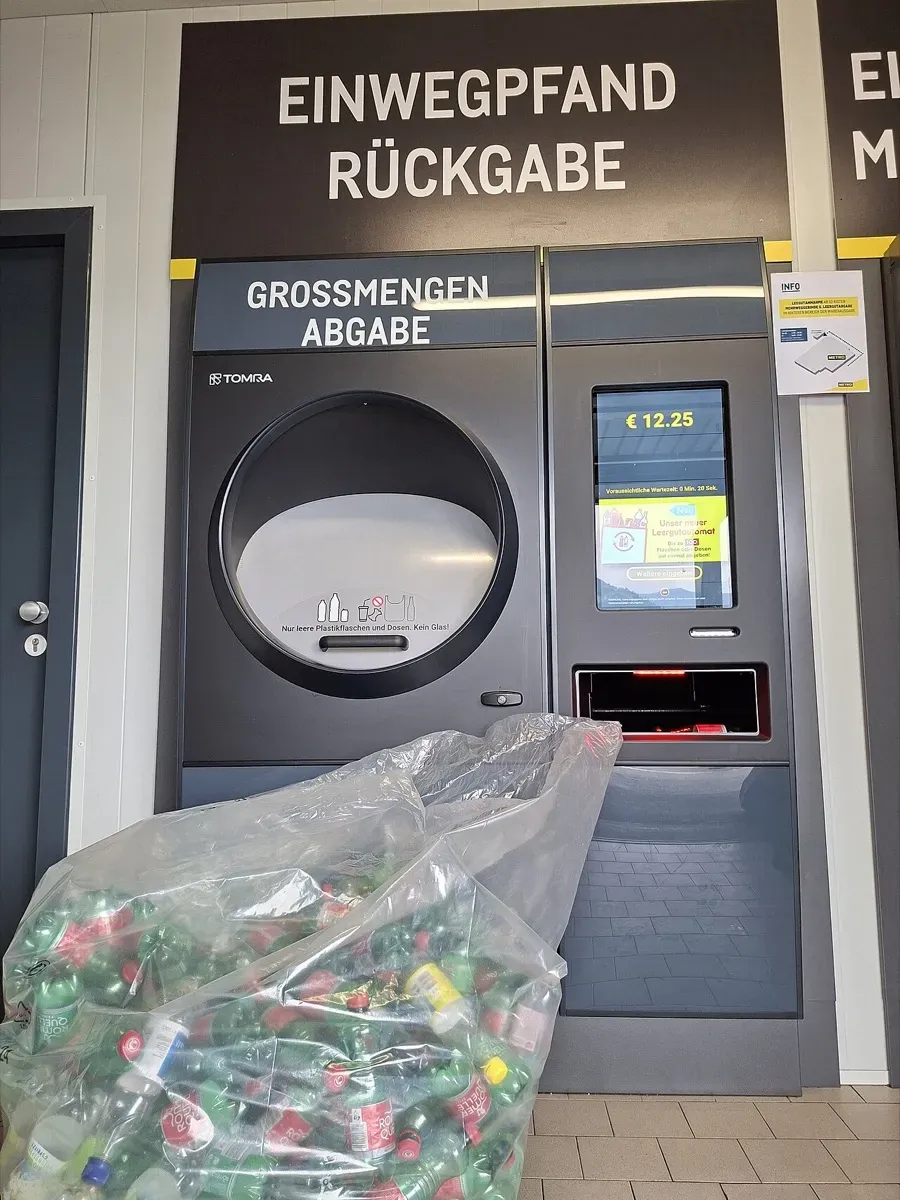
The TOMRA R1 is a high-volume “multi-feed” reverse vending machine for large supermarkets and hypermarkets. It has a wide, lidded opening into which shoppers pour a bag of empty cans and plastic bottles, a touch screen, a reject chute for ineligible items and a printer for deposit receipts, or a digital payout (TOMRA).
The R1 is sold as a system with the TOMRA T9, TOMRA’s flagship single-feed machine, and the MultiPac Air backroom, with up to seven storage cabinets, so it can process millions of containers a year. A “Drop and Go” feature sends rejected containers straight to the backroom to speed things up.
How it works
- Pour: the shopper empties a bag of containers into the opening and closes the lid.
- Separate: a singulator, adapted from TOMRA’s industrial counting and sorting equipment, lines the jumble up into single file.
- Recognise: TOMRA Flow technology, introduced in 2013, reads each container’s barcode and security mark and measures length, weight, shape and material. Its “OneRing” of six cameras takes up to 1,500 photos per second, so containers do not need to be rotated (TOMRA).
- Sort and compact: accepted containers are sorted by material and compacted, which stops them being redeemed twice; PET bottles end up 2.5 times smaller and cans six times smaller.
- Refund: the machine prints a voucher or pays digitally, and data flows to TOMRA’s digital tools for store managers.
Timeline
| Date | Milestone |
|---|---|
| 1972 | TOMRA founded; its first reverse vending machine installed |
| 2019 | TOMRA R1 multi-feed RVM launched |
| Feb 2023 | Smaller next-generation multi-feed concept shown at EuroShop |
| 9 Jan 2024 | 500 R1s installed in 16 countries |
| Oct 2025 | Poland’s deposit return system starts |
| 22 Feb 2026 | Revamped R1 concept and upgraded R2 (first TOMRA multi-feed to accept glass) shown at EuroShop |
| 17 Jul 2026 | 7,000 TOMRA RVMs installed in Poland; 800 million containers collected |
Impact and numbers
- Speed: for more than 100 containers, returns are up to five times faster than with single-feed machines (TOMRA).
- Store effects: on average 33% more consumer sessions and 86% more containers returned after installation; 87% of recycling shoppers in a TOMRA survey said they spend the refund in store.
- Footprint: R1s are installed in Norway, Sweden, Finland, Estonia, Denmark, Germany, the Netherlands, Latvia, Lithuania, Scotland, Ireland, Austria, the Czech Republic, Portugal, Romania and the United States.
- TOMRA Collection: more than 91,900 RVMs installed and over 53 billion containers collected a year (TOMRA).
- Finances: 2025 group revenue EUR 1.32 billion. In Q2 2026, revenue rose 25% to EUR 405 million and Collection revenue rose 45% to EUR 246 million, driven by Poland, Portugal, Singapore and Romania (TOMRA Q2 2026).
Honest caveats. The 33% and 86% uplifts and the five-times speed figure are TOMRA’s own numbers, averaged across retailers, and not independently audited. The R1 is designed for large stores; smaller shops need different machines, and the “smaller footprint” next-generation multi-feed concept is still evolving. The R1 accepts cans and plastic bottles only; glass needs the updated R2 or separate solutions. The revamped R1 shown at EuroShop 2026 is an early concept, not a launched product. Reverse vending machines use electricity and materials, and a DRS only cuts waste if collected material is actually recycled, which depends on the system operator. TOMRA’s Collection gross margin fell to 38.6% in Q2 2026 because new-market machine sales carry lower margins.
What’s next
TOMRA plans to refresh the R1 with a wider in-feed and a new interface, matching its R2 and T100 designs, and is adding glass handling and reuse modules, such as the SoftSlide concept, to prepare for refillable bottles under EU rules (TOMRA). New markets preparing DRS include the UK, where TOMRA is ramping up for a 2027 launch.
Why it matters for Europe / green buyers
The EU Packaging and Packaging Waste Regulation (EU) 2025/40 requires member states to set up deposit return systems for single-use plastic bottles and metal drink containers up to three litres by 1 January 2029, unless they already reach 80% separate collection, with a 90% separate collection target from 2029 (EUR-Lex). TOMRA says one third of Europe’s population already uses a DRS, and more markets are preparing to start. For retailers, high-volume machines like the R1 reduce queues and staff time, and bring shoppers into the store. When comparing suppliers, ask for independent return-rate data, uptime guarantees, service coverage and whether the machine can be upgraded for glass or refillables later.
In India, deposit systems are just emerging. Goa has installed more than 100 reverse vending machines ahead of its state deposit refund scheme, run by Hyderabad’s Recykal (Times of India). Those machines read a QR code on each container rather than relying on barcodes alone, a reminder that DRS hardware must adapt to local packaging and payment systems such as UPI.
Sources & image credits
- TOMRA, “TOMRA R1 and T9 with MultiPac Air”: https://www.tomra.com/reverse-vending/our-offering/reverse-vending-machines/tomra-r1-and-t9-with-multipac-air
- TOMRA, “Milestone 500 TOMRA R1 reverse vending machines installed” (9 Jan 2024): https://www.tomra.com/reverse-vending/media-center/news/2024/500-tomra-r1s-installed
- TOMRA, “TOMRA showcases latest generation of reverse vending machines at EuroShop 2026” (5 Feb 2026): https://www.tomra.com/reverse-vending/media-center/news/2026/concepts-new-products-euroshop-2026
- TOMRA, “TOMRA publishes Annual Report 2025: Circular Foundations” (20 Mar 2026): https://www.tomra.com/news-and-media/news/2026/tomra-publishes-annual-report-2025-circular-foundations
- TOMRA, Second Quarter 2026 results announcement (17 Jul 2026): https://www.tomra.com/-/media/project/tomra/tomra/investor-relations/quarterly-results-files/2026/2q/2026-q2_press-release_tomra.pdf
- TOMRA, “Discover the technology inside reverse vending machines”: https://www.tomra.com/reverse-vending/media-center/feature-articles/inside-reverse-vending-machines
- EUR-Lex, Regulation (EU) 2025/40 on packaging and packaging waste: https://eur-lex.europa.eu/eli/reg/2025/40/oj/eng
- Times of India, “Confusion over dual QR codes delays Goa’s liquor DRS launch” (3 Aug 2026): https://timesofindia.indiatimes.com/city/goa/confusion-over-dual-qr-codes-delays-goas-liquor-drs-launch/articleshow/132813014.cms
Images:
- “Dornbirn-Bottles and cans reverse vending machine-Tomra Systems-04ASD” by Asurnipal, 2025, licensed under CC BY-SA 4.0 (https://creativecommons.org/licenses/by-sa/4.0), via Wikimedia Commons: https://commons.wikimedia.org/wiki/File:Dornbirn-Bottles_and_cans_reverse_vending_machine-Tomra_Systems-04ASD.jpg