The problem
Bottled water is one of the most common single-use plastic products. A small PET bottle is used for minutes, and many end up as litter, in incinerators or in the sea, even though tap water in most of Europe is safe, cheap and closely monitored. Habit is the main barrier: people forget a bottle, or cannot find a place to refill it.
Founder Merijn Everaarts, in Dopper’s words, was “sick of seeing plastic water bottles polluting the sea” and wanted to give people an alternative. He founded the company in 2009 and the first Dopper bottle followed in 2010 (Dopper). Its stated goal is not just to sell bottles but to “end packaged water” by getting people to drink from the tap.
The product
The Dopper Original has three parts: a bottle, a screw cap and a cup that fits over the top. All parts come apart so they can be cleaned fully and replaced separately.
Its materials are:
- Bottle and cap: CirculenRenew polypropylene, made from 100% bio-based feedstock under a mass-balance system.
- Cup: Tritan Renew, with 50% recycled content.
- Seals: Thermolast thermoplastic elastomer (TPE).
All materials meet EU food-contact rules (Regulation 1935/2004) and US FDA requirements (Dopper help centre). The Original is Cradle to Cradle Certified at Gold level under version 4.1 of the standard, valid until September 2028, which covers material health, circularity, energy, water and social fairness (Cradle to Cradle Products Innovation Institute).
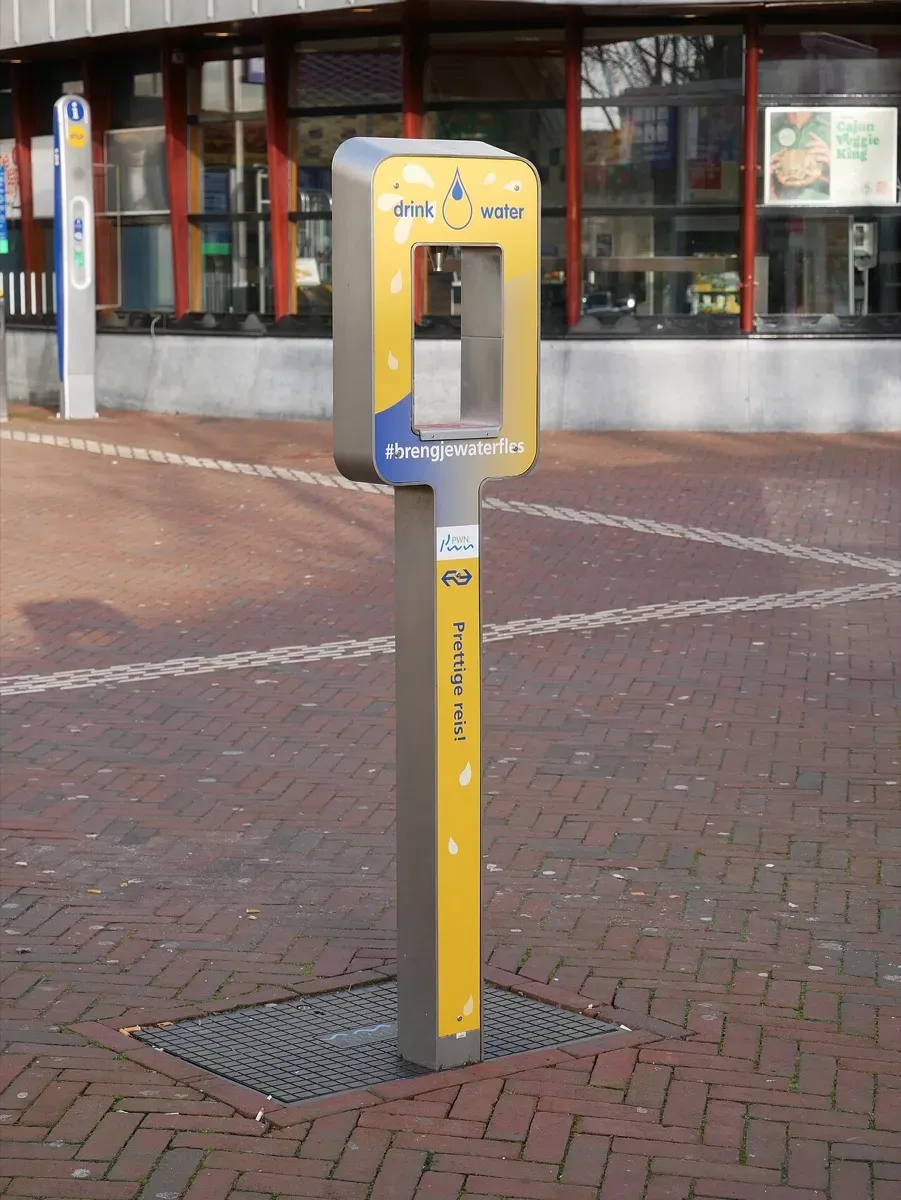
Dopper also sells Insulated and Steel bottles, upgraded in 2024 to 90% recycled steel, and in 2026 launched a new Steel Collection with a 490 ml bottle, a 350 ml Flip Straw bottle and a Travel Mug (Dopper). For businesses and cities it offers the Dopper Water Tap, a public refill station.
How it works
- Refill: users fill the bottle from the tap at home, at work or at public water points.
- Drink: the cap unscrews, and the cup can be used separately for hot or cold drinks.
- Clean: the three parts come apart, so every surface can be cleaned and dried.
- Repair: parts can be replaced instead of replacing the whole bottle.
- Information: a Digital Product Passport, launched in 2024, gives product information on materials and care.
Timeline
| Date | Milestone |
|---|---|
| 2009 | Merijn Everaarts founds Dopper and runs a bottle design competition |
| 2010 | First Dopper bottle goes on sale in the Netherlands |
| May 2014 | Dopper certified as a B Corp |
| 2024 | Insulated and Steel bottles move to 90% recycled steel; Digital Product Passport launched; Dopper joins 1% for the Planet |
| 2024 | Water-testing mini-lab opens in Changunarayan, Nepal |
| 2026 | New Steel Collection launched |
Impact and numbers
According to Dopper’s 2024 impact report (Dopper):
- Sales: nearly 1.6 million bottles sold in 2024.
- Avoided bottles (modelled): 828 million single-use plastic bottles and 20.7 million kg of plastic waste, calculated as bottles sold x 104 bottles saved per year x 5 years.
- Water Tap: 218,000 single-use bottles avoided, about 6,000 kg of plastic.
- Steel: the move to 90% recycled steel cut emissions by 1.25 kg CO2 per bottle and saved 130 litres of water per kg of material.
- Behaviour: 94% of participants in Dopper’s BYOB (Bring Your Own Bottle) Challenge said it made refilling second nature.
- Clean water: the Sarwacha Project in Nepal, run with Simavi, ENPHO and Biruwa, has reached 27,000 people; the Changunarayan mini-lab offers affordable water testing to residents, 71 schools and 15 health centres.
- Finances: gross revenue fell 9.5% from EUR 17.1 million to EUR 15.4 million, with a EUR 0.5 million loss in 2024.
Honest caveats. The 828 million figure assumes every bottle sold is used for five years and replaces 104 single-use bottles a year, based on a survey study in the Netherlands, Belgium and France: the median participant bought 1.5 fewer small and 0.5 fewer large bottles a week. Before late 2023, Dopper used a lower figure of 40 bottles a year from a 2017 study; the change alone more than doubled the claimed impact. The Water Tap figures rest on theoretical assumptions that, Dopper says, have not yet been reviewed. A reusable bottle has a much larger footprint to make than one PET bottle, so it only pays off if it is used for a long time; many people own several bottles that they rarely use. The bio-based polypropylene is assigned through mass balance, meaning the plastic in a specific bottle may not physically come from plant material. Dopper is also a small company that made a loss in 2024, and steel bottles, while more durable, generally take more energy to make than plastic ones, so they need even more uses to pay off.
What’s next
Dopper is focusing on its steel range, on public refill points and on behaviour campaigns such as the BYOB Challenge. Its Nepal project aims to reach 57,536 people by 2026. Through 1% for the Planet it now commits 1% of every sale to certified projects (Dopper).
Why it matters for Europe / green buyers
The EU’s recast Drinking Water Directive (2020/2184) requires member states to improve access to water for human consumption, especially in public spaces, and to encourage the use of tap water (EUR-Lex). The Packaging and Packaging Waste Regulation pushes reuse and refill in the drinks sector. Cities, offices and schools that install refill taps make reusable bottles easier to use. For buyers, Dopper’s Cradle to Cradle Gold certificate and B Corp score (141.3, well above the 80 needed to certify; B Lab lists operations in Austria, Belgium, France, Germany, the Netherlands, Portugal and Spain) give independent checks that most promotional bottles lack (B Lab). A branded bottle only helps if people keep using it.
India’s ban on identified single-use plastic items, in force since 1 July 2022, covers items like plastic cutlery, straws and stirrers but not PET water bottles (PIB). In Indian cities where tap water is not reliably safe, a refillable bottle works best alongside filtered water dispensers in offices, stations and schools.
Sources & image credits
- Dopper, “Our story”: https://www.dopper.com/mission/story
- Dopper help centre, “What is the Dopper bottle made of?”: https://help.dopper.com/migration/en/what-is-the-dopper-bottle-made-of
- Cradle to Cradle Products Innovation Institute, Dopper Original certificate: https://c2ccertified.org/certified-products/dopper-original
- Dopper, Impact Report 2024 (full report): https://25209588.fs1.hubspotusercontent-eu1.net/hubfs/25209588/2.%20Website%20and%20landing%20pages%20folder/Website%20-%20%20Documents/Website%20-%20Impact%20Report/Impact%20Report%202024/dopper_impact_report_2024_full_report_new.pdf
- Dopper, “Reports 2024”: https://www.dopper.com/mission/reports-2024
- Dopper, “Back to routine 2026” (Steel Collection): https://www.dopper.com/campaigns/back-to-routine-2026
- B Lab, Dopper B.V. B Corp profile: https://www.bcorporation.net/en-us/find-a-b-corp/company/dopper-bv/
- EUR-Lex, Directive (EU) 2020/2184 on the quality of water intended for human consumption: https://eur-lex.europa.eu/eli/dir/2020/2184/oj
- Press Information Bureau, Government of India, ban on identified single-use plastic items from 1 July 2022: https://www.pib.gov.in/PressReleaseIframePage.aspx?PRID=1837518
Images:
- “2022-01-03 Station Alkmaar watertappunt” by Fantaglobe11, 2022, licensed under CC BY-SA 4.0 (https://creativecommons.org/licenses/by-sa/4.0), via Wikimedia Commons: https://commons.wikimedia.org/wiki/File:2022-01-03_Station_Alkmaar_watertappunt.jpg