
The problem
Takeaway food and drink produce huge amounts of short-lived packaging. Paper coffee cups are lined with plastic, lids are polystyrene or polypropylene, and food boxes are often foam, plastic or coated card. Most cannot be recycled once they are dirty or because they combine several materials that cannot be separated, and many end up as litter in streets, parks and rivers. RECUP, citing Deutsche Umwelthilfe, puts Germany’s total at about 13 billion single-use takeaway packs a year, and Austria’s environment ministry counts 680 million in Austria.
Germany has tried to fix this by law. Since 1 January 2023, under the reuse-offer obligation (Mehrwegangebotspflicht), larger restaurants, cafés and caterers that sell takeaway food or drinks in single-use plastic packaging must also offer a reusable option at no higher price. In practice, uptake is low. WWF’s market analysis found that reusable packaging rose from 0.7% to only 1.6% of the takeaway market in 2023, with 7.0% for drinks but just 0.3% for food (WWF).
The product
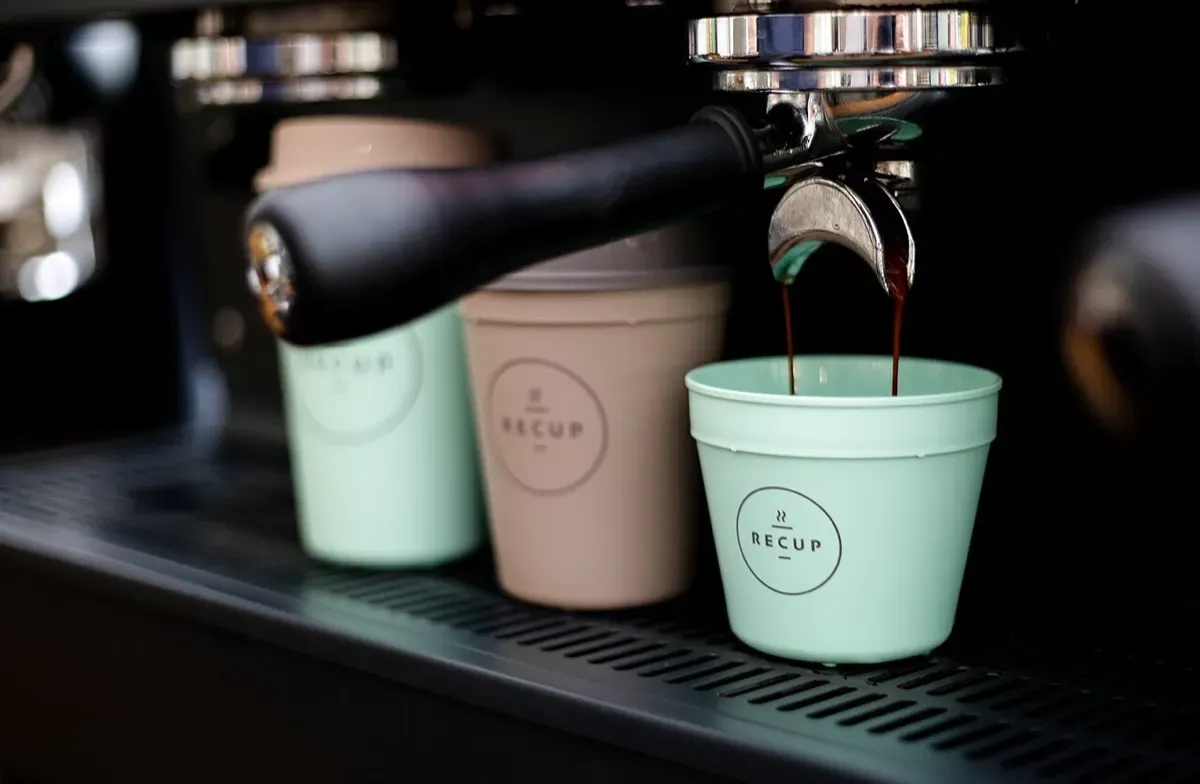
RECUP is a deposit cup for hot and cold drinks. Customers pay a EUR 1 deposit and EUR 1 for an optional lid, and get the money back when they return the cup at any partner. Cups come in 0.2, 0.3, 0.4 and 0.5 litre sizes; a transparent 0.5 litre cup with lid was added in September 2022 for cold drinks.
REBOWL, launched in 2020, is a reusable takeaway bowl in four versions with a EUR 5 deposit. A reusable pizza box with a EUR 7 deposit completes the range (RECUP press kit).
All products are made of one plastic, polypropylene (PP), are produced in Germany and are recycled into new material at the end of their life. Partners pay a system fee from about EUR 31 a month, rather than buying their own stock of containers (RECUP).
How it works
- Borrow: the customer orders a drink or meal in a RECUP cup or REBOWL and pays the deposit.
- Use: the cup or bowl is used like any takeaway packaging.
- Return anywhere: it can be returned at any RECUP partner, not only where it was bought; a map on the website and in the RECUP app shows partners. No app, account or personal data is needed, and there are no late fees.
- Wash and rebalance: partners wash the containers in their dishwashers and reuse them; if a partner ends up with more containers than it lends out, RECUP collects the surplus free of charge and redistributes it.
- Recycle: after about 1,000 washes for cups or 500 for bowls, worn items go back to RECUP’s manufacturer in Germany and are recycled as single-material PP. RECUP’s REBOWL maker, Crafting Future, is researching bowl-to-bowl recycling with the Institute for Bioplastics and Biocomposites (ifbb).
Timeline
| Date | Milestone |
|---|---|
| Nov 2016 | Pilot in Rosenheim, Bavaria, with 26 partners |
| May 2017 | Launch in Munich with 50 more partners |
| 2020 | REBOWL launched; RECUP cups awarded the Blue Angel ecolabel |
| Summer 2021 | REBOWL awarded the Blue Angel |
| Sep 2022 | Transparent 0.5 litre cup and lid added |
| 1 Jan 2023 | German reuse-offer obligation for takeaways begins |
| Feb 2025 | Dr Philipp Goos joins the management team |
| Apr 2026 | Five automated return machines open at Munich’s Viktualienmarkt |
| 3 Jun 2026 | Rollout to 92 train station and transit sites with Janova and HBB |
Impact and numbers
- Network: about 20,000 partner businesses, which RECUP describes as the largest reuse system for takeaway food and drink in Germany.
- Lifespan: about 1,000 washes per cup and about 500 per bowl or pizza box.
- Break-even: Germany’s Federal Environment Agency (UBA) estimates that a reusable cup has a better footprint than single-use cups after 10 to 25 uses, so a long-lasting cup that is actually returned can save a lot of waste (cited in the RECUP press kit).
- Markets: in January 2026 RECUP and Märkte München announced a five-year pilot at Munich’s Viktualienmarkt with five automated return machines from April, shared with reuse providers Cup Company, Relevo and CircleCube, so customers can return containers from several systems in one place (RECUP).
- Transit: in June 2026 RECUP and REBOWL launched at 92 sites with station caterers Janova (47 sites) and HBB, starting at three Hamburg stations (RECUP).
Honest caveats. RECUP does not publish how many cups are in circulation, the average number of times a cup is reused, or its return rate, so the real environmental saving is unknown. A cup only beats single-use packaging if it is returned and reused many times; cups kept at home as souvenirs can make things worse. Polypropylene is still plastic, and washing uses water and energy. Germany’s law is also poorly enforced: Deutsche Umwelthilfe (DUH) checked 208 branches of large chains in late 2025 and found that 116 broke the reuse-offer rules, and it called for a national single-use packaging tax (DUH). Many partners offer RECUP because the law requires them to, not because many customers ask for it.
What’s next
Shared return machines, like those at the Viktualienmarkt, could make returning easier by letting customers drop off containers from rival systems in one place. RECUP is also targeting high-footfall sites such as stations, where people buy drinks on the move. A few German cities, including Tübingen, Konstanz and Freiburg, now charge local taxes on single-use takeaway packaging, which makes reuse cheaper by comparison.
Why it matters for Europe / green buyers
The EU Packaging and Packaging Waste Regulation brings reuse into EU law. From February 2027 takeaway businesses must let customers bring their own containers, and from February 2028 larger final distributors must offer drinks and food in reusable packaging, with an aim of 10% of their sales in reuse formats by 2030 (EUR-Lex). RECUP’s network, ecolabel and deposit rules give a working template for other countries. Cafés, canteens and event caterers can join a shared pool rather than build their own.
India banned a list of single-use plastic items, including plastic cutlery, plates, straws and stirrers, from 1 July 2022 (PIB). Paper cups with plastic linings were not on the list and are still widely used for tea and coffee. A shared deposit system like RECUP would need dense networks and dishwashing capacity, but India’s long tradition of returnable steel tumblers and glass tea cups shows reuse can work.
Sources & image credits
- RECUP, homepage and partner information: https://recup.de/
- RECUP, press kit RECUP and REBOWL, February 2025: https://recup.de/wp-content/uploads/2025/02/Pressekit-RECUP-REBOWL-1.pdf
- RECUP and Märkte München, press release on the Viktualienmarkt return machines, 14 January 2026: https://recup.de/wp-content/uploads/2026/01/Pressemitteilung-RECUP-Maerkte-Muenchen.pdf
- RECUP, Janova and HBB, press release on transit rollout, 3 June 2026: https://recup.de/wp-content/uploads/2026/06/260603_REUCP_Janova_HBB.pdf
- WWF Germany, “Ein Jahr Mehrwegangebotspflicht: Erste Ergebnisse der WWF-Marktanalyse”: https://www.wwf.de/fileadmin/fm-wwf/Publikationen-PDF/Plastik/Ein-Jahr-Mehrwegangebotspflicht-Erste-Ergebnisse-der-WWF-Marktanalyse.pdf
- Deutsche Umwelthilfe, press release on breaches of the reuse-offer obligation, 30 December 2025: https://www.duh.de/presse/pressemitteilungen/pressemitteilung/mehrwegboykott-auch-nach-drei-jahren-angebotspflicht-deutsche-umwelthilfe-deckt-massive-verstoesse-be/
- EUR-Lex, Regulation (EU) 2025/40 on packaging and packaging waste: https://eur-lex.europa.eu/eli/reg/2025/40/oj
- Press Information Bureau, Government of India, ban on identified single-use plastic items from 1 July 2022: https://www.pib.gov.in/PressReleaseIframePage.aspx?PRID=1837518
Images:
- “RECUP Pfandbecher” by Greta RECUP, 2018, licensed under CC BY-SA 4.0 (https://creativecommons.org/licenses/by-sa/4.0), via Wikimedia Commons: https://commons.wikimedia.org/wiki/File:RECUP_Pfandbecher_(c)recup.jpg
recup.jpg)