
The problem
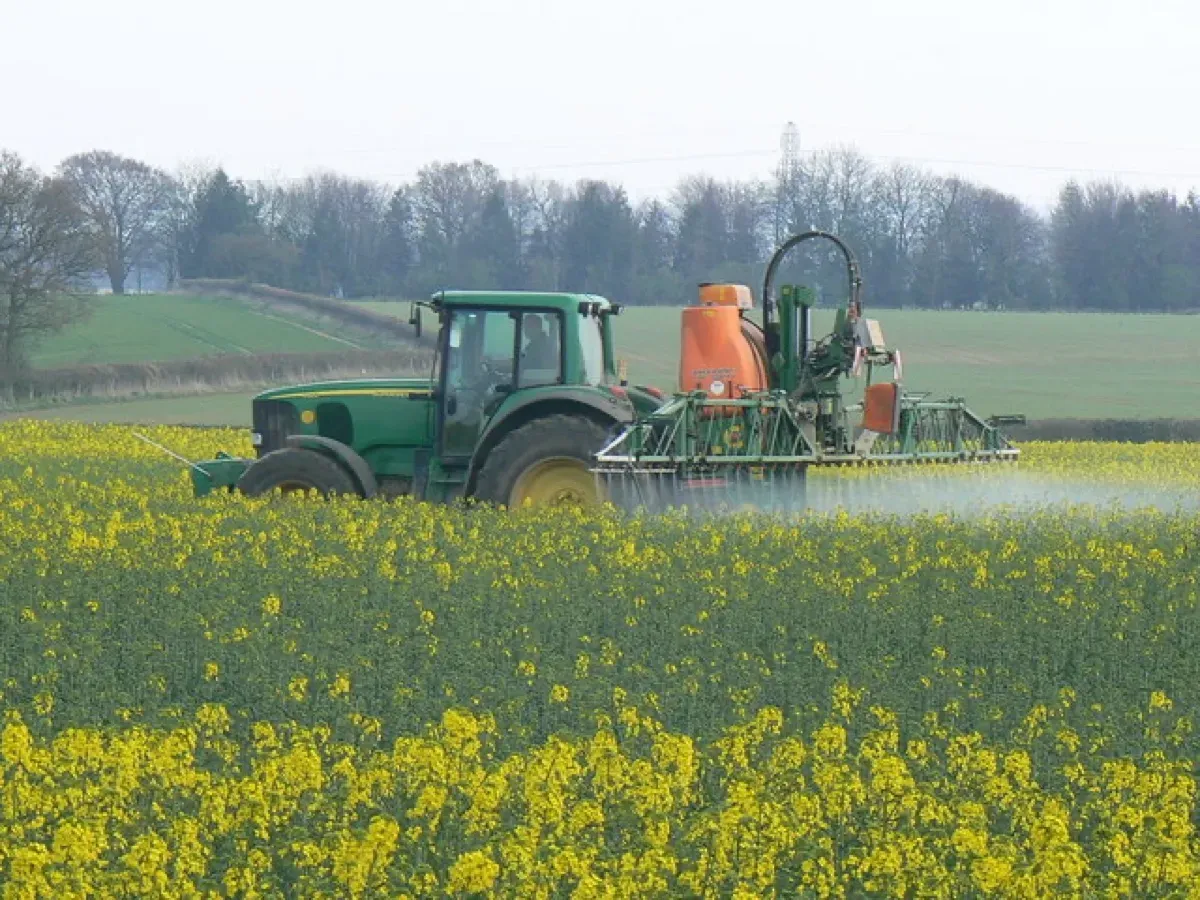
On the vast corn, soybean and cotton farms of North America, herbicide is usually broadcast: the whole field is sprayed whether weeds are dense or sparse. That makes sense when labour is scarce and fields are huge, but much of the chemical lands where no weed grows. It raises costs when input prices climb, speeds up herbicide resistance and adds to residues in soil and water.
Smaller precision sprayers had already shown what plant-level spraying can do in vegetables. The challenge in broadacre farming is speed and scale: a useful system has to recognise weeds among crop plants while a boom more than 30 metres wide moves fast across the field.
The product
See & Spray began in 2021 with See & Spray Select, which detects any green plant on fallow ground and sprays only those. On 7 March 2022 Deere launched See & Spray Ultimate, which distinguishes crop from weed in growing corn, soybean and cotton. Ultimate pairs the cameras with a split tank, so a farmer can apply a residual herbicide as a broadcast while reserving the second tank for targeted hits. A Premium version followed.
For model year 2027, announced in January 2026, Deere folded Select, Premium and Ultimate into one platform, See & Spray Gen 2, on its 408R, 410R, 412R, 612R and 616R sprayers. Gen 2 adds barley, canola, sugar beet, peanuts and wheat, and brings Variable Rate, which uses the cameras to judge how much herbicide each spot needs, to all in-crop users. The new sprayers can run at up to 16 miles per hour depending on crop and set-up, and a new centre-frame camera improves detection and reduces dust interference. Hagie STS sprayers get a factory option for See & Spray Premium.
How it works
- Look. Cameras along the boom scan more than 2,500 square feet per second at up to 15 miles per hour.
- Classify. Onboard processors run machine-learning models, developed with Deere’s subsidiary Blue River Technology, to decide whether each plant is crop or weed.
- Fire. A signal goes to the individual nozzle above each weed.
- Dose. With Variable Rate, the amount applied varies with what the cameras see.
- Record. Coverage maps go to the John Deere Operations Center, showing where herbicide went and where weed pressure is high.
- Pay. Farmers buy an unlimited annual licence or pay per acre where the technology is used.
Timeline
| Date | Milestone |
|---|---|
| 2017 | Deere acquires Blue River Technology, the computer-vision start-up behind the system |
| 2021 | See & Spray Select introduced for fallow ground |
| 7 Mar 2022 | See & Spray Ultimate unveiled for in-crop use in corn, soybean and cotton |
| Nov 2022 | European version shown at SIMA, for R900i trailed sprayers built in Horst, Netherlands |
| 18 Sep 2024 | Deere reports 59% average herbicide savings across more than 1 million acres |
| 4 Nov 2025 | Deere reports more than 5 million acres covered in 2025 |
| 27 Jan 2026 | See & Spray Gen 2 for model year 2027 announced |
| 20 Aug 2026 | Deere says factory adoption is nearly doubling on model year 2027 orders |
Impact and numbers
Deere’s figures show fast growth. In 2024, See & Spray covered more than 1 million acres with an average herbicide saving of 59% and an estimated 8 million gallons of herbicide mix saved. In 2025, it covered more than 5 million acres, cut non-residual herbicide use by nearly 50% and saved nearly 31 million gallons, despite heavy weed pressure and frequent rain. In fallow ground, Select used 77% less herbicide on average in Deere’s own testing.
Deere also points to yield. Company-commissioned soybean trials across seven US states found an average gain of 2 bushels per acre compared with broadcast spraying, which Deere links to less crop injury.
Adoption is accelerating. On Deere’s third-quarter earnings call on 20 August 2026, Deanna Kovar, president of the Worldwide Agriculture and Turf division, said customers were using See & Spray on significantly more acres than a year earlier and achieving more than 50% herbicide savings. Early-order trends suggest about a third of North American sprayers ordered for model year 2027 will include it.
Pricing has shifted to lower farmers’ risk. In 2025 Deere introduced an Application Savings Guarantee, charging the per-acre fee of $1 on fallow and $5 in crop only when the technology actually saved product, and added an unlimited annual licence for 2026.
Honest caveats
Company numbers. Acreage, savings and yield figures are Deere’s own. The University of Arkansas extension service analysed data from about 16,000 Deere-treated fields and stressed that savings and payback depend heavily on herbicide spend and farm size.
Residuals still broadcast. The nearly 50% figure applies to non-residual herbicide; residual products are still sprayed across the whole field, so total chemical savings are lower.
Europe is behind. The 2022 European system was a green-on-brown version, sold in limited numbers from spring 2023 on 36 and 39 metre R900i booms. The sources give no recent European adoption data, and Gen 2 has so far been described for North American models.
Lock-in. The system ties farmers to Deere hardware, software and subscriptions, and its benefit depends on connectivity and dealer support.
What’s next
Gen 2 extends See & Spray to the small-grain and oilseed crops that dominate European and Australian farms, making the cereal belt the next test. Deere is also adding AI tools to its Operations Center, which already tracks more than 520 million engaged acres across nearly 1.2 million connected machines.
Why it matters for Europe and green buyers
For Europe, See & Spray proves that plant-by-plant spraying can work at broadacre scale, not just in vegetables. That matters for cereal, maize and sugar beet growers facing tighter pesticide rules and buffer zones. Deere builds its European trailed sprayers in Horst in the Netherlands, so a European rollout of Gen 2 would be a short step; its arrival in wheat and barley is the development to watch.
For India, where farms are small and much spraying is done by hand, a 36-metre camera boom is not the near-term fit; the precision principle may arrive through drones and smaller rigs. For the world, cutting herbicide volumes by half on millions of acres reduces runoff and slows resistance.
Sources & image credits
- John Deere, The Furrow, “Tech@Work: See & Spray Ultimate”, March 2022. https://www.deere.ca/en/publications/the-furrow/2022/march-2022/tech-at-work-see-and-spray-ultimate/
- John Deere Australia, “John Deere launches See & Spray Ultimate technology”, 7 March 2022. https://www.deere.com.au/en/news/all-news/see-spray-ultimate/
- top agrar, “Pflanzenschutztechnik: John Deere See & Spray kommt nach Europa”, November 2022. https://www.topagrar.com/technik/news/pflanzenschutztechnik-john-deere-see-spray-kommt-nach-europa-13227958.html
- John Deere, “See & Spray customers see 59% average herbicide savings in 2024”, 18 September 2024. https://www.deere.ca/en/news/all-news/see-spray-herbicide-savings/
- John Deere, “Deere customers use See & Spray technology across 5 million acres in 2025”, 4 November 2025. https://www.deere.ca/en/news/all-news/see-spray-technology-across-5-million-acres/
- University of Arkansas Division of Agriculture, “Opportunity costs to consider when adopting See & Spray technology” (FSA2225). https://uaex.uada.edu/publications/pdf/FSA2225.pdf
- AgTechNavigator, “John Deere reveals See & Spray Gen 2, updates for model year 2027 sprayers”, 27 January 2026. https://www.agnavigator.com/Article/2026/01/27/john-deere-updates-model-year-2027-sprayers-see-spray-tech/
- Farm Equipment, “Deere reports growth in See & Spray and planter technology adoption”, August 2026. https://www.farm-equipment.com/articles/25619-deere-reports-growth-in-see-and-spray-and-planter-technology-adoption
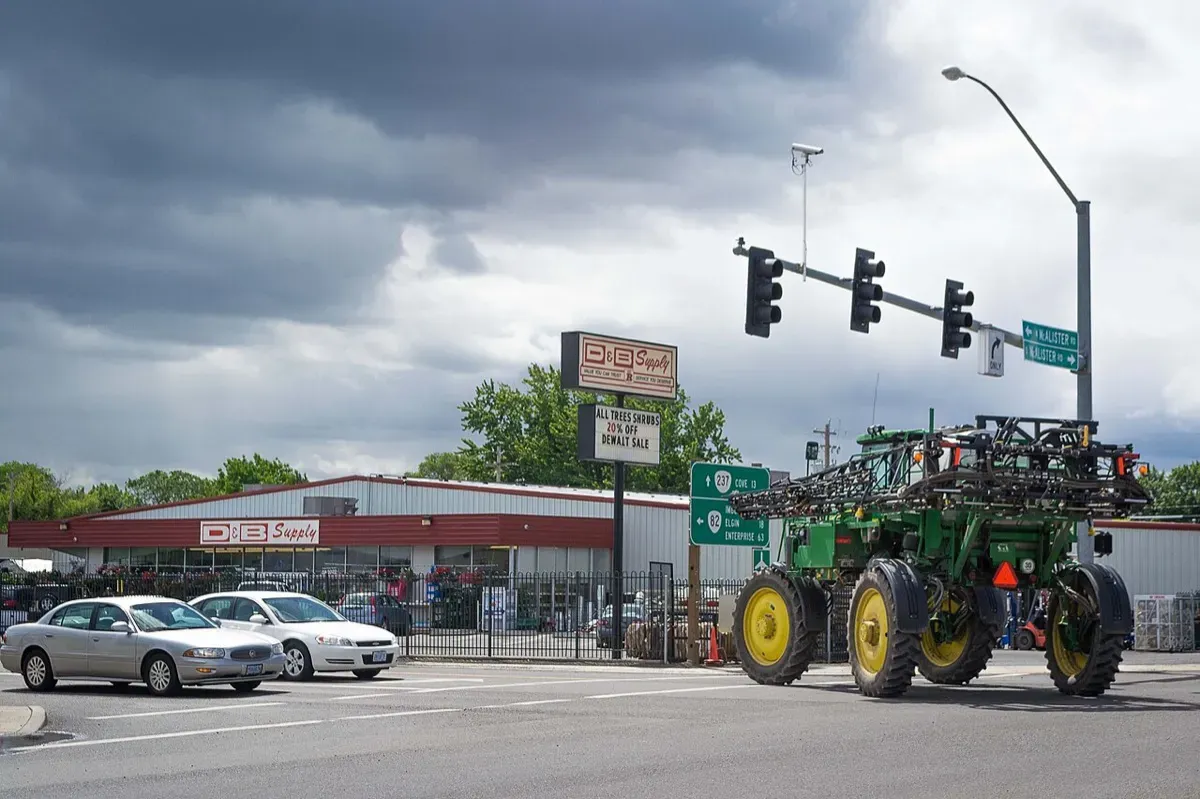
- Wikimedia Commons, “John Deere 4930 Sprayer (La Grande, Oregon)”. https://commons.wikimedia.org/wiki/File:John_Deere_4930_Sprayer_(La_Grande,_Oregon).jpg
Images: “John Deere 4930 Sprayer (La Grande, Oregon)”, Visitor7, CC BY-SA 3.0, via Wikimedia Commons. Illustrative; a conventional Deere sprayer, not a See & Spray unit.
.jpg)