The problem
Electric cars, vans, buses and trucks all need fast charging, but no two vehicles charge the same way. A car may take 150 kW for a few minutes and then slow down; a bus depot needs many vehicles charged overnight; a truck needs a burst of very high power during a driver’s break. A conventional all-in-one charger has a fixed amount of power locked inside each post, so part of it is wasted whenever the connected vehicle cannot use it.
That matters because grid connections and power electronics are the most expensive parts of a charging site. Operators who build too much power waste money; those who build too little leave drivers waiting. And Europe needs a lot of sites: the Alternative Fuels Infrastructure Regulation (AFIR) sets spacing rules for car charging pools every 60 km on main roads and requires pools for heavy vehicles with 350 kW points (European Commission).
The product
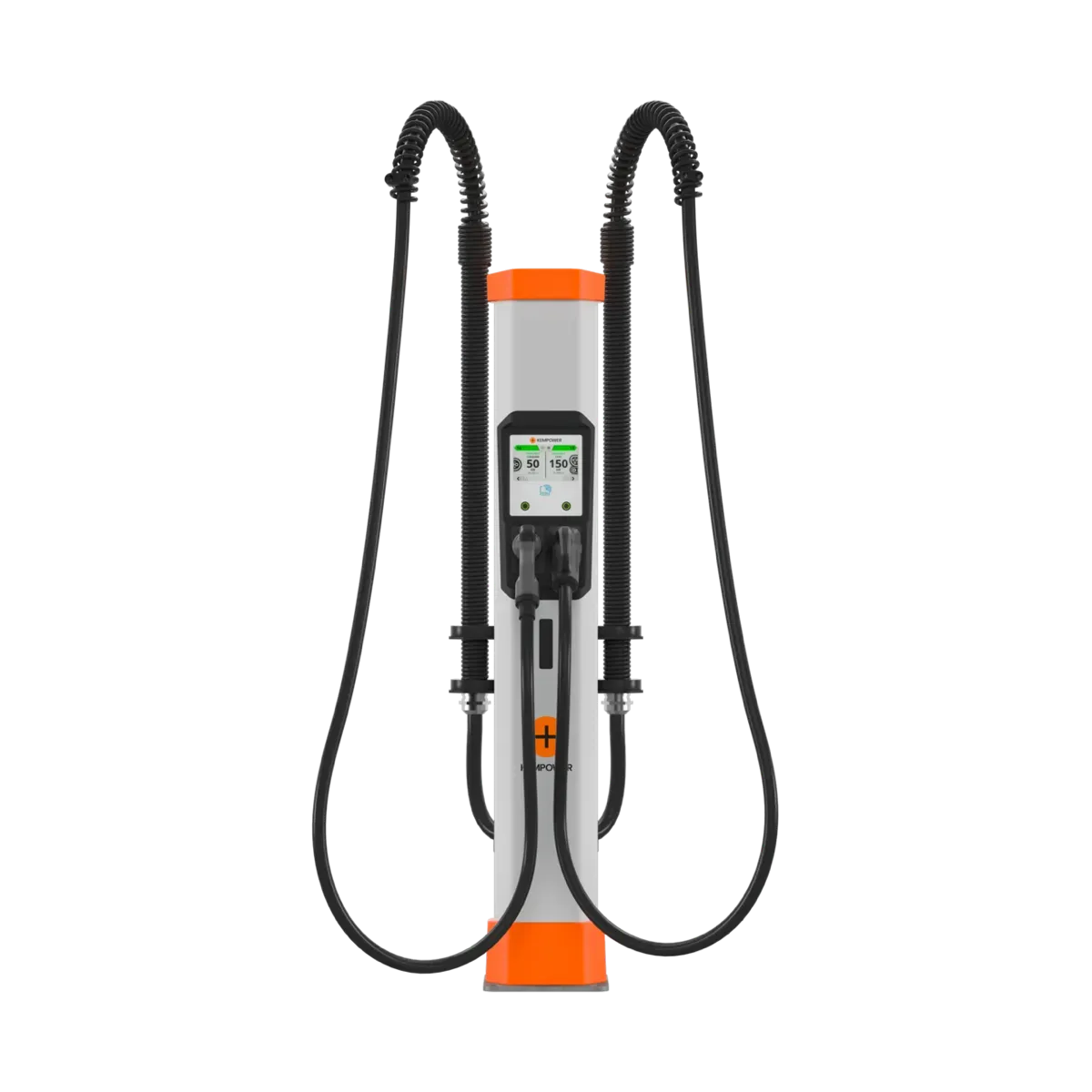
The Kempower Satellite charging system is a “distributed” charger. A rack-style Power Unit converts AC grid power to DC and sends it to separate Satellites, the slim posts drivers plug into, which can stand up to 80 metres away (Kempower):
- power modules of 50 kW, from 1 to 12 modules, in single, double or triple cabinets of 200, 400 or 600 kW;
- one system feeds up to 8 Satellites, with one or two outlets each;
- dynamic power routing moves power channels between vehicles during charging;
- adaptive voltage serves vehicles from 150 to 920 V DC, covering 400 V and 800 V cars;
- spring-assisted cable handling and a touch screen at each Satellite (Kempower).
For heavy vehicles, the Mega Satellite Flex, unveiled in May 2026, is Kempower’s first dispenser with both a CCS connector (up to 560 kW) and a Megawatt Charging System (MCS) connector (up to 1.2 MW). It went on sale in July 2026 (Kempower).
How it works
- Connect to the grid: the Power Unit takes AC power from the site’s grid connection.
- Convert: 50 kW modules convert it to DC, in 25 kW channels.
- Distribute: DC power is cabled to Satellites placed where vehicles park.
- Share: software assigns channels to each vehicle according to what its battery can accept.
- Re-route: as a car’s charging slows, freed channels move to another vehicle.
- Manage and grow: the operator monitors the site in the ChargEye cloud software and adds modules or Satellites later without replacing the cabinet.
Timeline
| Date | Milestone |
|---|---|
| 2017 | Kempower founded in Lahti, Finland |
| 14 Dec 2021 | Shares start trading on Nasdaq First North Growth Market |
| 2024 | Zeon partnership in India for over 20 highway charging hubs; first site in Sira, Karnataka |
| Dec 2024 | ChargeZone opens a 400 kW Kempower hub on the Ahmedabad to Mumbai highway, India |
| May 2026 | Mega Satellite Flex (CCS and MCS) unveiled at ACT Expo, Las Vegas |
| Jul 2026 | Mega Satellite Flex on sale |
| 23 Jul 2026 | H1 2026: revenue up 28%, outlook narrowed |
Impact and numbers
- Revenue: EUR 135.5 million in H1 2026, up 28%; order intake EUR 138.8 million, up 4%; order backlog up 18% year on year (Kempower).
- Use: 624,653 MWh of energy was charged through Kempower chargers in H1 2026, almost double the 314,680 MWh a year earlier.
- Fleets: fleet order intake “remained strong”, and e-truck and e-bus registrations grew 37% year on year in Q1 2026, according to the company.
- Lifecycle business: aftermarket revenue, which covers parts, service contracts, upgrades and software, grew 40% in H1 2026, and gross margin rose to 47.2% in Q2. North American revenue grew 54% in Q2.
- People: 856 staff in H1 2026, with development and production based in Finland and the US, and most materials sourced locally (Kempower).
Honest caveats. Kempower is not yet profitable at operating level: operative EBIT was minus EUR 5.4 million in H1 2026, better than minus EUR 9.0 million a year earlier. It cut the top of its 2026 growth outlook from 30% to 25% because charge point operators are consolidating and focusing on using existing networks rather than building new ones. New public DC fast-charging installations in Europe fell 19% in Q2 2026, and the company describes a “price-sensitive, competitive market”, with a new fixed cost programme of more than EUR 5 million. Power sharing means a single car may not get full power when a site is busy, which is a trade-off for higher site use. The climate benefit of any charger depends on the electricity mix; Kempower’s own target is carbon neutrality by 2035. Several product pages are written for the US market, so connector details vary by region.
What’s next
Kempower’s 2030 targets are revenue growth of 15 to 25% a year and an operative EBIT margin of 10 to 15%. The Mega Satellite Flex is aimed at depots and corridors preparing for megawatt-charged trucks, letting operators serve CCS vehicles today and MCS vehicles as they arrive.
Why it matters for Europe / green buyers
AFIR, Regulation (EU) 2023/1804, turns charging from a nice-to-have into an obligation for EU member states, including heavy-vehicle charging with high-power points and ad hoc payment without a contract. Modular, European-made systems like Kempower’s let operators meet these rules and add power step by step as traffic grows. For fleet buyers, a shared-power depot can charge more buses or trucks from the same grid connection.
In India, Kempower equipment powers ChargeZone’s hub on the highway between Ahmedabad and Mumbai: a 400 kW Power Unit with five CCS2 connectors serving both passenger cars and electric trucks, one of the first sites of its kind in India (Kempower). Kempower has also partnered with Zeon, one of India’s largest charge point operators, with a target of over 20 highway hubs of 200 to 400 kW and 6 to 8 outputs each, starting with a site in Sira, Karnataka (Kempower). The same modular logic suits India well: operators can start small on a highway where EV traffic is still light and add power modules as more cars and trucks arrive, without replacing the site.
Sources & image credits
- Kempower, “Distributed Charging Systems”: https://kempower.com/solution/distributed-charging-systems/
- Kempower, “Kempower Satellite”: https://kempower.com/solution/kempower-satellite/
- Kempower, “Kempower introduces Mega Satellite Flex to support the transition to megawatt charging” (May 2026): https://kempower.com/news/kempower-introduces-mega-satellite-flex-charger-to-support-the-transition-to-megawatt-charging/
- Kempower, “Half Year Financial Report 2026, 1 January to 30 June 2026” (23 Jul 2026): https://investors.kempower.com/releases/kempower-corporation-half-year-financial-report-2026-1-january-30-june-2026-continued-revenue-growth-momentum-with-sequentially-improving-gross-margin/
- Kempower, “Company”: https://kempower.com/company/
- Kempower Investors, “Initial Public Offering 2021, First North”: https://investors.kempower.com/ipo/
- Kempower, “ChargeZone expands EV fast-charging network across India with Kempower technology”: https://investors.kempower.com/releases/chargezone-expands-ev-fast-charging-network-across-india-with-kempower-technology-unveils-first-hub-in-gujarat/
- Kempower, “Kempower to deliver EV fast-charging solutions to Zeon, one of India’s largest Charge Point Operators” (2024): https://kempower.com/news/zeon-india-charge-point-operators/
- European Commission, “Questions and answers on the regulation on the deployment of alternative fuels infrastructure (EU 2023/1804)”: https://transport.ec.europa.eu/transport-themes/clean-transport/alternative-fuels-sustainable-mobility-europe/alternative-fuels-infrastructure/questions-and-answers-regulation-deployment-alternative-fuels-infrastructure-eu-20231804_en
Images:
- “Kempower-Satellite” by Kempower-DE, licensed under CC BY 4.0 (https://creativecommons.org/licenses/by/4.0), via Wikimedia Commons: https://commons.wikimedia.org/wiki/File:Kempower-Satellite.png