The problem
India’s e-mobility shift is led by two-wheelers and three-wheelers, as NITI Aayog’s draft Battery Swapping Policy noted in 2022 (NITI Aayog). These vehicles carry passengers and parcels all day, often for drivers on low incomes. For them, an electric vehicle has three big drawbacks: a high upfront price, mostly because of the battery; range anxiety; and long charging times that take the vehicle off the road.
Fixed charging is also hard in dense cities where many drivers have no private parking. And buses face the same issue on a larger scale: an electric bus is far more expensive to buy than a diesel one, largely because of its battery.
The product
SUN Mobility separates the battery from the vehicle. Its system has three parts (SUN Mobility):
- Smart Batteries: modular, IoT-connected battery packs on an open architecture that works across multiple vehicle makers and types;
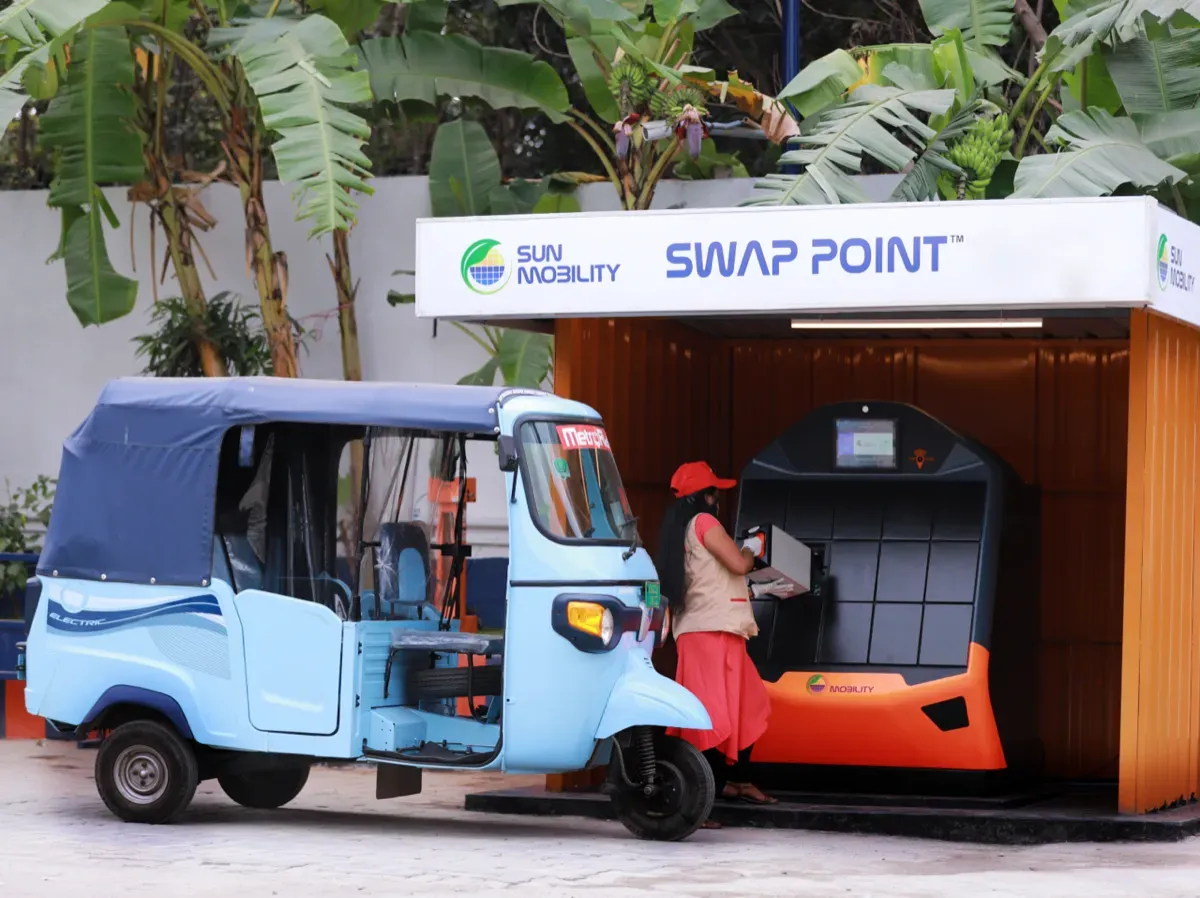
- Quick Interchange Stations (QIS) and Swap Points: a dense network of stations, including sites at Indian Oil fuel stations, where a depleted battery is exchanged for a charged one in minutes;
- Smart Network: a cloud platform that manages charging and battery health and can charge batteries off-peak or when renewable power is most available.
Drivers buy the vehicle without the battery and pay per use under a Battery-as-a-Service model. The core business serves two-wheelers, three-wheelers and small commercial vehicles under two tonnes.
For heavy vehicles, SUN Mobility unveiled a modular multi-battery swappable solution at Prawaas 5.0 in Gandhinagar in July 2026, shown on a 12-metre Tata Starbus EV. Two battery modules are swapped at the same time in under five minutes, in 50 kWh or 100 kWh configurations, for buses of 7 to 13.5 metres and trucks of 3 to 55 tonnes. The company says the platform received the industry’s first AIS-038 certification from ARAI for an indigenously developed swappable high-voltage battery platform for trucks and buses (Sustainable Bus).
How it works
- Buy without battery: the driver or fleet buys a swap-compatible vehicle without a battery pack.
- Drive: the vehicle runs on a SUN Smart Battery leased as a service.
- Swap: at a Swap Point, the driver exchanges the depleted pack for a charged one in minutes.
- Pay per use: the driver pays for the energy used through a pay-as-you-go app.
- Charge centrally: stations recharge returned batteries, ideally off-peak or with renewable power.
- Manage: the cloud platform tracks battery health, location and energy, and retires or replaces packs when needed.
Timeline
| Date | Milestone |
|---|---|
| 2017 | SUN Mobility founded by the SUN Group and the Maini Group |
| 2019 | Bosch acquires a stake; India’s first swappable battery system for buses |
| Oct 2021 | Vitol invests USD 50m; target of 500 Swap Points by end-2022 |
| Apr 2022 | NITI Aayog publishes a draft Battery Swapping Policy |
| Jul 2025 | USD 60m round led by Helios Climate and PIDG; about USD 135m raised over the year |
| Mar 2026 | Indofast Energy passes 1,600 stations in 23 cities and 90,000 vehicles |
| Jul 2026 | Modular bus swapping unveiled on Tata Starbus EV; 2,000+ stations in operation |
Impact and numbers
- Network: 2,000+ battery swapping stations and more than 1.5 million swaps every month in India, serving over 125,000 vehicles (SUN Mobility, July 2026).
- Cumulative use: more than 70 million swaps, over 2.1 billion electric kilometres and more than 100,000 tonnes of CO2 avoided, according to the company (Sustainable Bus).
- Indofast: the IndianOil joint venture ended FY 2025-26 with over 1,600 stations in 23 cities, more than 90,000 vehicles and 32 vehicle-maker partnerships. It reports 1.6 billion km travelled and 80,000 tonnes of CO2 avoided, with many users being gig workers in quick commerce, food delivery and logistics (Autocar Professional).
- Buses: SUN Mobility says swapping can cut the upfront cost of an electric bus by about 40%, close to a diesel bus, and lower operating costs by up to 20%.
Honest caveats. Almost all numbers here come from SUN Mobility or Indofast and are not independently audited, and they differ: 2,000+ stations on the company’s website versus “more than 1,900 Swap Points” quoted in July 2026, and CO2 savings of 100,000 tonnes (SUN) versus 80,000 tonnes (Indofast), partly because they cover different scopes. CO2 savings depend on India’s coal-heavy grid and on what the vehicles replaced. Swapping only works for vehicles designed for SUN’s batteries, which is why Indofast counts its vehicle-maker partnerships as a key metric. India’s 2022 battery swapping policy was published as a draft focused on interoperability, so common national standards are still a work in progress. The bus solution is new: it has been demonstrated and certified, but large-scale fleet use is not yet reported. Growth has also been slower than early plans: in 2021 the company spoke of onboarding 1 million EVs on its platform by 2025 (Business Standard), while it reported about 125,000 vehicles served in 2026. Swap stations also need spare batteries, which adds materials and capital per vehicle.
What’s next
SUN Mobility is expanding to Africa, starting in Kenya with fuel retailer Vivo Energy, and to Southeast Asia, starting with the Philippines. The PIDG-backed investment is expected to fund over 232,000 batteries and over 2,000 Quick Interchange Stations in those regions. In India, Indofast is moving from metros into Tier II and Tier III cities.
Why it matters for Europe / green buyers
The EU Batteries Regulation, Regulation (EU) 2023/1542, applies from 18 February 2024 with phased requirements up to 2031, including rules on the removability and replaceability of batteries in light means of transport such as e-scooters and e-bikes (European Commission). Swappable, centrally managed battery fleets fit this direction: they make battery health tracking, second life and recycling easier. European companies already back the model. Bosch holds a stake in SUN Mobility, Italy’s Piaggio partnered with it on the Apé E-City three-wheeler, and energy trader Vitol invested USD 50 million in 2021, saying the system is “not reliant on grid infrastructure, public fast charging availability or access to dedicated parking” and could also suit last-mile delivery in OECD markets (Vitol).
In India, SUN Mobility shows how battery swapping can make electric three-wheelers and scooters affordable for drivers who cannot wait hours to charge. The bus solution could help cities under PM E-DRIVE electrify fleets with lower upfront costs.
Sources & image credits
- SUN Mobility, “About”: https://www.sunmobility.com/about/
- SUN Mobility, homepage (technology, Quick Interchange Stations and awards): https://www.sunmobility.com/
- Sustainable Bus, “Battery swapping for buses: SUN Mobility unveils modular solution on Tata Starbus EV” (10 Jul 2026): https://www.sustainable-bus.com/components/sun-mobility-battery-swapping-prawaas/
- Autocar Professional, “Indofast Energy reports network growth in FY26, eyes expansion into Tier II and III markets” (May 2026): https://www.autocarpro.in/news/indofast-energy-reports-network-growth-in-fy26-eyes-expansion-into-tier-ii-and-iii-markets-132422
- NITI Aayog, “Draft Battery Swapping Policy” (Apr 2022): https://www.niti.gov.in/sites/default/files/2022-04/20220420_Battery_Swapping_Policy_Draft.pdf
- European Commission, “Batteries” (Regulation (EU) 2023/1542): https://environment.ec.europa.eu/topics/waste-and-recycling/batteries_en
- Vitol, “Vitol invests in emerging market electric mobility business” (20 Oct 2021): https://www.vitol.com/vitol-invests-in-emerging-market-electric-mobility-business/
- Business Standard, “Chetan Maini’s SUN Mobility raises $50 mn from Dutch energy giant Vitol” (20 Oct 2021): https://www.business-standard.com/article/companies/chetan-maini-s-sun-mobility-raises-50-mn-from-dutch-energy-giant-vitol-121102000408_1.html
Images:
- “SUN Mobility Swap Point” by Eshshiv, released under CC0 1.0 (https://creativecommons.org/publicdomain/zero/1.0/), via Wikimedia Commons: https://commons.wikimedia.org/wiki/File:SUN_Mobility_Swap_Point.png