The problem
Street litter bins are one of the least efficient parts of city logistics. They are emptied on fixed rounds whether they are full or not, so crews visit half-empty bins in quiet areas while busy ones overflow, attract gulls and rats, and spill litter on to pavements. Each extra emptying run costs labour and, usually, a diesel van in crowded streets.
Two technologies tackle this: compaction, which lets a bin hold more before it needs emptying, and sensors, which tell the crew which bins actually need a visit. The US firm Bigbelly built the category in the 2000s. Mr. Fill is one of the main European makers.
The product
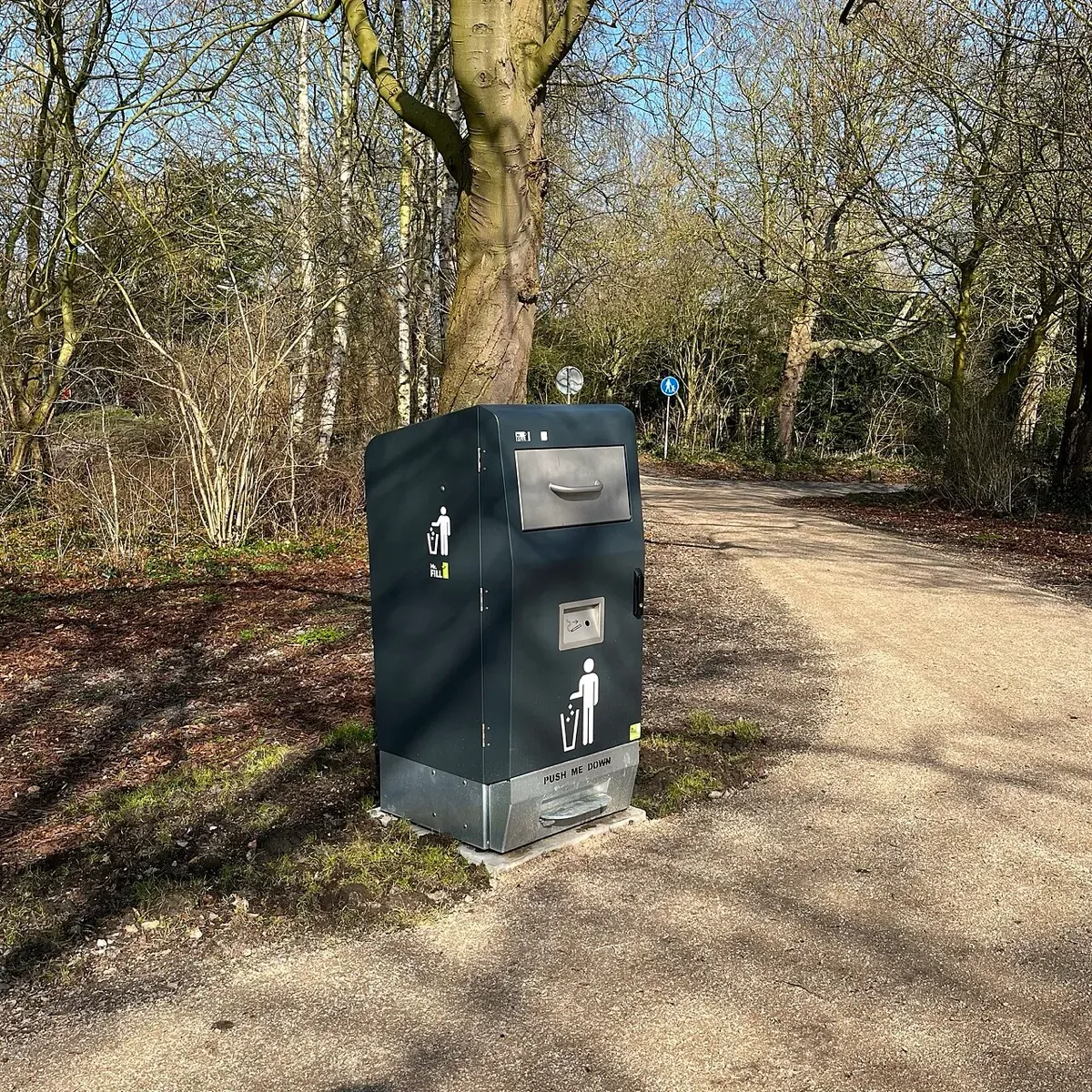
The Ultra Fill is a free-standing steel street bin with a small solar panel on top, a battery and an electric press inside. Specifications published by Mr. Fill and its distributors include (Mr. Fill; German Distribution; Braums brochure):
- 120 litre and 240 litre versions; the 120 litre unit is about 1,200 x 569 x 605 mm and weighs about 120 kg;
- a press of about 6,000 newtons, compacting waste at a ratio of roughly 1:5 to 1:7;
- a 12 volt, 20 amp-hour battery charged by the solar panel;
- a laser sensor that measures fill level, plus a stainless steel insertion flap, a foot pedal for hands-free use and a separate compartment for cigarette butts;
- a small display, remote locking and data sent to Mr. Fill’s online platform, where councils see fill levels and plan collections.
The company began life as ECOnX, which sold an earlier solar compactor called the ECOnTop through a German partner, German EcoTec (PR Newswire). After Theo Kik took over in 2018 the business was renamed Mr. Fill and its main products became the Ultra Fill bins, sold mostly to Dutch councils (Wikipedia NL). The bins are sold through distributors in Germany, Australia and elsewhere.
Mr. Fill claims its bins can cut waste collection costs by up to 75%, offers a three-year warranty and also leases bins to councils.
How it works
- Throw: a passer-by opens the flap by hand or with the foot pedal and drops rubbish in.
- Sense: the laser sensor measures how high the waste is inside.
- Press: when a threshold is reached, the press compacts the contents, running on battery power topped up by the sun.
- Report: the bin sends its fill level and status to the online dashboard several times a day.
- Plan: the council sends crews only to bins that are nearly full, instead of on fixed rounds.
- Empty: a crew removes the compacted bag and resets the bin.
Timeline
| Date | Milestone |
|---|---|
| 2017 | Bigbelly sues ECOnX and its German partner over a solar compactor patent |
| 2018 | Theo Kik takes over and renames the company Mr. Fill |
| 2020 | Bigbelly announces a win in the Munich Regional Court |
| 10 Mar 2022 | Munich Higher Regional Court rules no infringement on appeal, per ECOnX’s lawyers |
| May 2024 | Rotterdam installs 40 Ultra Fill bins in the city centre |
| 2025 | Mr. Fill bins photographed in use in Middelburg |
Impact and numbers
- Rotterdam: the city placed 40 bins in May 2024: 18 on the Lijnbaan, 8 in the Beurstraverse, 7 on the Hoogstraat and 7 at the Grote Markt, with the first by the Markthal. Rotterdam said each compacting bin holds about three times as much as a normal bin, and the bin’s display thanks users for their litter (Open Rotterdam; Mr. Fill).
- Other cities: Dutch Wikipedia lists 69 Mr. Fill bins in Delft and use in a range of Dutch municipalities (Wikipedia NL).
- Fewer trips: compaction of 1:5 to 1:7 means far fewer emptying visits for the same waste, which is where the claimed cost and emission savings come from.
Honest caveats. The headline savings, such as “up to 75%” lower collection costs, are Mr. Fill’s own figures; we found no independent audit of a Dutch rollout. Capacity numbers also vary: Mr. Fill’s Rotterdam page speaks of about 600 litres of uncompacted waste, while the city said “three times” a normal bin, and actual gains depend on what goes in, since glass and cans compact less than paper and packaging. A smart bin reduces van trips and overflowing litter; it does not reduce the waste itself, and compacted mixed waste is hard to sort for recycling unless the bin has separate streams. Each unit carries a battery, electronics and steel, so the embodied footprint only pays back where the bin is busy. Finally, the firm’s history includes a patent fight: Bigbelly won in the Munich Regional Court (PR Newswire), but ECOnX’s law firm reports the Munich Higher Regional Court found no infringement on 10 March 2022 (CH Kilger). Buyers should check the current legal position in their market.
What’s next
The next step for smart bins is data: using fill reports not only to plan rounds, but to place bins where they are needed, size collection fleets and link to electric collection vehicles. Multi-stream versions, with separate compartments for packaging, paper and residual waste, would help councils meet recycling targets as well as cleanliness ones.
Why it matters for Europe / green buyers
The EU Waste Framework Directive sets a waste hierarchy and recycling targets for municipal waste (EUR-Lex), and cities are under pressure to keep streets clean with fewer staff and less diesel. Solar compactors fit public procurement as a measurable service: fewer runs, data on fill levels and less overflow. Buyers should ask for the city’s own before-and-after collection data, battery life and replacement cost, and whether bins can separate recyclables.
In India, the Solid Waste Management Rules 2026, in force from 1 April 2026, require segregation into four streams and put new duties on bulk waste generators such as large campuses and markets (PIB). Segregation at source makes single-chamber compactors a poor fit for Indian streets unless they are built with separate wet and dry compartments. For Indian cities the lessons are robust, dust-proof hardware, separate compartments, solar panels sized for monsoon months and a business model that pays back in labour and fuel saved.
Sources & image credits
- Mr. Fill, “Specification 120L / 240L”: https://www.mr-fill.com/specification-120l-240l/
- Mr. Fill, “Rotterdam introduces smart solar compacting waste bins”: https://www.mr-fill.com/developments/rotterdam-introduces-smart-solar-compacting-waste-bins/
- Open Rotterdam, “Het centrum van Rotterdam krijgt pratende duurzame prullenbakken: bedankt!” (2024): https://openrotterdam.nl/het-centrum-van-rotterdam-krijgt-pratende-duurzame-prullenbakken-bedankt/
- Wikipedia (Dutch), “Mr. Fill”: https://nl.wikipedia.org/wiki/Mr._Fill
- German Distribution, “Mr. Fill 240L Ultra Fill solar compactor bin”: https://www.germandistribution.com/products/innovative-waste-management/mr-fill-240l-ultra-fill-solar-compactor-bin
- Braums, Mr. Fill brochure: https://www.braums.com.au/ArticleDocuments/307/BRAUMS%20Mr%20Fill%20Brochure.pdf.aspx
- PR Newswire, “Bigbelly wins infringement lawsuit against ECOnX and German EcoTec”: https://www.prnewswire.com/news-releases/bigbelly-wins-infringement-lawsuit-against-econx-and-german-ecotec-301143630.html
- CH Kilger, “CH Kilger prevails in patent infringement proceedings” (LinkedIn, 2022): https://www.linkedin.com/posts/ch-kilger_ch-kilger-prevails-in-patent-infringement-activity-6910605700763136000-PUI7
- EUR-Lex, Directive 2008/98/EC on waste: https://eur-lex.europa.eu/eli/dir/2008/98/oj/eng
- PIB, Solid Waste Management Rules 2026: https://www.pib.gov.in/PressReleasePage.aspx?PRID=2219676&lang=1®=3
Images:
- “Mr. Fill compactor in Middelburg” by Mikalagrand, licensed under CC BY 4.0 (https://creativecommons.org/licenses/by/4.0), via Wikimedia Commons: https://commons.wikimedia.org/wiki/File:Mr._Fill_compactor_in_Middelburg.jpg