The problem
Illegal logging is often the first step in clearing a rainforest. RFCx cites UN figures that up to 90% of logging in tropical rainforests is illegal (RFCx), and Sustainability Magazine describes illegal logging as the world’s third-largest transnational crime, worth an estimated USD 50 to 150 billion a year (Sustainability Magazine).
Rangers are few and forests are vast, so most patrols are blind. Satellite alerts arrive after trees have fallen. Meanwhile, restoration projects and protected areas struggle to show whether wildlife is actually recovering, because traditional surveys are slow and expensive.
The product
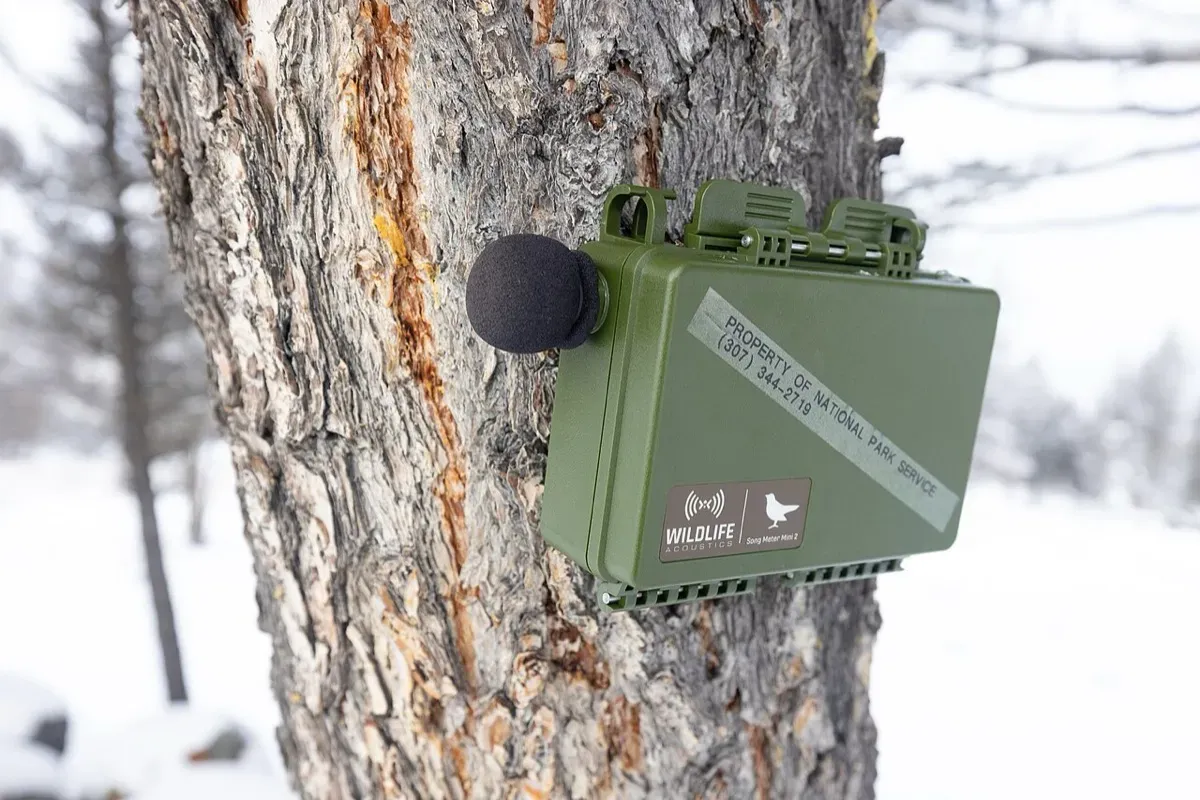
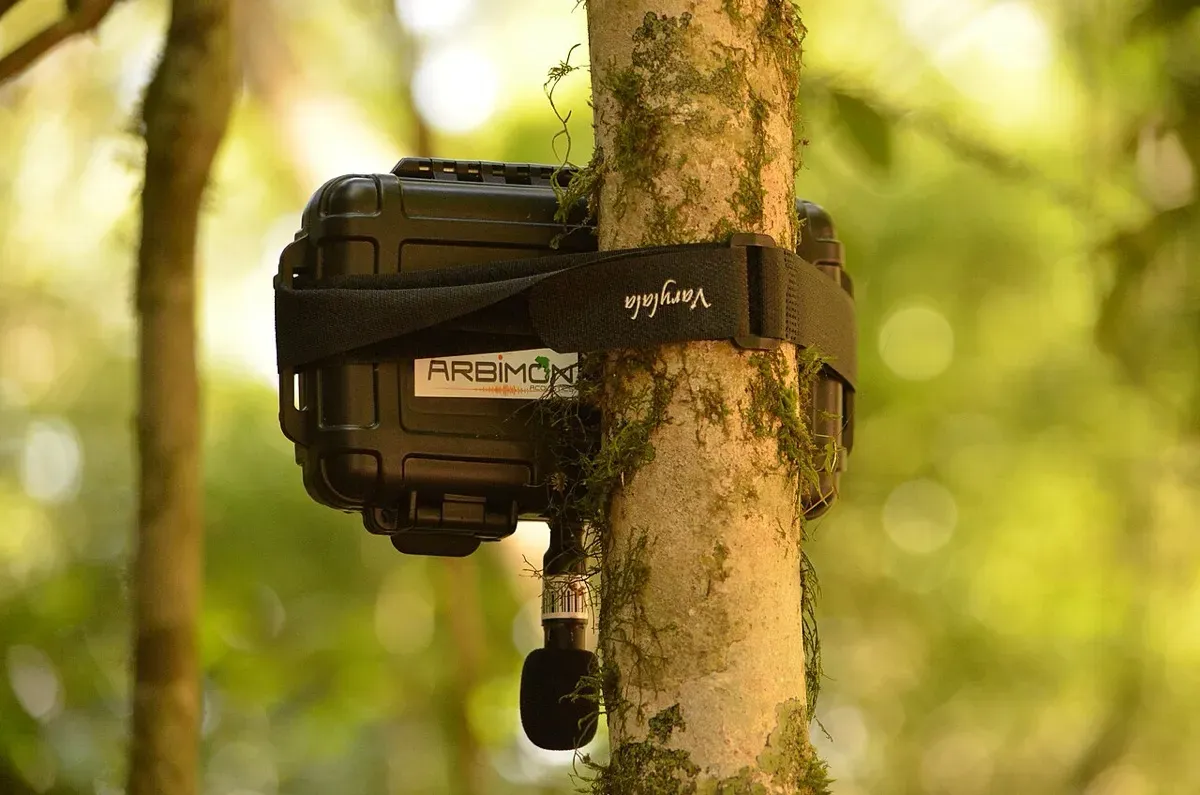
Guardian 3 (G3), designed by Topher White, is RFCx’s most advanced device. It combines three highly sensitive microphones that capture ambient sound within a radius of 50 to 1,500 m, depending on the source. Solar panels, on-board power management and LFP battery packs keep it running, and its design is adapted to collect the flecks of light that reach through the canopy (RFCx). Besides GSM and Wi-Fi, it has satellite connectivity, so it can run audio analysis on board and send alerts in real time (RFCx).
It is the third generation. The G1 repurposed used smartphones, fitted with solar panels, external microphones and custom software. The G2 moved to custom hardware and logic boards for better power management and reliability.
Arbimon is the companion platform: a free, web-based ecoacoustic tool where anyone can upload recordings from any device, store them without limits and run AI analyses such as pattern matching and cluster analysis (Arbimon). It began as a University of Puerto Rico research project, and RFCx took it over in about 2019. CEO Bourhan Yassin says its pattern matching tool has run about 1.2 billion analyses (The Markup).
How it works
- Install: RFCx staff and local partners climb trees and mount Guardians high in the canopy, often around a forest’s perimeter or along key access roads.
- Listen: the device records all ambient sound 24 hours a day.
- Detect: AI models, on the device or in the cloud, recognise chainsaws, vehicle engines, hunting dogs and gunshots, and can also flag blast fishing and forest fires.
- Alert: a nearby ranger gets a real-time notification on the RFCx app with the threat’s location and the captured audio, so they can respond before damage is done.
- Monitor: the same audio feeds Arbimon, where scientists detect species and track biodiversity over time.
Timeline
| Date | Milestone |
|---|---|
| Early 2010s | First Guardians (G1) built from recycled smartphones |
| c. 2019 | RFCx takes over the Arbimon platform |
| 2020 | Pilot with the Philippine DENR in Palawan and Mt. Irid |
| 20 Jan 2024 | RFCx reports monitoring in 37 countries, nearly 2 million acres |
| Feb 2025 | 587 Guardians, 155 reserves, 736,200 ha; 160 million recordings |
| 2026 | Guardian 3 is the current device, with satellite connectivity |
Impact and numbers
- Scale: as of February 2025, RFCx said it had deployed Guardians in 587 canopies across 37 countries and 155 protected reserves, monitoring 736,200 ha. Its recordings totalled 160 million, distinguishing 4,208 species, 408 of them near threatened or worse, and 955 species could be detected automatically (Sustainability Magazine).
- Peru: in Tambopata National Reserve, a project funded by IUCN NL and Stichting Otterfonds with the environmental law NGO SPDA used RFCx alerts to stop illegal logging in real time and as forensic evidence in court cases (RFCx).
- Philippines: in 2020 RFCx, with Huawei and the Department of Environment and Natural Resources, installed five Guardians in El Nido-Taytay, Palawan, part of the country’s last continuous primary forest, and Mt. Irid. RFCx reports faster and more accurate ranger responses (RFCx).
- Africa: in a test project, RFCx showed that monitoring one key road used by poachers could help protect a large area of rainforest, and its data showed vehicle and poaching activity after dark and at weekends, so partners could target patrols at the riskiest times (RFCx).
- Puerto Rico: a project with the US Fish and Wildlife Service collected 8 million recordings in three months and showed animals moving to higher elevations as the island gets drier (The Markup).
Honest caveats. Most impact numbers come from RFCx itself and its project pages, and they vary between sources: its pages quote different hectare and country totals at different times. Leadership reporting is also inconsistent, with The Markup naming Bourhan Yassin as CEO in 2024 while Sustainability Magazine called Topher White founder and CEO in 2025. Yassin is frank about the limits. With the Tembé people in Brazil, alerts went unanswered until RFCx helped with basics such as funding to fix bikes for patrols (The Markup). RFCx itself lists patchy mobile coverage, termites, weather and weak winter sunlight as practical problems. As a donor-funded non-profit, its reach depends on grants and corporate partners.
What’s next
Yassin says RFCx holds what may be the biggest collection of soundscape data ever assembled and wants to move beyond individual projects to global analytics on the state of nature (The Markup). RFCx also pitches Arbimon’s dashboards for reforestation strategies and verifiable ESG reporting (RFCx).
Why it matters for Europe / green buyers
The EU Deforestation Regulation requires that products such as wood, cocoa, coffee, palm oil, soy, rubber and cattle sold in the EU do not come from deforestation or forest degradation. It applies to large and medium operators from 30 December 2026 (European Commission). European buyers will need credible evidence from sourcing landscapes. Real-time acoustic alerts and forensic audio, as used in court in Peru, add ground-level proof to satellite checks, and European funders such as IUCN NL already back RFCx projects.
India’s forests face a different but related pressure: fire. The India State of Forest Report 2023 counted 203,544 fire hotspots in the 2023-24 season, with Uttarakhand, Odisha and Chhattisgarh worst affected, and the Forest Survey of India now sends pre-fire and near real-time alerts (Forest Survey of India). RFCx says Guardians can detect forest fires as well as chainsaws and gunshots, so acoustic sensors could complement satellite alerts in Indian tiger reserves and hill forests.
Sources & image credits
- Rainforest Connection, home page: https://rfcx.org/
- Rainforest Connection, “Real-Time Threat Detection” (Guardian): https://rfcx.org/guardian
- Arbimon, ecoacoustic analysis platform: https://arbimon.org/
- Sustainability Magazine, “How AI is Protecting Trees from Illegal Logging in Real-Time” (Feb 2025): https://sustainabilitymag.com/articles/how-ai-is-protecting-trees-from-illegal-logging-in-real-time
- The Markup, “How to Use Sound and AI to Protect the Environment”, interview with Bourhan Yassin (20 Jan 2024): https://themarkup.org/hello-world/2024/01/20/how-to-use-sound-and-ai-to-protect-the-environment
- Rainforest Connection, “Protecting Peru’s Tambopata National Reserve”: https://rfcx.org/projects/tambopata
- Rainforest Connection, “Protecting the Palawan Rainforest in the Philippines”: https://rfcx.org/projects/palawan
- European Commission, “Regulation on Deforestation-free products”: https://environment.ec.europa.eu/topics/forests/deforestation/regulation-deforestation-free-products_en
- Forest Survey of India, India State of Forest Report 2023, Vol. I (Dec 2024): https://fsi.nic.in/uploads/isfr2023/isfr_book_eng-vol-1_2023.pdf
Images:
- “ARBIMON Recorder” by Orlando Acevedo-Charry, CC BY-SA 4.0 (https://creativecommons.org/licenses/by-sa/4.0), via Wikimedia Commons: https://commons.wikimedia.org/wiki/File:ARBIMON_Recorder.jpg