The problem
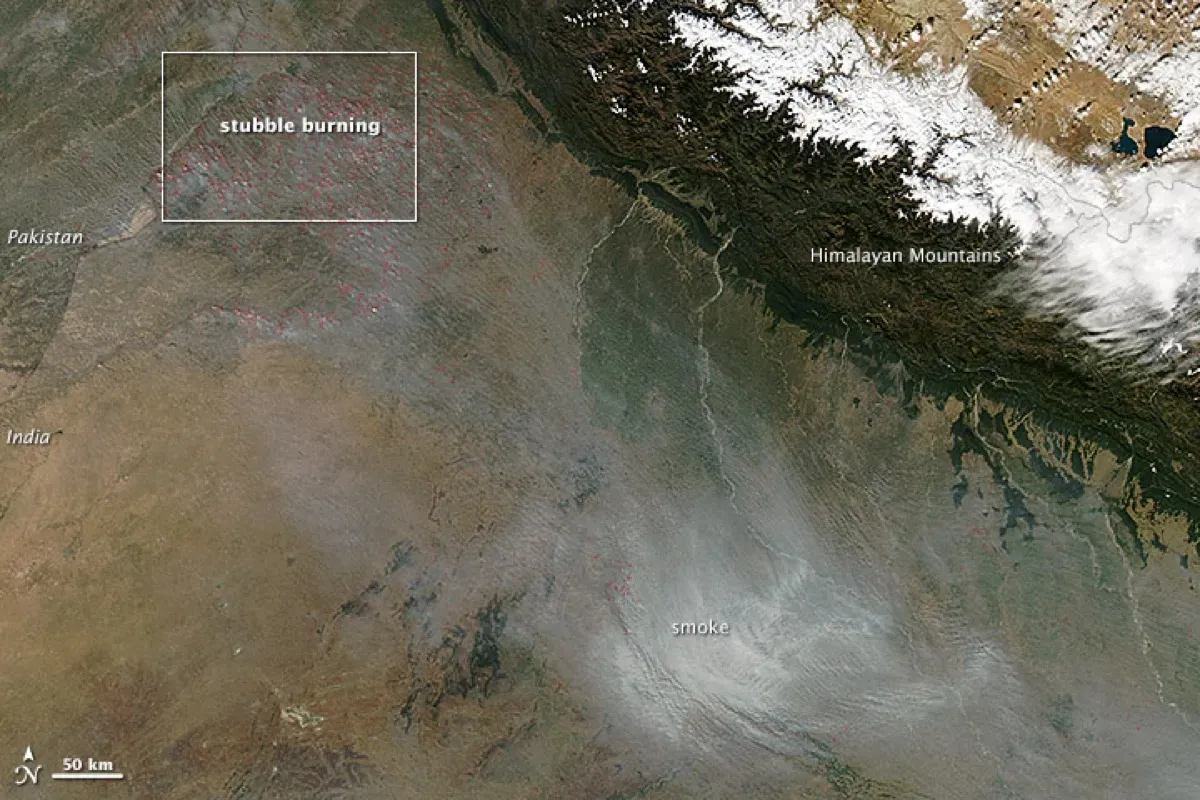
In Punjab and Haryana, farmers have only a few weeks between the rice harvest and sowing wheat. The quickest way to clear the fields is to burn the leftover stubble. The smoke adds to the toxic air that settles over Delhi every October and November. Bans and subsidies for machines have reduced burning but not ended it, because straw still has little value to farmers.
At the same time, India’s construction boom uses huge amounts of plywood, MDF, particle board and gypsum board. Wood-based boards rely on timber and often on formaldehyde-based glues, while gypsum and cement boards are energy intensive. A board made from straw could turn a pollutant into a product, as long as it is cheap and strong enough.
The product
The AgriBioPanel is a hot-pressed board made mainly from rice and wheat straw. Strawcture sells it for interior walls (drywall partitions), false ceilings, doors, furniture, flooring underlay and acoustic panels (Strawcture).
According to the company:
- thicknesses range from 8 to 35 mm;
- Basic grade has a density of about 700 kg/m³ and a 45 minute fire rating; HD about 800 kg/m³ and 1 hour; Premium about 800 kg/m³ and 2 hours;
- the website gives a straw content of 90%, while a 2026 profile describes 96% agricultural residue and 4% binder with no added formaldehyde (ImpactX);
- the panels can contribute to LEED and GRIHA green building credits.
Strawcture also supplies drywall systems built from its panels, with installed fire ratings of 1 hour for Basic and 2 hours or more for HD and Premium, according to its product pages.
How it works
- Collect: straw is bought from farmers and aggregators after harvest, giving it a cash value instead of a match.
- Prepare: the straw is cleaned, chopped and dried.
- Blend: the fibres are mixed with a small amount of binder that contains no added formaldehyde.
- Hot press: the mat is pressed under heat and pressure into dense boards of set thickness.
- Finish: boards are trimmed, sanded and, for some grades, treated for fire and moisture resistance.
- Install: builders cut and fix the panels with normal woodworking tools, onto metal or timber studs for walls and ceilings.
Timeline
| Date | Milestone |
|---|---|
| 2018 | Shriti Pandey starts working with straw as a building material |
| 3 Mar 2022 | $375,000 seed round led by Social Alpha, Villgro and Brigade REAP |
| 2025 | Italian firm Ricehouse begins representing Strawcture products in Europe |
| 2025 | Listed among HCL ClimaForce low-carbon building innovations |
| Feb 2026 | Expansion, exports and a new fundraising round of about $1 million reported |
Impact and numbers
- Funding: the 2022 seed round of $375,000 was led by Social Alpha, Villgro Innovations Foundation and Brigade REAP; at that point the company said revenue had doubled in two years and it served clients in more than 11 states, including Jayadeva Hospital and SELCO Foundation health projects (Entrepreneur India).
- Growth: FY25 revenue of about ₹4 to 5 crore, with a target of ₹11 to 12 crore for FY26, and a capacity of about 50,000 sq ft of panel a day, according to the 2026 ImpactX profile.
- Exports: sales to Singapore, Germany, Italy and the UK, with about ₹70 lakh of European sales in 12 months, as reported by ImpactX.
- Europe: Ricehouse, a rice-straw building company based in Milan, represents and sells Strawcture products in Europe (Strawcture on LinkedIn).
- Support: Strawcture appears among the low-carbon building innovations backed through the HCL ClimaForce programme (HCL ClimaForce).
Honest caveats. Almost all the numbers here come from the company or company-sourced profiles. Revenue, capacity and export figures have not been independently audited in public sources. The straw share is given as 90% on the website and 96% in a 2026 interview, and the exact binder is not disclosed. No public EPD or third-party life-cycle assessment was found, so “carbon negative” claims cannot be checked. Fire ratings are stated by the company; buyers should ask for the test reports and the standard used. Agri-fibre boards can swell if they get wet, so moisture performance in bathrooms and humid coastal cities needs checking. Straw supply is also seasonal and must be stored safely for the rest of the year. Finally, buying straw from farmers reduces burning only if it pays enough and the collection is timely; a single company’s demand is small next to the tens of millions of tonnes burned each year.
What’s next
Strawcture is raising about $1 million to expand production and is building distribution in India and abroad. It is adding acoustic products that combine AgriBioPanels with natural felt. Watch for an independent EPD, which European buyers will increasingly expect, larger repeat orders from developers, and whether the company can open regional plants close to straw-producing districts. Another signal will be whether large Indian developers and hospital builders start specifying straw boards as standard rather than as a pilot, because that is where the volumes that change farmers’ behaviour would come from.
Why it matters for Europe / green buyers
Under the recast Energy Performance of Buildings Directive, Directive (EU) 2024/1275, new buildings in the EU will have to calculate and disclose their life-cycle carbon from 2028 for large buildings and 2030 for all (EUR-Lex). Interior boards, partitions and furniture are a meaningful share of that carbon, and bio-based boards could help. Strawcture already reaches European buyers through Ricehouse in Milan. European specifiers will want CE marking where required, an EPD and fire test reports to European standards, and they should weigh the transport emissions of shipping boards from India against local straw boards.
For India, the opportunity is larger. India has a growing green building sector under IGBC and GRIHA, and only a small share of buildings is certified. A low-cost, low-GST interior board made from stubble links three problems: urban air pollution, farm incomes and construction emissions. If Strawcture and similar companies can scale, straw could become a regular construction raw material instead of a seasonal pollutant.
Sources & image credits
- Strawcture, “AgriBioPanel” product page: https://strawcture.com/agribiopanel/
- Strawcture, company website: https://strawcture.com/
- ImpactX Media, “When farms become factories: Strawcture Eco’s straw-to-scale materials revolution” (Feb 2026): https://impactx.media/when-farms-become-factories-strawcture-ecos-straw-to-scale-materials-revolution/
- Entrepreneur India, “Strawcture Eco raises $375,000 in seed funding round led by Social Alpha, Villgro Innovations Foundations and Brigade REAP” (3 Mar 2022): https://india.entrepreneur.com/news-and-trends/strawcture-eco-raises-375000-in-seed-funding-round-led-by/421284
- Strawcture Eco on LinkedIn, partnership with Ricehouse, Milan (2025): https://www.linkedin.com/posts/strawcture-eco_activity-7295095173250719744-5-ok
- HCL ClimaForce Fund, “Call for innovation” (innovations list): https://hclclimaforcefund.com/en/innovation
- EUR-Lex, Directive (EU) 2024/1275 on the energy performance of buildings (recast): https://eur-lex.europa.eu/eli/dir/2024/1275/oj/eng
Images:
- “Aerial view of Air Pollution in North India, Agriculture Fires, November 2013” by NASA (Jeff Schmaltz, LANCE MODIS Rapid Response Team, NASA GSFC), public domain, via Wikimedia Commons: https://commons.wikimedia.org/wiki/File:Aerial_view_of_Air_Pollution_in_North_India,_Agriculture_Fires,_November_2013.jpg