The problem
Hydrogen is already a big industrial commodity. It is used to desulphurise fuels in refineries, to make ammonia for fertiliser and to make methanol. Almost all of it is produced from natural gas or coal, which releases carbon dioxide. Replacing that “grey” hydrogen with hydrogen made from water and renewable electricity is one of the few practical ways to decarbonise these processes, and it is also the route Sweden’s fossil-free steel projects depend on.
Europe set ambitious goals: 10 million tonnes of domestic renewable hydrogen and 10 million tonnes of imports by 2030, plus an aim of 40 GW of electrolysers. In July 2024 the European Court of Auditors concluded that these targets were not based on robust analysis and were unlikely to be met, and that the 40 GW figure was weakly grounded (ECA Special Report 11/2024). One recurring reason is cost: electrolyser plants have been expensive to build, especially once compressors, gas cleaning and civil works are added.
The product
Sunfire’s answer is HyLink Alkaline, a range of standardised, pressurised alkaline electrolysers. The 10 MW HyLink Alkaline 22 module is the established option for projects up to about 100 MW (Sunfire alkaline technology). On 14 April 2026 Sunfire launched HyLink Alkaline 23, a pre-assembled 50 MW outdoor module for projects in the hundreds of megawatts. The company says it can cut a customer’s total installed cost by up to 50% compared with its earlier design (Sunfire, 14 April 2026). It was shown publicly for the first time at the World Hydrogen Summit in Rotterdam on 20 May 2026, where Sunfire said its current 100 MW projects were repeat orders from existing customers (Sunfire, 20 May 2026).
According to the fact sheet, each 50 MW module produces up to 1,000 kg of hydrogen an hour at 30 bar(g), with 99.8% purity before final gas cleaning. It runs between 20% and 100% load, ramps at 4% per second, and consumes 46.5 to 52.3 kWh of AC electricity per kilogram of hydrogen (HyLink Alkaline 23 fact sheet). The stack efficiency is quoted at 67% (lower heating value, DC).
The alkaline technology came from Switzerland. In January 2021 Sunfire bought IHT Industrie Haute Technologie of Monthey, a company with decades of experience in pressurised alkaline electrolysis and about 240 MW of installed electrolysers (Sunfire, January 2021). Sunfire later moved that production to Germany. Sunfire also develops solid oxide electrolysers (SOEC) for sites with spare industrial heat.
How it works
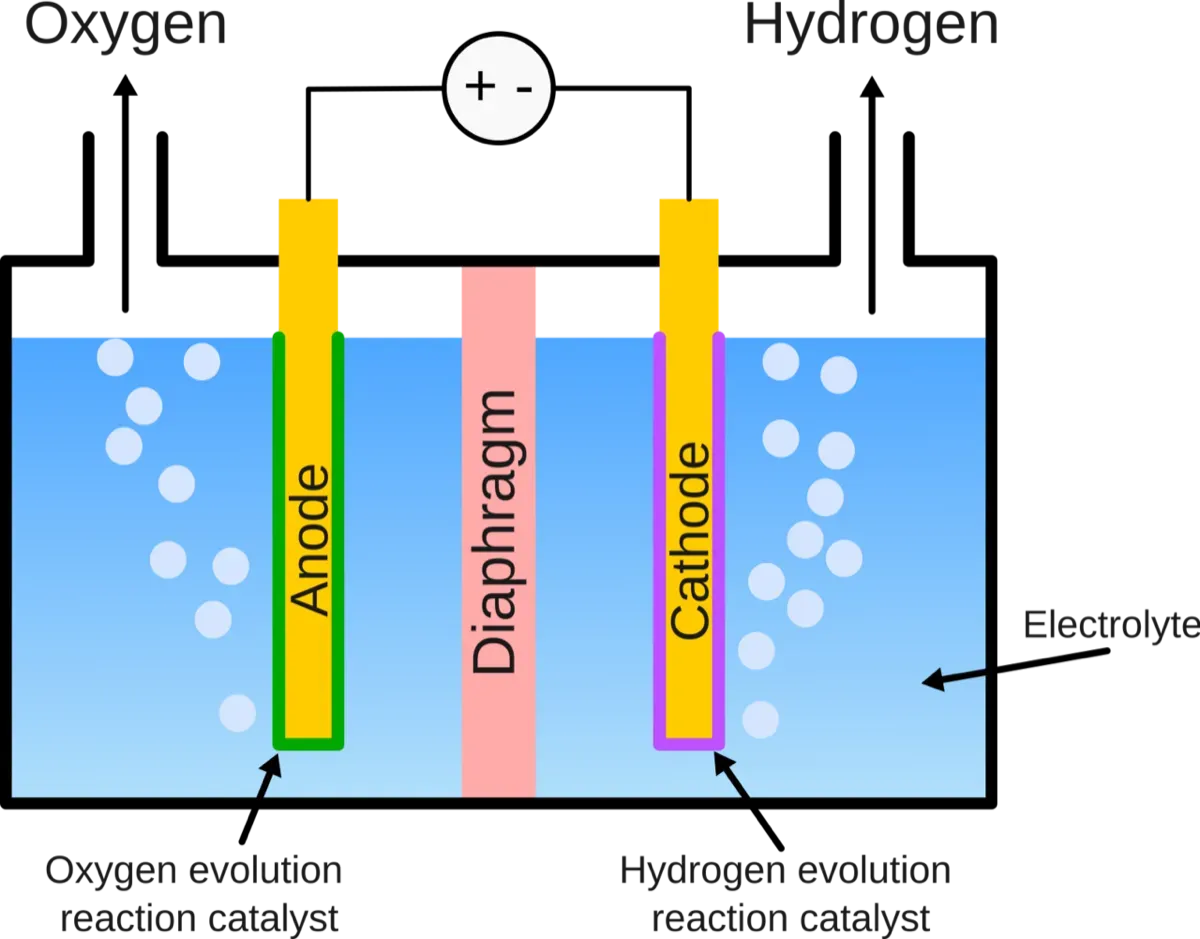
An electrolyser uses electricity to split water into hydrogen and oxygen. In the alkaline version:
- Electrolyte: water mixed with potassium hydroxide circulates through the stack.
- Electrodes: nickel-based electrodes on either side of a gas-tight separator carry the current. Unlike PEM electrolysers, alkaline stacks do not need iridium or platinum, two scarce metals.
- Splitting: hydrogen forms at the cathode and oxygen at the anode; the separator keeps the gases apart.
- Pressure: Sunfire runs the stack at 30 bar, so the hydrogen leaves already compressed. This cuts the size and energy use of downstream compressors.
- Balance of plant: gas separators, drying and purification, cooling and power electronics turn the raw gas into product hydrogen.
In the 50 MW module, key components such as rectifiers and gas treatment are centralised and the whole unit is designed for outdoor installation, which reduces buildings and site work. Each kilogram of hydrogen needs about 9 litres of purified water in theory, so water treatment is part of every project.
Timeline
| Date | Milestone |
|---|---|
| 2010 | Sunfire founded in Dresden |
| Jan 2021 | Sunfire acquires IHT, adding pressurised alkaline electrolysis |
| 5 Mar 2024 | €215 million Series E plus up to €100 million EIB loan |
| 11 Sep 2024 | RWE orders a 100 MW Sunfire electrolyser for GET H2 Nukleus in Lingen |
| 14 Apr 2026 | HyLink Alkaline 23 (50 MW) launched |
| 4 Aug 2026 | First hydrogen from Lingen reaches Evonik’s Marl chemical park |
| 17 Aug 2026 | 20 Sunfire stacks shipped by water to Lingen |
Impact and numbers
- Lingen: RWE is building a 300 MW electrolysis complex. Sunfire and Bilfinger supply the third 100 MW plant, made up of ten 10 MW modules, due for installation and commissioning in 2027 (RWE, 11 September 2024). On 4 August 2026 the first hydrogen from Lingen, produced during commissioning of the first two 100 MW plants, reached Evonik’s Marl site about 120 km away through converted pipelines; RWE plans full 300 MW operation from 2027 (RWE, 4 August 2026).
- Stack shipment: in August 2026 Sunfire shipped 20 stacks by inland waterway on a 340 km journey to Lingen (Global Hydrogen Review, 17 August 2026).
- Smaller references: Sunfire lists operating plants such as a 3.2 MW unit for the Austrian retailer MPREIS.
- Capital: in March 2024 Sunfire announced €215 million of new equity, an EIB loan of up to €100 million and access to about €200 million of approved grants, making it one of the best-funded electrolyser makers (Sunfire, 5 March 2024).
Honest caveats. Green hydrogen only cuts emissions if the electricity is genuinely renewable and additional; on a fossil-heavy grid it can be worse than grey hydrogen. The cost cut of “up to 50%” and the efficiency figures are Sunfire’s own claims, and the 50 MW module has no operating track record yet. Europe’s hydrogen market has grown more slowly than planned, several large projects have been cancelled or delayed, and electrolyser makers worldwide face strong price competition from Chinese suppliers. Sunfire’s growth depends on customers reaching final investment decisions, which in turn depends on subsidies and long-term offtake contracts.
What’s next
The next test is delivery at scale: commissioning the Lingen plant in 2027 and turning the 50 MW module into repeat orders in refining, ammonia and chemicals. EU tools such as the Hydrogen Bank auctions and national contracts for difference will shape how many projects reach construction. Sunfire’s parallel SOEC line, which targets about 37.5 kWh per kilogram where waste heat is available, could become relevant for steel, e-fuels and chemical sites.
Why it matters for Europe / green buyers
For industrial buyers, HyLink Alkaline is a European-made, pressurised electrolyser with a working order book in Germany. Delivering hydrogen at 30 bar saves compression costs, and avoiding iridium and platinum reduces exposure to scarce metals. Buyers should compare total installed cost rather than stack price alone, check guarantees on efficiency and degradation, and secure renewable power contracts before the hardware.
India is pursuing the same path at a larger scale. Its National Green Hydrogen Mission aims for 5 million tonnes a year by 2030, and the questions Europe faces about cost, renewable sourcing and buyers will decide whether those plans become plants.
Sources & image credits
- Sunfire, “Sunfire launches new 50-megawatt electrolyzer system for the next phase of industrial green hydrogen scale-up”, 14 April 2026: https://sunfire.de/en/news/sunfire-launches-new-50-megawatt-electrolyzer-system-for-the-next-phase-of-industrial-green-hydrogen-scale-up/
- Sunfire, “HyLink Alkaline 23” fact sheet (version July 2026): https://backend.sunfire.de/wp-content/uploads/2026/04/EN_HyLink-Alkaline-23_Fact-Sheet_Sunfire.pdf
- Sunfire, “Sunfire unveils new 50 MW electrolyzer system and highlights the strategic importance of green hydrogen for Europe”, 20 May 2026: https://sunfire.de/en/news/sunfire-unveils-new-50-mw-electrolyzer-system-and-highlights-the-strategic-importance-of-green-hydrogen-for-europe/
- Sunfire, “HyLink Alkaline electrolyzers”: https://sunfire.de/en/alkaline-technology/
- Sunfire, “Sunfire acquires Swiss alkaline electrolysis company IHT”, January 2021: https://sunfire.de/en/news/sunfire-acquires-swiss-alkaline-electrolysis-company-iht/
- Sunfire, “Sunfire secures more than EUR 500 million to accelerate its growth”, 5 March 2024: https://sunfire.de/en/news/sunfire-secures-more-than-eur-500-million-to-accelerate-its-growth/
- RWE, “RWE commissions Sunfire and Bilfinger to build third electrolyser plant for GET H2 Nukleus in Lingen”, 11 September 2024: https://www.rwe.com/en/press/rwe-generation/2024-09-11-rwe-commissions-sunfire-and-bilfinger-to-build-third-electrolyserplant-for-geth2-nukleus/
- RWE, “GET H2 Nukleus gains momentum: first hydrogen from Lingen reaches Marl”, 4 August 2026: https://www.rwe.com/en/press/rwe-generation/2026-08-04-get-h2-nukleus-gains-momentum/
- Global Hydrogen Review, “Sunfire ships 20 pressurised alkaline electrolyser stacks to RWE”, 17 August 2026: https://www.globalhydrogenreview.com/hydrogen/17082026/sunfire-ships-20-pressurised-alkaline-electrolyser-stacks-to-rwe/
- European Court of Auditors, Special report 11/2024, “The EU’s industrial policy on renewable hydrogen”, July 2024: https://www.eca.europa.eu/ECAPublications/SR-2024-11/SR-2024-11_EN.pdf
Images:
- “Alkaline water electrolyser” by Gary thelake, licensed CC BY-SA 4.0 (https://creativecommons.org/licenses/by-sa/4.0), via Wikimedia Commons: https://commons.wikimedia.org/wiki/File:Alkaline_water_electrolyser.png