The problem
Timber is renewable and stores carbon, which makes it popular for low-carbon buildings. But most engineered timber, such as cross-laminated timber (CLT) and glulam, is bonded with adhesive and fixed with screws and metal plates. That makes clean separation at the end of a building’s life very hard: the wood is usually downcycled into chipboard or burned for energy, and the stored carbon goes back into the air.
At the same time, Central European forests produce large amounts of timber that sawmills struggle to sell for construction: wood from storms, bark beetle damage, thinning and treetops. TRIQBRIQ says millions of cubic metres of this timber arise every year and much of it ends up as fuel (TRIQBRIQ system).
The product
TRIQBRIQ turns that low-grade wood into a masonry-style building block. Each BRIQ is machined from planed softwood battens of 83.3 by 83.3 mm, and the blocks are 250 mm high (DIBt approval). The WS25 system includes:
- BRIQ 25 and BRIQ 50: the basic wall blocks;
- BRIQ-B: beams for spans over openings;
- BRIQ-S: columns;
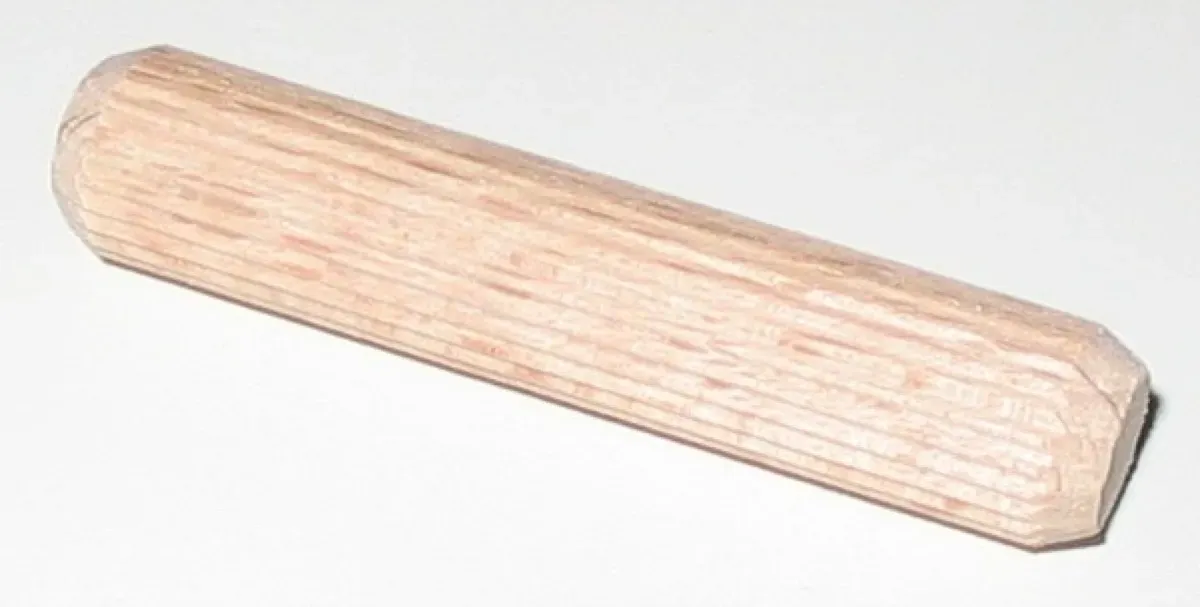
- beech dowels: inserted into blind holes to lock the courses together; dowel moisture at manufacture must not exceed 8%.
The Deutsches Institut für Bautechnik (DIBt) granted a general building approval and type approval, number Z-9.1-912, on 8 April 2024, valid until 2 November 2028. It covers load-bearing and bracing walls in service classes 1 and 2 (dry or sheltered conditions) with a clear wall height of up to 4.0 m.
Raw material comes from industrial and calamity timber bought from regional forestry businesses, plus reclaimed construction timber; one partner sawmill is 20 km from the Tübingen plant. BRIQs are delivered on Euro pallets under reusable covers, with no packaging waste (TRIQBRIQ production). Standard insulation, cladding and interior finishes are added as usual.
How it works
- Source: damaged and small-diameter timber is cut into battens at a regional sawmill and dried to 12 to 20% moisture.
- Machine: robots cut, drill and assemble the battens into BRIQs of standard geometry.
- Stack: on site, builders lay the BRIQs in a bond pattern, like bricks, with no drying time.
- Lock: beech dowels are driven through the courses, tying the wall into a solid timber shell.
- Finish: insulation, façade and interior linings go on as in any timber building.
- Reverse: at the end of the building’s use, the wall can be taken apart by type and the BRIQs reused in another building (TRIQBRIQ).
Timeline
| Date | Milestone |
|---|---|
| 8 Apr 2024 | DIBt approval Z-9.1-912 for the WS25 wall system |
| Early 2026 | Austrian licensee TRIQBRIQ AT GmbH active |
| 24 Jun 2026 | First fully automated production line presented in Tübingen |
| 18 Aug 2026 | Founders outline plans for up to 30 micro-factory cells in Germany |
| 2 Nov 2028 | Current DIBt approval expires unless renewed |
Impact and numbers
- Carbon storage: about 177 kg of CO2 per m² of wall, according to TRIQBRIQ’s EPD (TRIQBRIQ system).
- Factory: the new line is about 25 m long, has four cells and five KUKA robots, makes one BRIQ every 1 minute 30 seconds to 3 minutes 20 seconds, and can run for up to an hour without an operator; capacity is up to 100,000 BRIQs a year (TRIQBRIQ).
- Projects: single-family houses, a bungalow, rooftop extensions in Dresden, Konstanz and Ansbach, an extension in Bad Dürkheim, a Netto supermarket in Fulda and a pilot house in Panguipulli, Chile (TRIQBRIQ projects).
- Licensing: a company in Austria with two plants in the pipeline, a company founded in Sweden, sales building in Portugal, a pilot in Switzerland and talks in the US.
Honest caveats. The 177 kg figure is biogenic carbon stored in the wood, not a net life-cycle saving; it only stays out of the atmosphere while the BRIQs remain in use, and TRIQBRIQ did not publish the full EPD results on the pages used here. “Fully reusable” is a design claim: no TRIQBRIQ building has yet been dismantled and rebuilt elsewhere at scale, and reuse will depend on dowel removal, moisture history, damage and the paperwork needed to approve used blocks. The approval limits clear wall height to 4 m and use to service classes 1 and 2, so the system needs protection from the weather. A solid timber wall uses far more wood per m² than a timber frame, which raises questions if demand ever outgrows the supply of damaged timber. Capacity of 100,000 BRIQs a year is a maximum, not output. TRIQBRIQ is a start-up that is raising money through its own investment platform, and no revenue or volume figures were found.
What’s next
TRIQBRIQ plans decentralised production: compact robot cells set up directly at sawmills, either run by the company in Germany or bought by licensees abroad. The founders say they want up to 30 cells across Germany and are targeting housing associations and municipal landlords with repeat pipelines (Roland Berger). The real test will be a documented dismantling and reuse project, and renewal of the DIBt approval before November 2028.
Why it matters for Europe / green buyers
Europe is moving from embodied-carbon disclosure to limits: the EU Taxonomy and national rules already ask for life-cycle data, and the new Construction Products Regulation (EU) 2024/3110, applying since 8 January 2026, will bring environmental data and digital product passports to construction products (European Commission). A wall made of standard, uniquely shaped blocks is a good candidate for such passports, because each component can be counted and traced. For buyers, the questions are the wall build-up needed for fire, sound and insulation, the availability of local production, and who will own and take back the BRIQs at the end of use.
India has little timber to spare and a strong masonry tradition, so a solid wood wall is not a direct fit. But the principle of dry-jointed, dowelled or interlocking blocks that can be taken apart applies to local materials too, and Indian builders already use interlocking stabilised earth and waste-based blocks that need no mortar. TRIQBRIQ’s approval route shows how such systems can win formal acceptance from building authorities.
Sources & image credits
- TRIQBRIQ, home page: https://triqbriq.de/en/
- TRIQBRIQ, “TRIQBRIQ-System”: https://triqbriq.de/en/triqbriq-system/
- TRIQBRIQ, “Decentralized Production for TRIQBRIQ’s Industrial Scale-Up” (Jun 2026): https://triqbriq.de/en/swabian-timber-construction-start-up-on-a-growth-course/
- TRIQBRIQ, “Produktion”: https://triqbriq.de/produktion/
- Deutsches Institut für Bautechnik, general approval Z-9.1-912 for TRIQBRIQ WS25 (8 Apr 2024): https://triqbriq.de/wp-content/uploads/2024/04/Allgemeine-bauaufsichtliche-Zulassung-TRIQBRIQ-Holzbausystem-WS25.pdf
- Roland Berger, “A circular approach to timber construction” (18 Aug 2026): https://www.rolandberger.com/en/Insights/Publications/A-circular-approach-to-timber-construction.html
- TRIQBRIQ, “Projekte”: https://triqbriq.de/projekte/
- European Commission, “CPR 2024 revision”: https://single-market-economy.ec.europa.eu/sectors/construction/construction-products-regulation-cpr/cpr-2024-revision_en
Images:
- “Holzduebel-D10mm x L50mm” by User 1-1111 on de.wikipedia, licensed under CC BY-SA 3.0 (http://creativecommons.org/licenses/by-sa/3.0/), via Wikimedia Commons: https://commons.wikimedia.org/wiki/File:Holzduebel-D10mm_x_L50mm.jpg