The problem
Most first-generation biofuels are made from food crops such as rapeseed, maize or sugar cane, which competes with food for land. Waste fats such as used cooking oil avoid that problem, but they are traded globally, are limited in volume and have been hit by fraud scandals. Europe’s fuel rules now reward “advanced” biofuels made from listed residues that do not need extra land.
Forest industry side streams are one of the largest such residues in the Nordic countries. The question is whether they can be refined into fuels that meet the strict diesel standard and work in every engine, without felling more trees.
The product
UPM BioVerno diesel is a paraffinic, high-cetane, sulphur-free diesel with low aromatics. UPM says it is a pure hydrocarbon matching fossil diesel, with the same energy content, and can be used neat or blended in any concentration in all diesel engines (UPM BioVerno diesel). Its density at 15 °C is 805 to 820 kg/m³.
UPM BioVerno naphtha comes out of the same process. It can be blended into petrol or fed into steam crackers to make bio-based plastics for packaging, textiles, labels and car parts.
UPM also markets BioVerno to shipping. It says marine biofuels let operators cut CO2, eliminate sulphur dioxide, reduce nitrogen oxides by about 10% and halve fine particle emissions, and that biofuels could make up around 5 to 10% of marine fuel by 2030 (UPM BioVerno diesel). Unlike traditional biodiesel, there is no blending limit.
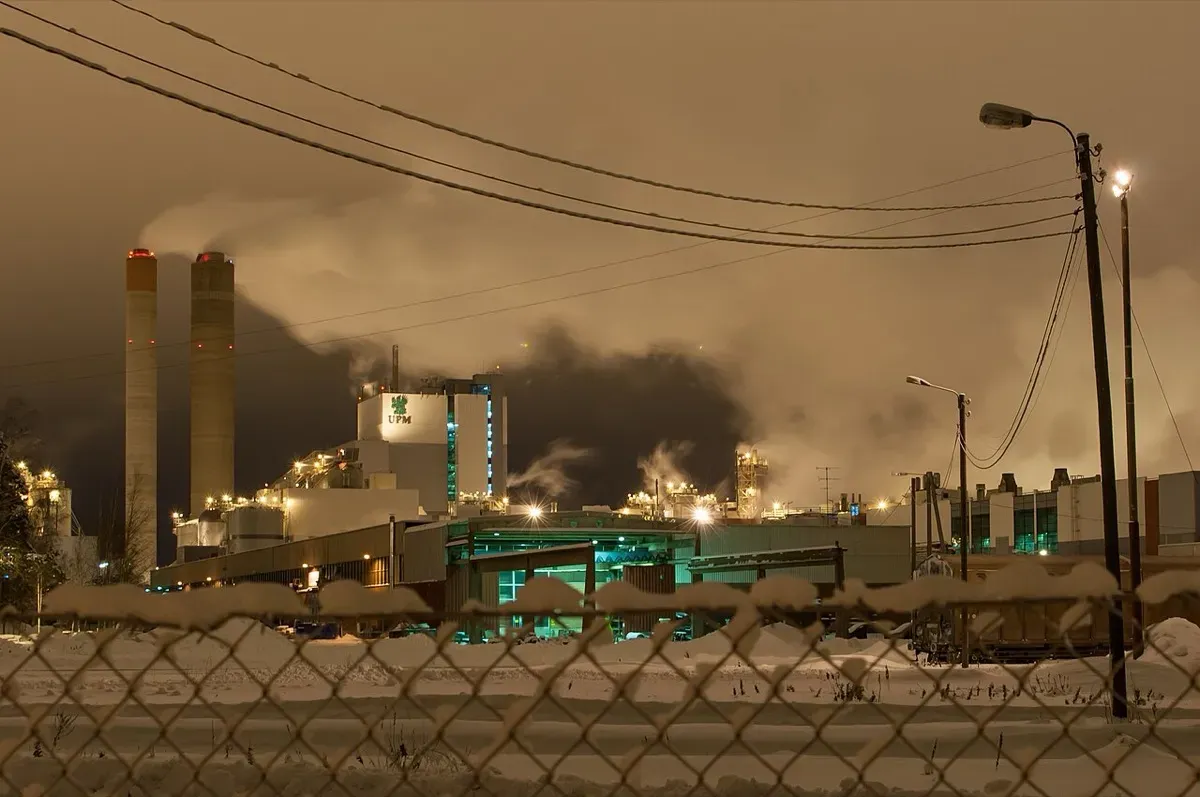
The feedstock is crude tall oil (CTO), a wood extract separated when softwood fibre is cooked into pulp. A substantial part comes from UPM’s own Finnish pulp mills, including the neighbouring Kaukas mill. UPM says using CTO does not increase wood use or cause extra felling (UPM Lappeenranta).
How it works
- Pulp: softwood is cooked in a kraft pulp mill; tall oil soap is skimmed from the spent cooking liquor and acidified into CTO.
- Deliver: CTO from UPM and other mills is brought to the biorefinery at Lappeenranta.
- Purify: the oil is cleaned to remove impurities that would poison catalysts.
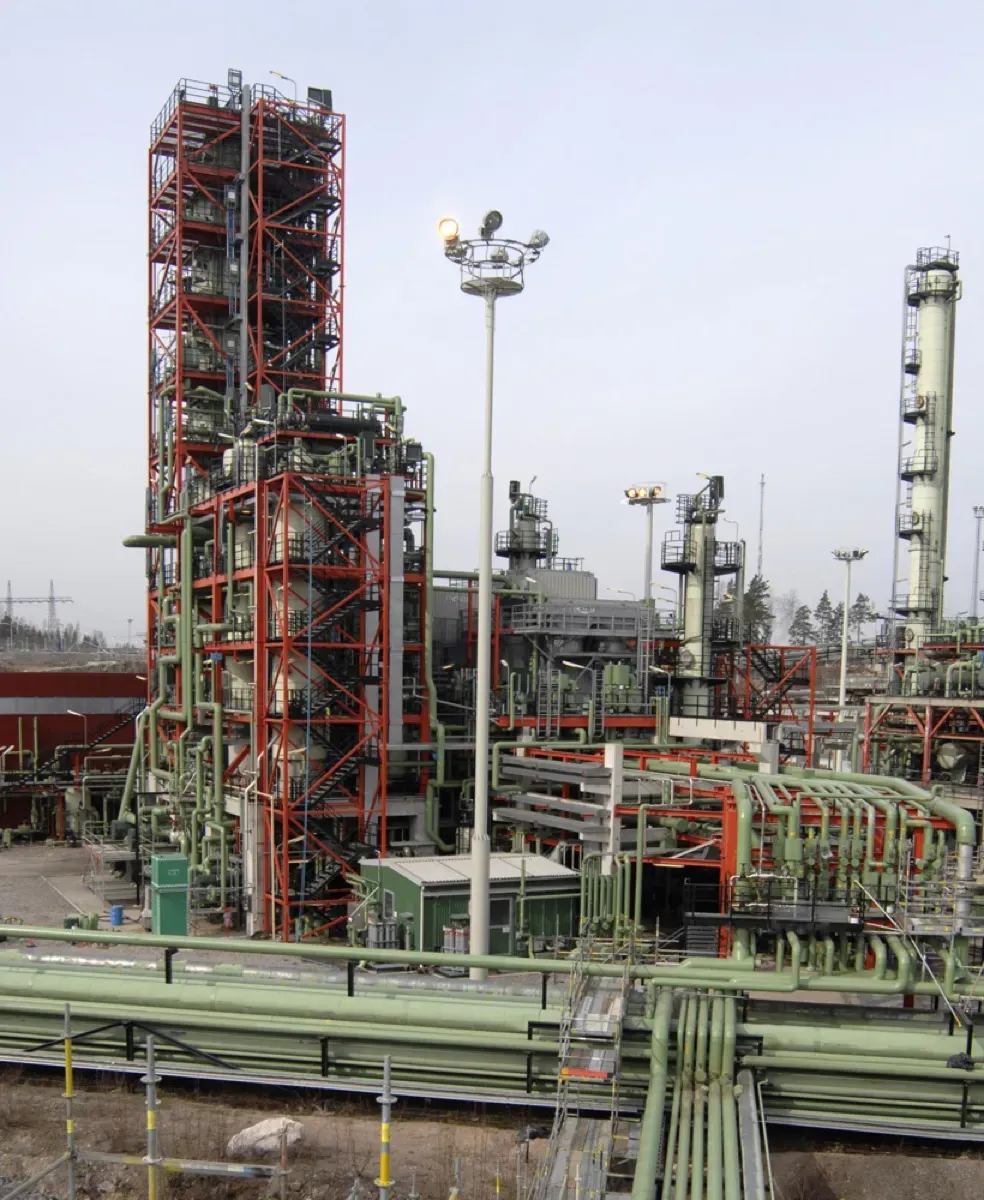
- Hydrotreat: a hydrotreatment process developed at the UPM Research Centre in Lappeenranta removes oxygen with hydrogen and cracks the molecules into diesel and naphtha ranges.
- Separate: the products are distilled into BioVerno diesel and BioVerno naphtha.
- Sell: diesel goes to fuel distributors as a blend component or as a 100% product; naphtha goes to fuel blenders and petrochemical plants.
Timeline
| Date | Milestone |
|---|---|
| 2015 | Lappeenranta Biorefinery starts as the first commercial-scale plant making wood-based renewable diesel |
| Apr 2025 | UPM marks ten years of production at about 130,000 tonnes a year |
| 27 May 2025 | UPM plans to discontinue its Rotterdam biofuels refinery project and focus on Lappeenranta |
| H1 2026 | Biofuels comparable EBIT of EUR 58 million, 35% of sales |
| Q3 2026 | Scheduled maintenance at the Lappeenranta biorefinery |
Impact and numbers
- Emissions: UPM says BioVerno diesel cuts life-cycle greenhouse gas emissions by over 80% compared with fossil diesel (UPM, 2025).
- Local air: UPM cites studies showing tailpipe particle mass, hydrocarbons, NOx and CO reduced by up to 10% compared with conventional diesel (UPM BioVerno diesel).
- Capacity: about 130,000 tonnes a year of diesel and naphtha; 100 direct and 150 indirect jobs; EUR 179 million invested.
- Profit: UPM’s Q2 2026 presentation reports strong biofuel results, with H1 2026 comparable EBIT of EUR 58 million, or 35% of sales, on “healthy bio premiums” (UPM Q2 2026).
Honest caveats. The 80% saving and the tailpipe figures are UPM’s own; buyers should check the certificate for each batch. Tall oil is not an unlimited waste: its volume depends on how much softwood kraft pulp is made, and it already has buyers in the pine chemicals industry, so burning it as fuel diverts it from adhesives, inks and other products rather than coming from nowhere. That is why UPM dropped the much larger Rotterdam project in May 2025 and is now looking at “low capex” debottlenecking and new feedstocks instead (UPM). At 130,000 tonnes a year, BioVerno is small: Neste’s renewable diesel output in the first half of 2026 alone was more than ten times larger. Its jet fuel version is not yet approved; ASTM qualification of CTO-based SAF is still under way. And like other drop-in diesels, it extends the life of combustion engines rather than replacing them.
What’s next
UPM’s stated plan has three parts: evaluate debottlenecking at Lappeenranta to squeeze out more volume cheaply; get CTO-derived fuel qualified as SAF under ASTM, building on trials with Diamond Aircraft and Austro Engine; and develop technology to use other sustainable biomass residues for road and aviation fuels. UPM calls the Lappeenranta plant “the nucleus” of its biofuels platform, so any growth will start there. In the near term, the Q2 2026 presentation lists a scheduled maintenance shutdown at the biorefinery in Q3 2026, which will trim this year’s volumes.
Why it matters for Europe / green buyers
Under RED III, member states must meet a combined sub-target for advanced biofuels and renewable fuels of non-biological origin, with feedstocks listed in Annex IX of the directive (EUR-Lex). Residue-based fuels like BioVerno help fuel suppliers meet those quotas without food crops. For buyers, the questions are availability (one plant, mostly sold into Nordic and EU markets), the certified GHG value for each delivery and the price premium over HVO from waste fats.
India has no tall-oil diesel. Its residue-based fuel effort is 2G ethanol from crop straw, where IndianOil’s Panipat plant, built on Praj technology, has struggled with straw quality and reached 62% of design capacity in December 2025 (ChiniMandi). With indicative SAF blending targets of 1% in 2027 and 2% in 2028 (PIB), Indian refiners will look at every residue, including paper mill side streams, that can be turned into drop-in fuels.
Sources & image credits
- UPM Biofuels, “UPM BioVerno diesel for fuels”: https://www.upmbiofuels.com/traffic-fuels/upm-bioverno-diesel-for-fuels/
- UPM Biofuels, “UPM Lappeenranta Biorefinery”: https://www.upmbiofuels.com/about-upm-biofuels/upm-lappeenranta-biorefinery/
- UPM Biofuels, “UPM Biofuels marks 10 years of pioneering renewable fuel production in Lappeenranta” (Apr 2025): https://www.upmbiofuels.com/whats-new/news/2025/04/upm-biofuels-marks-10-years-of-pioneering-renewable-fuel-production-in-lappeenranta-finland/
- UPM (Cision), “UPM sharpens its focus on biofuels growth strategy and plans to discontinue the Rotterdam Biofuels Refinery project” (27 May 2025): https://news.cision.com/upm-kymmene-oyj/r/upm-sharpens-its-focus-on-biofuels-growth-strategy-and-plans-to-discontinue-the-rotterdam-biofuels-r,c4155751
- UPM, CEO presentation Q2 2026 (PDF): https://www.upm.com/siteassets/investors/reports-and-presentations/2026/upm-ceo-presentation-q2-2026-final.pdf
- EUR-Lex, Directive (EU) 2023/2413 (RED III): https://eur-lex.europa.eu/eli/dir/2023/2413/oj/eng
- ChiniMandi, “India’s first 2G ethanol plant at Panipat costs ₹984 Crore, Government tells Lok Sabha” (2026): https://www.chinimandi.com/indias-first-2g-ethanol-plant-at-panipat-costs-%E2%82%B9984-crore-government-tells-lok-sabha/
- Press Information Bureau, SAF indicative blending targets: https://www.pib.gov.in/PressReleaseIframePage.aspx?PRID=1979705
Images:
- “UPM Kaukas paper and pulp mill” by Tuomas Vitikainen, licensed under CC BY-SA 3.0 (https://creativecommons.org/licenses/by-sa/3.0), via Wikimedia Commons: https://commons.wikimedia.org/wiki/File:UPM_Kaukas_paper_and_pulp_mill.jpg