The problem
Europe wants offshore wind to supply a large share of its electricity by the 2030s and to reduce its dependence on imported gas. But offshore wind farms are expensive to build: every turbine needs a foundation, cables, a long trip on a specialised vessel and decades of maintenance at sea. The industry’s main answer has been to build bigger turbines, so that fewer machines produce the same energy.
Bigger turbines also bring risk. Each new generation stretches blades, bearings and supply chains, and in recent years several manufacturers have had costly quality problems after scaling up too fast. At the same time, Chinese turbine makers are offering ever larger machines at lower prices. For European developers, the question has been whether a European-made 15 MW turbine could be delivered reliably and in volume.
The product
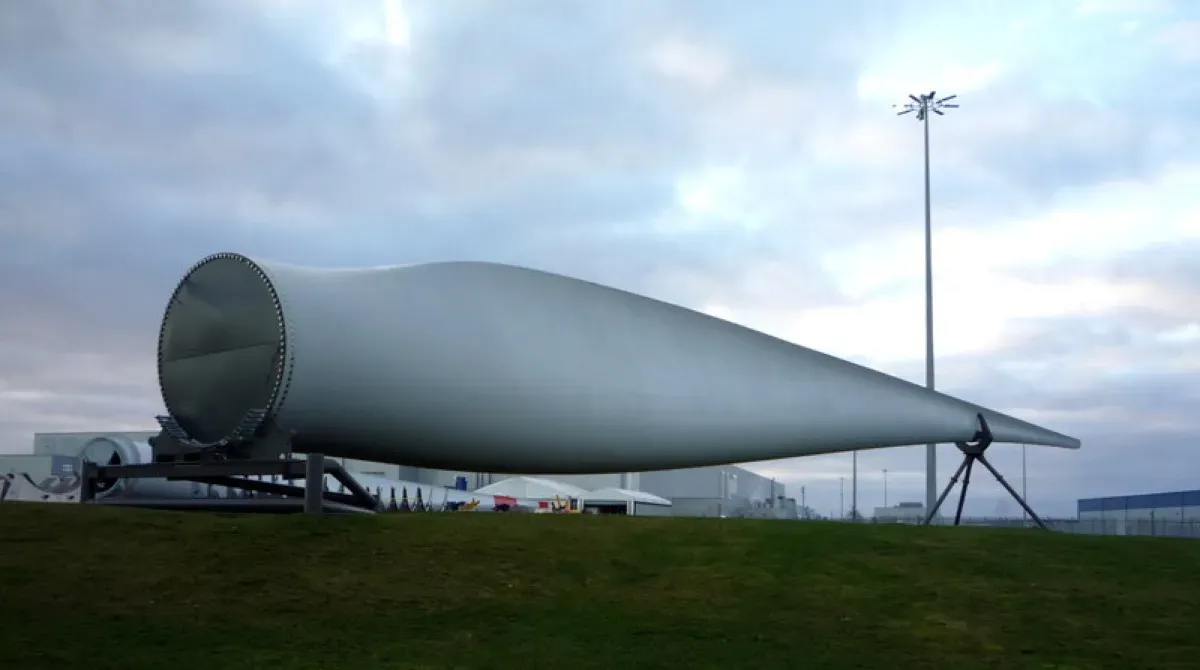
Vestas introduced the V236-15.0 MW in February 2021, calling it the first 15 MW turbine offered to the market. It combines technology from Vestas’s EnVentus onshore platform and its earlier 9 MW offshore platform. The rotor is 236 metres across and sweeps 43,742 square metres, with each 115.5 metre blade longer than a football pitch. Vestas says one turbine can produce up to 80 GWh a year depending on the site, with a capacity factor above 60%, and is designed for a 30-year life (Vestas).
The prototype was installed at Denmark’s Østerild national test centre in December 2022, reached its rated 15 MW three months later, and in August 2023 set a world record by producing 363 MWh in 24 hours. It received its type certificate in December 2023, confirming it was ready for commercial use (offshoreWIND.biz). Vestas says it has won more than 12 GW of orders for the model.
How it works
- Rotor: three 115.5 metre blades capture the wind; the pitch of each blade is adjusted continuously to control power and loads.
- Drivetrain: a medium-speed gearbox raises the slow rotor speed for a compact generator, a middle way between gearless direct-drive and high-speed designs.
- Power electronics: a full-scale converter turns the variable-frequency output into grid-quality electricity at 50 or 60 Hz.
- Operating range: the turbine starts generating at 3 m/s and shuts down above 31 m/s to protect itself in storms.
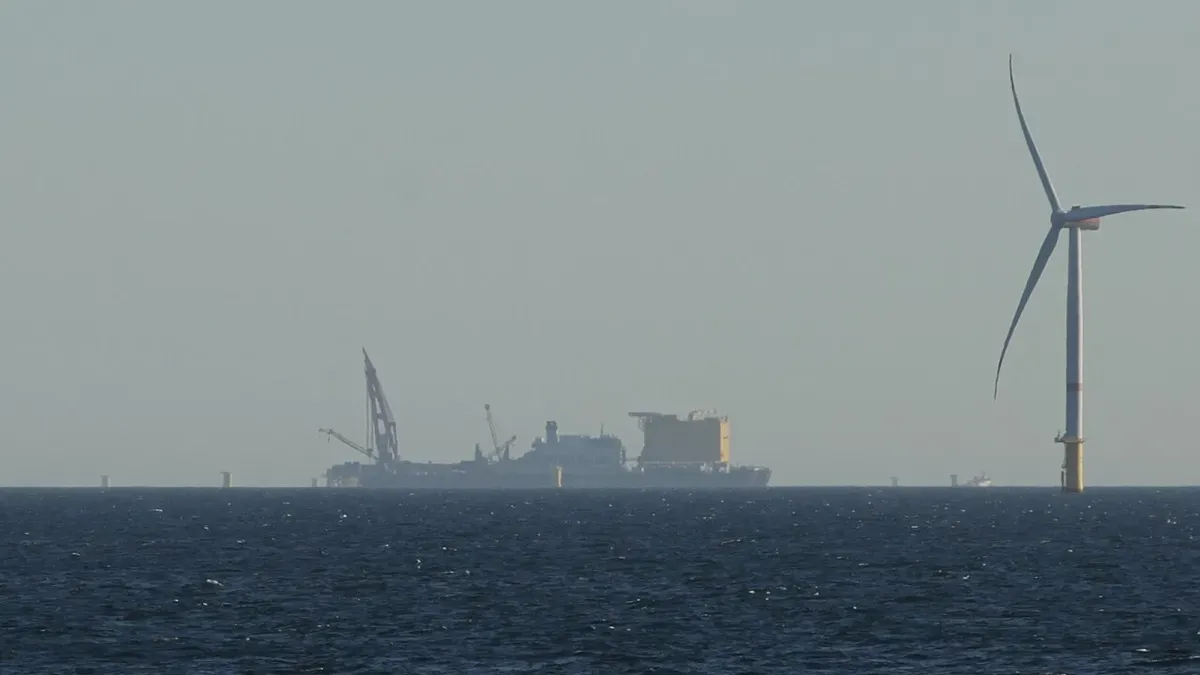
- Grid connection: at He Dreiht, turbines feed an offshore platform built by grid operator TenneT, which sends the power ashore through submarine cables.
Timeline
| Date | Milestone |
|---|---|
| Feb 2021 | V236-15.0 MW launched |
| Dec 2022 | Prototype installed at Østerild, Denmark |
| Aug 2023 | Prototype produces a record 363 MWh in 24 hours |
| Dec 2023 | Type certificate granted |
| 24 Apr 2025 | First commercial V236 installed at He Dreiht |
| Nov 2025 | He Dreiht feeds first power into the German grid |
| 10 Jul 2026 | First power from Poland’s Baltic Power wind farm |
| 22 Jul 2026 | Blade failure on one He Dreiht turbine |
| 12 Aug 2026 | All 64 He Dreiht turbines installed |
| 17 Sep 2026 | He Dreiht inaugurated; full commissioning expected in the following months |
Impact and numbers
- He Dreiht: 64 turbines with 960 MW of capacity, about 85 km northwest of Borkum, able to supply the equivalent of about 1.1 million households. EnBW invested around EUR 2.4 billion and sells the power through long-term contracts with companies including Google, Deutsche Bahn, Evonik, Salzgitter, Bosch and DHL, without state funding (EnBW).
- Scale per turbine: at a hub height of 142 metres, EnBW says one rotation of the rotor produces enough electricity to supply four households for a day.
- Poland: Baltic Power, built by Orlen and Northland Power, uses 76 V236 turbines for 1.2 GW. It delivered first power on 10 July 2026 and is expected to produce about 4 TWh a year. The nacelles and hubs are made at Vestas’s factory in Szczecin, which employs more than 600 people (Invest Szczecin).
- Company: in the second quarter of 2026, Vestas reported revenue of EUR 4.7 billion, an EBIT margin of 9.4% and a combined order backlog of EUR 76.9 billion, and raised its full-year profit guidance, citing improvements in both onshore and offshore (Vestas).
Honest caveats. On 22 July 2026, a blade failed on one of the He Dreiht turbines. EnBW said some activities were temporarily paused as a precaution and that work was not allowed on the affected turbine or on blades from the same production site, while basic commissioning continued. Vestas and EnBW were still investigating the root cause in August, although EnBW said it assumed a single issue with one blade (reNEWS). The incident is a reminder of the risks of scaling up quickly. The project was also later than first planned: Vestas’s 2023 order announcement expected commissioning in the fourth quarter of 2025, but full commissioning was still expected “in the coming months” at the September 2026 inauguration. Vestas’s offshore business was loss-making during the ramp-up, and Vestas has said it expects offshore to become profitable only in 2027. Finally, at 15 MW the V236 is no longer the largest turbine: Chinese makers have announced and tested machines well above 20 MW, which puts pressure on European prices.
What’s next
After He Dreiht’s full commissioning and Baltic Power’s completion in autumn 2026, Vestas has further V236 orders in the North Sea and Baltic. A planned blade factory in Szczecin is intended to supply V236 blades and deepen the Polish supply chain. The root cause of the He Dreiht blade failure, and whether it affects other blades, will be closely watched by developers and insurers.
Why it matters for Europe / green buyers
The V236 shows that Europe can still design, build and install the largest class of offshore turbines with a supply chain spread across Denmark, Germany, Poland and other EU states. Vestas’s chief executive Henrik Andersen said the project shows “Europe can turn ambition into action and keep control of our critical infrastructure”. For corporate buyers, He Dreiht is also a model of subsidy-free offshore wind financed by long-term power purchase agreements, which gives them price stability and verifiable renewable supply.
For India, which has targets for offshore wind off Gujarat and Tamil Nadu and a viability gap funding scheme, the V236 shows the scale of turbines that could be used, and the port, vessel and grid infrastructure needed to install them.
Sources & image credits
- Vestas, “V236-15.0 MW” product page: https://www.vestas.com/en/energy-solutions/offshore-wind-turbines/V236-15MW
- Vestas, “Vestas secures a 960 MW firm order of V236-15.0 MW wind turbines for EnBW’s He Dreiht offshore wind project”, 2023: https://www.vestas.com/en/media/company-news/2023/vestas-secures-a-960-mw-firm-order-of-v236-15-0-mw-wind-c3845287
- offshoreWIND.biz, “Record-Breaking Vestas 15 MW Offshore Wind Turbine Now Type-Certified”, 4 December 2023: https://www.offshorewind.biz/2023/12/04/record-breaking-vestas-15-mw-offshore-wind-turbine-now-type-certified/
- EnBW, “First EnBW He Dreiht wind turbine is now in place”, April 2025: https://www.enbw.com/press/enbw-he-dreiht-offshore-wind-farm.html
- Cadeler, “Cadeler installs final turbine at He Dreiht Offshore Wind Farm”, 12 August 2026: https://www.cadeler.com/news/cadeler-installs-final-turbine-at-he-dreiht-offshore-wind-farm
- EnBW, “Inauguration of He Dreiht wind farm”, 17 September 2026: https://www.enbw.com/press/inauguration-of-he-dreiht-wind-farm.html
- reNEWS, “‘Certain activities’ paused after He Dreiht blade failure”, 7 August 2026: https://www.renews.biz/offshore-wind/enbw-pauses-certain-activities-after-he-dreiht-blade-failure/
- Invest Szczecin, “Prąd z Baltic Power popłynął do sieci” (Power from Baltic Power reaches the grid), July 2026: https://invest.szczecin.eu/en/prad-z-baltic-power-poplynal-do-sieci-kluczowe-komponenty-farmy-powstaly-w-szczecinie/
- Vestas, “Interim Report, Second Quarter 2026”, 12 August 2026: https://view.news.eu.nasdaq.com/view?id=bfc47dac6643e7f36b68c58e4a405fd72&lang=en
Images:
- “Pioneering Spirit in Windfarm He Dreiht” by MikeTango, released under CC0 (http://creativecommons.org/publicdomain/zero/1.0/deed.en), via Wikimedia Commons: https://commons.wikimedia.org/wiki/File:Pioneering_Spirit_in_Windfarm_He_Dreiht.jpg