
The problem
Heavy-duty vehicles cause more than a quarter of greenhouse gas emissions from road transport in the EU, and over 6% of total EU emissions (European Commission). Most of that comes from big diesel tractors running between cities and logistics hubs.
Battery trucks have worked well in cities and regional distribution, but long haul is harder. A truck needs enough energy for a full day’s driving without losing too much payload to battery weight, and it needs to charge quickly enough to keep to tight delivery schedules. In 2025, only close to 5,000 of the 263,000 heavy trucks sold in the EU were zero-emission, a 1.9% share (ICCT).
The product
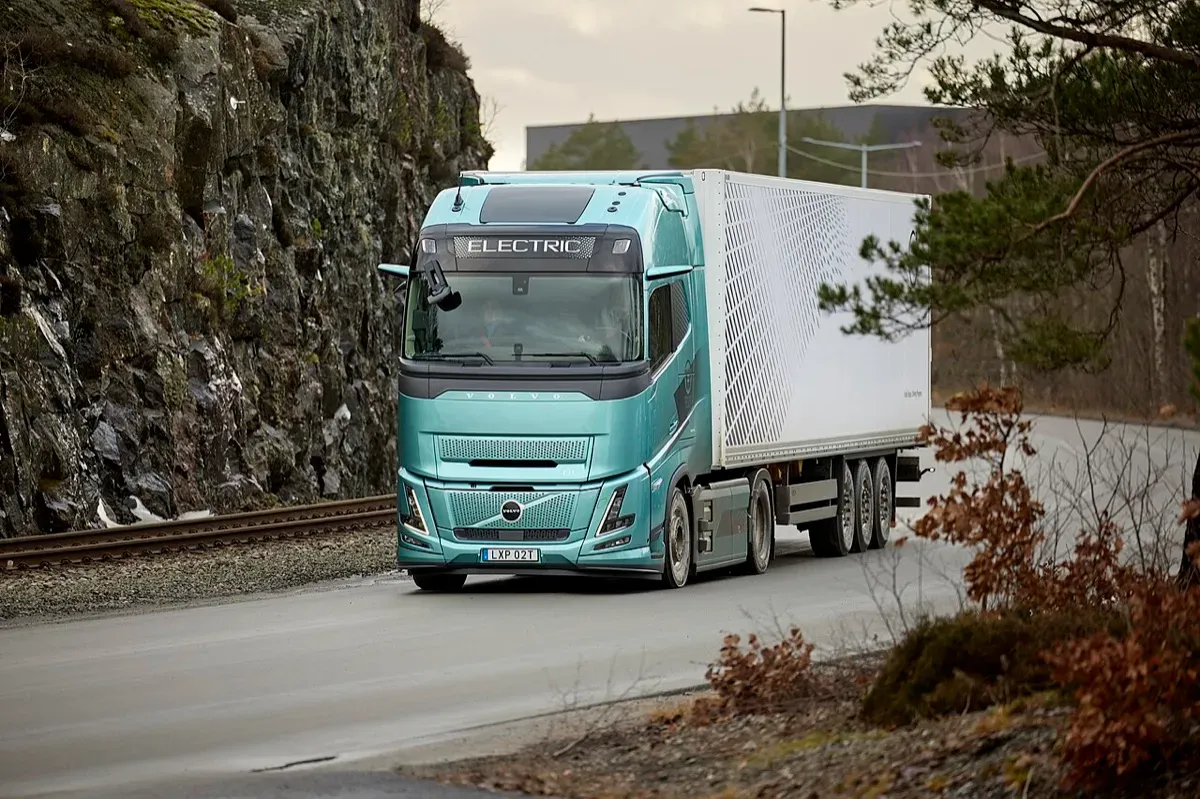
The Volvo FH Aero Electric is the electric version of Volvo’s aerodynamic FH Aero long-distance truck. It comes in two forms (Volvo Trucks):
- the standard version, with up to 460 kWh of usable battery energy, a gross combination weight of up to 65 tonnes and 350 kW CCS charging (20 to 80% in around 65 minutes);
- the extended-range version, launched in April 2026, in which a compact e-axle frees chassis space for six to eight battery packs and up to 725 kWh of usable energy.
The e-axle combines two electric motors, power electronics, a six-speed transmission and a 13-tonne axle in one unit, at 420 kW (570 hp) or 460 kW (625 hp). The extended-range truck is rated for up to 700 km per charge, a gross combination weight of up to 48 tonnes and a payload of up to 28 tonnes (Volvo Trucks, April 2026). It is adapted to the new Megawatt Charging System (MCS) standard at up to 700 kW. An electric power take-off can run refrigerated trailers without a separate diesel generator.
How it works
- Plan: the fleet sizes battery packs to the route, trading range against payload.
- Drive: the e-axle drives the rear wheels through a six-speed powershift gearbox.
- Recover: braking energy is fed back into the battery on descents and in traffic.
- Rest and charge: during the driver’s legal break, an MCS charger fills the battery from 20 to 80% in about 50 minutes.
- Fallback: where no MCS charger exists, a 350 kW CCS charger does the same in about 85 minutes.
- Power the load: the electric power take-off runs refrigeration units from the truck’s battery.
Timeline
| Date | Milestone |
|---|---|
| 2024 | Earlier FH Aero Electric model on the road (pictured) |
| 2025 | Volvo Trucks leads Europe’s heavy-truck market (16 t+) with a 19.0% share |
| 14 Apr 2026 | New generation launched, including the 700 km extended-range FH Aero Electric |
| 14 Sep 2026 | Series production starts at Tuve, Gothenburg; first customer deliveries begin |
| 14 to 20 Sep 2026 | New range shown at IAA Transportation in Hanover |
| Early 2027 | Related high-weight rigid FH Electric combination rolls out in Nordic markets |
Impact and numbers
- Range: up to 700 km on one charge for the extended-range FH Aero Electric, and up to 470 km for the next-generation FH, FM and FMX Electric (Volvo Trucks).
- Charging: Volvo says the MCS charge time means charging “can be done within the legislated rest period for truck drivers in the EU”, keeping productivity close to diesel.
- Scale of the maker: about 120,000 Volvo trucks were delivered worldwide in 2025, and Volvo offers eight electric truck models. In Europe it led the heavy-truck market in 2025 with a 19.0% share, and nearly 33,000 FH Aero trucks were ordered in Europe that year (Volvo Trucks via PR Newswire).
- Heavier loads: in September 2026 Volvo also presented an electric truck and trailer combination for 74 to 76 tonnes in Sweden and Finland, with 640 kWh usable battery and up to 420 km range (Heavy-Shift).
Honest caveats. The 700 km figure is a maximum: Volvo itself says range depends on weather, wind, total weight and driving style, and every extra battery pack adds weight that comes off payload. Volvo’s sources give slightly different specifications for the two versions (65 tonnes for the standard truck, 48 tonnes for the extended-range one), so buyers should check the exact configuration. The climate benefit depends on the electricity mix, and Volvo does not publish a life-cycle figure for this model in these sources. Megawatt charging is new and few public MCS sites exist yet; as Heavy-Shift notes, charging, more than the trucks, decides how much of the long-haul fleet can switch. Volvo is not alone: according to Heavy-Shift, Scania and MAN presented long-haul trucks claiming up to 720 km at the same show. And in 2025 Volvo’s zero-emission share of its own heavy-truck sales stayed at around 2%, while Mercedes became the largest seller of zero-emission heavy trucks in the EU (ICCT). Volvo also follows a “three-path” strategy that keeps hydrogen and renewable-fuel combustion trucks alongside battery models.
What’s next
The new trucks are being rolled out market by market from 2026, with production in both Gothenburg and Ghent. Volvo Trucks’ stated target is net-zero emissions by 2040. The bigger question is infrastructure: the speed at which MCS charging is built along Europe’s main freight corridors will set the pace of adoption.
Why it matters for Europe / green buyers
The EU’s revised CO2 standards for heavy-duty vehicles, Regulation (EU) 2024/1610, require new trucks to cut CO2 emissions per km by 45% from 2030, 65% from 2035 and 90% from 2040 (European Commission). Makers can only meet those targets if long-haul customers buy zero-emission trucks, so a 700 km truck built in Sweden and Belgium matters for both climate and European industry. For shippers buying freight, it means low-carbon long-distance transport is becoming a real option to ask carriers for.
In India, the government launched its first incentive for electric trucks under PM E-DRIVE in July 2025, with up to ₹9.6 lakh per vehicle and support for about 5,600 e-trucks. The minister noted that diesel trucks are about 3% of vehicles but 42% of transport greenhouse gas emissions, and named Volvo Eicher among Indian e-truck makers (PIB).
Sources & image credits
- Volvo Trucks, “Volvo starts series production of electric trucks with up to 700 km range” (14 Sep 2026): https://www.volvotrucks.com/en-en/news-stories/press-releases/2026/sep/volvo-starts-series-production-of-electric-trucks-with-up-to-700.html
- Volvo Trucks, “Volvo launches new electric trucks, with ranges up to 700 km” (14 Apr 2026): https://www.volvotrucks.com/en-en/news-stories/press-releases/2026/apr/volvo-launches-new-electric-trucks---with-ranges-up-to-700-km.html
- Volvo Trucks, “Volvo FH Aero Electric” product page: https://www.volvotrucks.com/en-en/trucks/electric/volvo-fh-aero-electric.html
- Heavy-Shift, “Volvo puts its 700 km electric truck into series production and adds an 80-tonne combination” (Sep 2026): https://heavy-shift.com/volvo-puts-its-700-km-electric-truck-into-series-production-and-adds-an-80-tonne-combination/
- Volvo Trucks via PR Newswire, “Volvo leads the market for heavy trucks in Europe” (2026): https://www.prnewswire.com/news-releases/volvo-leads-the-market-for-heavy-trucks-in-europe-302670942.html
- ICCT, “Race to zero: European heavy-duty vehicle market development quarterly (January to December 2025)”: https://theicct.org/publication/r2z-eu-hdv-market-development-quarterly-jan-dec-2025-mar26/
- European Commission, “Reducing CO2 emissions from heavy-duty vehicles”: https://climate.ec.europa.eu/eu-action/transport-decarbonisation/road-transport/reducing-co2-emissions-heavy-duty-vehicles_en
- Press Information Bureau, Ministry of Heavy Industries, “India Rolls Out First-Ever e-Truck Incentive Scheme” (11 Jul 2025): https://pmedrive.heavyindustries.gov.in/docs/press_release/PIB%20Release%20on%20Roll%20out%20of%20Guidelines%20for%20e-trucks%2011%2007%202025.pdf
Images:
- “Volvo FH Aero Electric (2024)” by Lars Ardarve, licensed under CC BY-SA 4.0 (https://creativecommons.org/licenses/by-sa/4.0), via Wikimedia Commons: https://commons.wikimedia.org/wiki/File:Volvo_FH_Aero_Electric_(2024).jpg
.jpg)