The problem
Tokamaks are the most studied route to fusion power, but conventional designs are huge. ITER, under construction in southern France with European, Indian and other partners, uses low-temperature superconducting magnets cooled with liquid helium to about 4 kelvin. Their field strength limits how compact the machine can be, and size drives cost and construction time.
The physics offers a lever. At a given ratio of plasma pressure to magnetic pressure, fusion power density rises roughly with the fourth power of the magnetic field. Double the field and, in principle, the same power fits in a much smaller device. High-temperature superconductors made of rare-earth barium copper oxide (REBCO) can carry large currents in very strong fields at about 20 kelvin. Until 2021, though, nobody had built a large-bore fusion magnet from them that worked at full scale.
The product
CFS was founded in 2018 by a team from MIT’s Plasma Science and Fusion Center to commercialise exactly this idea. Its product is the HTS toroidal field magnet: a D-shaped coil that wraps around the doughnut-shaped vacuum vessel of a tokamak. SPARC needs 18 of them, alongside poloidal field magnets and a central solenoid also built from HTS.
The design was proven by the Toroidal Field Model Coil (TFMC), tested with MIT. On 8 September 2021 CFS announced that the coil had reached a sustained field of more than 20 tesla, calling it the world’s strongest HTS magnet of its kind (CFS, 8 September 2021). A detailed synopsis presented at the IAEA in 2023 gives the numbers: a 9,270 kg magnet using 270 km of REBCO tape reached 20.3 T peak field on coil at 40.5 kA, with 110 MJ of stored energy, during its first full test on 5 September 2021 (IAEA 2023 synopsis).
How it works
Each SPARC TF magnet is a stack of 16 “pancakes”: flat steel plates with a spiral groove that holds many layers of HTS tape. Because the TF magnets carry steady current rather than pulses, CFS can leave out electrical insulation between turns. When the magnet is cold and charged, current follows the zero-resistance superconductor and ignores the surrounding metal. The tape also does not need to be twisted. CFS calls this NINT, and says it lets it build stronger, smaller magnets faster (CFS, 6 January 2026).
The 2021 test showed how robust the approach is. Lorentz loads above 800 kN per metre acted on the innermost tape stacks without degradation, the steel case absorbed stresses approaching 1 GPa, and the total cryogenic heat load was only 112 W at full current. The 32 internal joints between pancakes measured about one nano-ohm each at 20 K. Later campaigns deliberately triggered worst-case quenches at 31.3 kA to test resilience, and the data was used to validate the models behind the SPARC design.
Timeline
| Date | Milestone |
|---|---|
| 2018 | CFS founded by MIT scientists |
| 5 September 2021 | TFMC reaches 20.3 T at 40.5 kA in its first full test |
| Autumn 2021 | Further tests probe steady-state performance and deliberate quenches |
| June 2025 | Google agrees to buy 200 MW from CFS’s first ARC power plant |
| 22 September 2025 | Eni signs a power purchase agreement worth more than US$1 billion |
| December 2025 | First production SPARC TF magnet shipped from the Devens factory to the tokamak hall |
| April 2026 | SPARC about 75% complete; vacuum vessel halves and two TF magnets in the tokamak hall |
| September 2026 | SPARC cryogenic system reaches its 8 K target |
Impact and numbers
- Field and current: 20.3 T and 40.5 kA in a full-scale model coil, with 110 MJ stored energy.
- Efficiency: a cryogenic heat load of only 112 W at full current, showing how little cooling power HTS magnets need once cold.
- Manufacturing: CFS now runs a magnet production line. “We didn’t just make a single magnet. We made a whole manufacturing facility that can make many, many magnets,” said co-founder and Chief Science Officer Brandon Sorbom.
- Construction: SPARC was almost 80% complete in August 2026, with magnets being installed and support systems operating (CFS, 5 August 2026).
- Commercial demand: offtake agreements with Google (200 MW) and Eni (more than US$1 billion) for the first 400 MW ARC plant in Chesterfield County, Virginia (CFS and Eni).
Honest caveats. A magnet is not a power plant. In 2021 CFS said SPARC was on track to demonstrate net energy by 2025; that target has since moved to 2027, a reminder that fusion timelines slip. SPARC is designed to show Q>1, meaning more fusion power than heating power, not net electricity to the grid. Tritium breeding, materials that survive neutron bombardment and plant availability all remain to be proven. Most figures above come from CFS and its partners.
What’s next
The remaining TF magnets are being installed in SPARC, and CFS is preparing an integrated “dry dress rehearsal” of the machine before first plasma (Fusion Future). In parallel, the company has cleared US Department of Energy milestones for the ARC preconceptual design and technology roadmap, says ARC should deliver 400 MW of net electricity, and is working with the UK Atomic Energy Authority’s LIBRTI facility to validate tritium breeding. The aim is grid electricity from ARC in the early 2030s.
Why it matters for Europe / green buyers
CFS is American, but its story is tightly linked to Europe. Italy’s Eni is a long-standing investor and the largest offtaker so far, the UK’s fusion agency is a partner on fuel-cycle testing, and European HTS programmes, from Tokamak Energy in Oxfordshire to stellarator developers in Germany, are chasing the same magnet technology. The 2021 test gave the whole sector a public, peer-reviewed benchmark for what a large HTS fusion coil can do.
For European utilities, data-centre operators and policy makers, the lesson is to judge fusion on hardware milestones: measured field, current, stored energy, endurance and independent review. Firm offtake contracts tied to delivery are also a useful signal, as long as buyers keep in mind that first-of-a-kind plants carry real schedule risk.
Sources & image credits
- Commonwealth Fusion Systems, “CFS creates viable path to commercial fusion power with world’s strongest magnet”, 8 September 2021: https://www.cfs.energy/news-and-media/cfs-commercial-fusion-power-with-hts-magnet/
- “The SPARC Toroidal Field Model Coil Project” synopsis, IAEA Fusion Energy Conference 2023: https://conferences.iaea.org/event/316/contributions/27775/attachments/14226/23508/IAEA2023_TFMCSynopsis.pdf
- CFS, “CFS delivers its first fusion magnet, a stronger, smaller design”, 6 January 2026: https://blog.cfs.energy/cfs-delivers-its-first-fusion-magnet-a-stronger-smaller-design/
- CFS, “Our SPARC fusion facility is now about 75% done”, 9 April 2026: https://blog.cfs.energy/our-sparc-fusion-facility-is-now-about-75-done-take-a-virtual-tour-of-the-progress/
- CFS, “SPARC progress, DOE Milestone approvals reflect CFS power plant maturity”, 5 August 2026: https://blog.cfs.energy/sparc-progress-doe-milestone-approvals-reflect-cfs-power-plant-maturity/
- Fusion Future, “CFS confirms SPARC cryogenic system hits 8 Kelvin”, September 2026: https://fusion-future.com/news/cfss-sparc-cryogenic-system-hits-8-kelvin-target
- CFS, “Eni and Commonwealth Fusion Systems sign $1 billion+ power purchase agreement”, 22 September 2025: https://www.cfs.energy/news-and-media/eni-and-commonwealth-fusion-systems-sign-1-billion/
- CFS, “Google and Commonwealth Fusion Systems sign strategic partnership”, June 2025: https://www.cfs.energy/news-and-media/google-and-commonwealth-fusion-systems-sign-strategic-partnership/
Images:
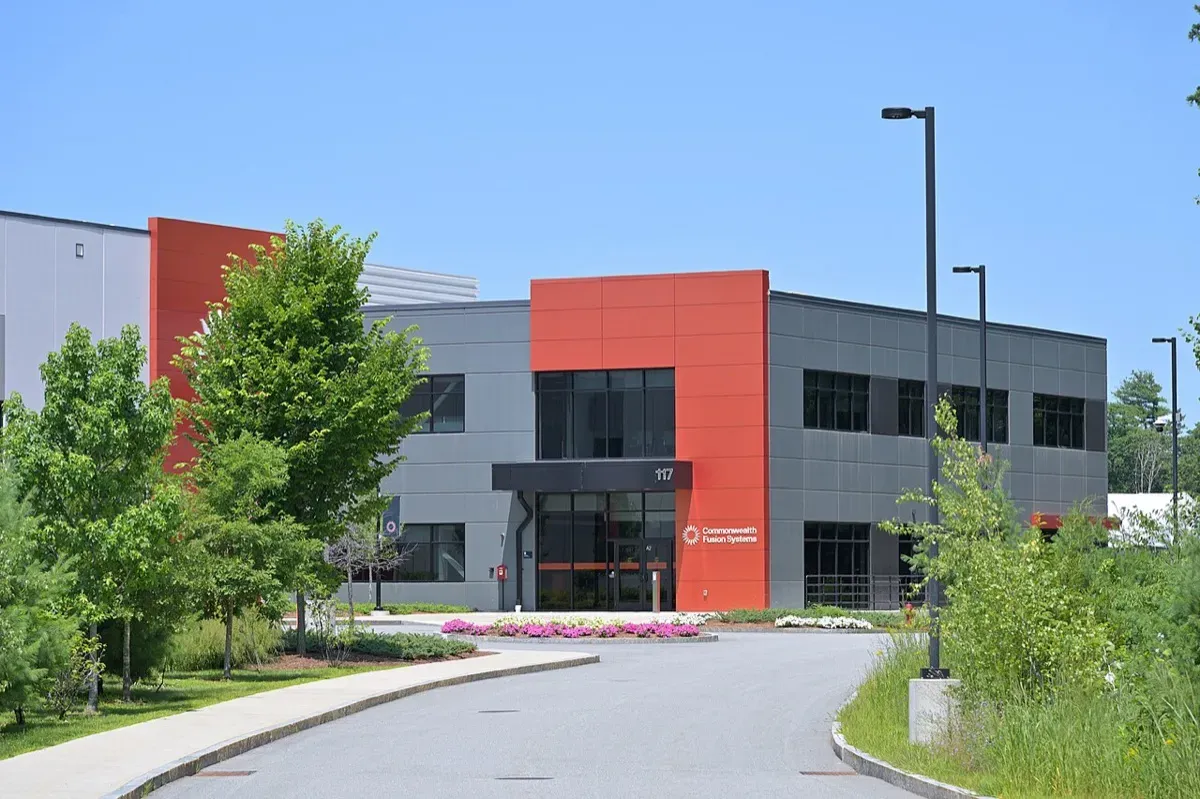
- “Commonwealth Fusion Systems headquarters, Devens, MA July 2026 1” by 4300streetcar, licensed CC BY 4.0 (https://creativecommons.org/licenses/by/4.0), via Wikimedia Commons: https://commons.wikimedia.org/wiki/File:Commonwealth_Fusion_Systems_headquarters,_Devens,_MA_July_2026_1.jpg