
The problem
Drones are becoming everyday tools for inspecting power lines, pipelines, solar farms and forests, and for moving urgent goods. Most use lithium-ion batteries, which in practice give about half an hour of flight, so large jobs need many take-offs, battery swaps and charging stops. Petrol-powered drones fly longer, but they are noisy, vibrate, wear out parts and burn fossil fuel (DMI).
A hydrogen fuel cell stores much more energy per kilogram than a battery and emits only water. The hard part for a drone is weight: fuel cell systems built for cars use heavy liquid cooling that a vertical-lift aircraft cannot afford.
The product
The DS30W is DMI’s second-generation hydrogen drone, an eight-rotor industrial aircraft designed for long-endurance missions. According to DMI (DMI):
- it can fly for up to 120 minutes and operate up to 80 km away;
- it carries a maximum payload of 3 kg;
- it uses a semi-monocoque structure to save weight, with propellers mounted on top of the body for thrust efficiency;
- arms and propellers fold with a one-touch system, and the drone fits in a dedicated travel case for an SUV, van or pickup;
- it lands at the nearest safe point or returns home when hydrogen runs low, and makes an emergency landing if communication becomes unstable.
The drone is powered by the DP30M2S fuel cell power pack, and the drone and power pack are sold separately, so operators can also fit the pack to other airframes (DMI). The DS30W won a CES Innovation Award in 2022.
How it works
- Load: a carbon composite hydrogen tank clips onto the drone; DMI says a tank can be swapped in under 5 minutes.
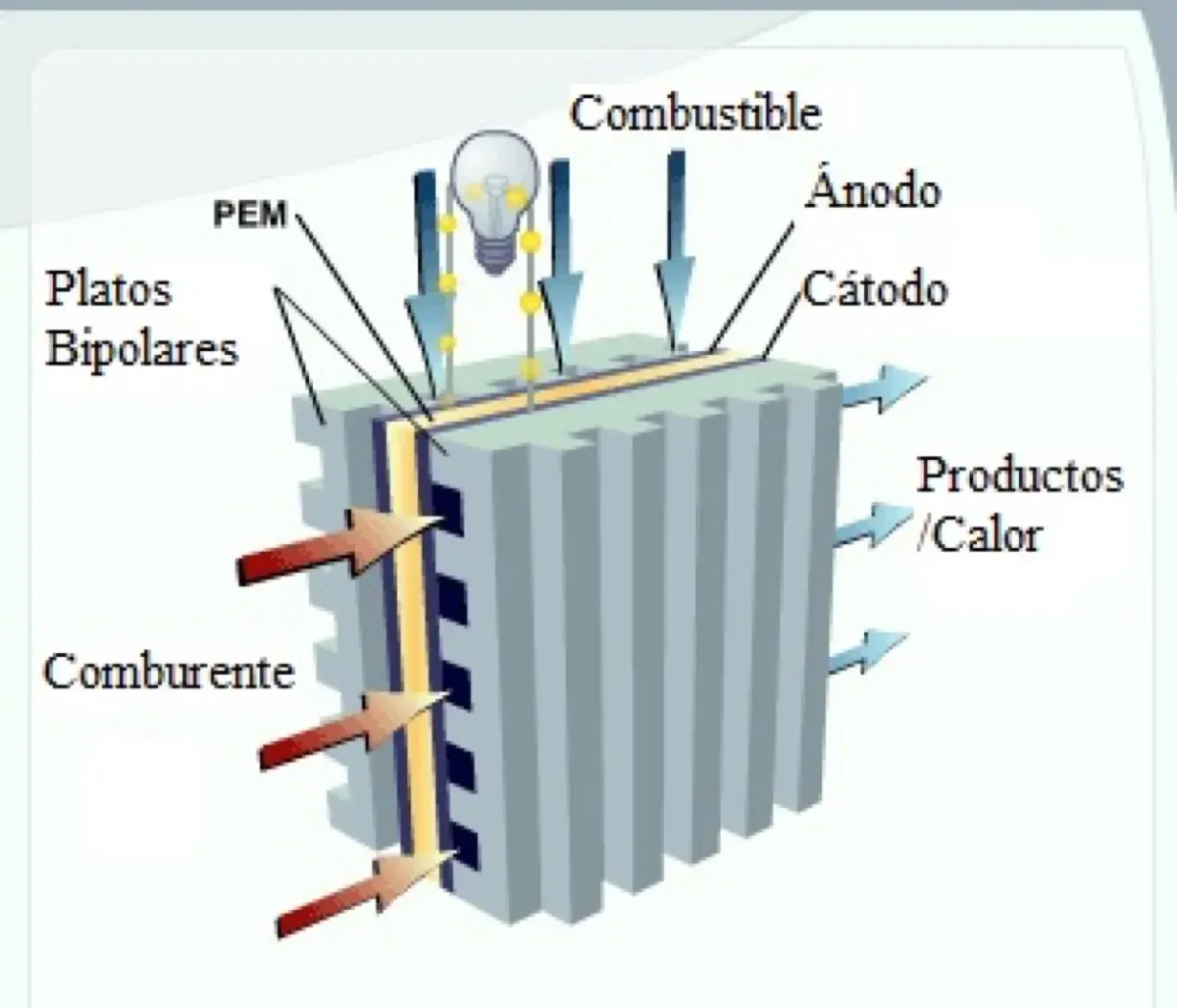
- React: the PEM fuel cell power pack combines hydrogen with oxygen from the air to produce electricity, water and heat.
- Cool: instead of the water cooling used in cars, DMI uses air recirculation to keep the stack at temperature while saving weight.
- Fly: electricity drives eight motors; the flight controller, a Cube Orange autopilot, follows planned routes.
- Monitor: power pack and flight data stream to DMI’s web ground control station and to the cloud, allowing remote monitoring and preventive maintenance.
- Refill: operators can order refilled hydrogen tanks for delivery to their site.
Timeline
| Date | Milestone |
|---|---|
| Oct 2019 | First-generation DS30 launched as a mass-produced commercial hydrogen drone |
| Nov 2019 | DS30 flies 43 miles of open ocean between St. Croix and St. Thomas, US Virgin Islands |
| Apr 2020 | Hydrogen drone delivers 15,000 masks to Gapa, Mara and Biyang islands off Jeju |
| 29 Oct 2021 | Second-generation DS30W launched for Europe in Den Helder, Netherlands |
| Jan 2022 | CES Innovation Award; delivery partnership signed with 42air |
| Jun 2026 | Doosan and LG CNS agree to scale hydrogen drone logistics |
Impact and numbers
- Design: the first DS30 took two and a half years to develop, and weighed about 20 kg with its tank. DMI said in 2019 that at 10 m/s it could cover 72 km on one fill, enough to reach any part of Seoul, and that it was working with Korea Electric Power Corporation on transmission tower inspection and with the state forest agency on monitoring pine trees for nematode disease (The Korea Herald).
- Open-ocean delivery: in November 2019 a DS30 carried 40 simulation vials and health supplies 43 miles from a testing facility on St. Croix to a hospital on St. Thomas, at an average 23 knots, with about 30 minutes of hydrogen left on landing. The project, with Skyfire Consulting and the US Virgin Islands Department of Health, grew out of the need for medical links after Hurricane Maria (DMI).
- Island relief: during the COVID-19 pandemic, with Jeju province, the drone delivered 15,000 masks, a three-month supply for 490 residents, to three islands with no pharmacy or post office, including an 8.8 km flight to Mara Island. Korea’s transport ministry granted a special waiver for the beyond-line-of-sight flights (Asian Surveying & Mapping).
- Endurance claim: DMI says hydrogen gives four to five times the flight time of battery drones and offers a warranty period of over 1,000 hours for the power pack.
- Logistics: in June 2026 Doosan Corporation and LG CNS agreed to build on a partnership that began in 2025 and create a framework for full deployment of a hydrogen fuel cell logistics business (The Korea Herald).
Honest caveats. DMI calls itself the world’s first maker of mass-produced hydrogen drones, but it does not publish production or sales numbers, so the scale of its fleet is unknown. Flight time is quoted without payload; with the 3 kg maximum load, endurance will be shorter. Payload figures also differ between sources: DMI’s own 2019 release on the Virgin Islands flight says the DS30 could handle up to 11 pounds, about 5 kg, against 3 kg for the DS30W today. Dates differ too: The Korea Herald reported an October 2019 launch for the DS30, while Dronewatch says it was announced in 2020. The Virgin Islands and Jeju flights were demonstrations or relief missions under special permissions, not routine services, and the 42air and LG CNS agreements are memorandums, not orders. Like any fuel cell product, the climate benefit depends on the hydrogen: most hydrogen sold today is made from natural gas.
What’s next
DMI is extending the same power packs to a hydrogen VTOL drone, the DJ25, which it says can fly for 5.5 hours, and to larger mobility uses such as construction machinery, ships and urban air mobility. With LG CNS, Doosan also plans to combine hydrogen drones, fuel cells and digital twins for autonomous maintenance of factories and large plants.
Why it matters for Europe / green buyers
The DS30W reached Europe on 29 October 2021, when DroneQ Robotics flew it at a meeting of the Maritime Emerging & Enabling Technologies Innovation Park (METIP) in Den Helder. DMI joined METIP and signed an agreement with METIP and DroneQ to test maritime and offshore uses such as inspecting offshore installations, search and rescue and urgent deliveries to platforms, using the possibilities of new European drone rules to support the North Sea energy transition (Dronewatch). For European wind farm, grid and port operators, a two-hour zero-emission drone could replace many helicopter and boat trips.
In India, the liberalised Drone Rules notified in August 2021 abolished many approvals, opened drone use to foreign-owned companies registered in India and promised special corridors for cargo deliveries, with the government saying India could become a global drone hub by 2030 (Hindustan Times). Long-range hydrogen drones fit Indian needs such as medicine delivery to hill and island communities and inspection of long pipelines and power lines.
Sources & image credits
- Doosan Mobility Innovation, DS30W product page: https://www.doosanmobility.com/en/products/drone-ds30/
- Doosan Mobility Innovation, hydrogen drone technology page: https://www.doosanmobility.com/en/technology/hydrogen-drone
- Doosan Mobility Innovation, “Doosan Mobility Innovation partners with CubePilot” (news): https://www.doosanmobility.com/en/about-us/news-events/news/21000436
- The Korea Herald, “[Hydrogen Korea] Doosan’s hydrogen drone pushes the limits” (23 Sep 2019): https://www.koreaherald.com/view.php?ud=20190923000788
- Doosan Mobility Innovation, “Hydrogen-powered drone completes 43-mile open-ocean flight” (Nov 2019): https://www.doosanmobility.com/en/about-us/news-events/news/20173303
- Asian Surveying & Mapping, “Doosan Mobility Innovation completed contactless drone delivery to remote islands without a proper mask supplier” (Apr 2020): https://asmmag.com/news/26371-doosan-mobility-innovation-completed-contactless-drone-delivery-to-remote-islands-without-a-proper-mask-supplier.html
- Dronewatch Europe, “New hydrogen drone from Doosan Mobility Innovation to help accelerate North Sea energy transition” (Nov 2021): https://www.dronewatch.eu/new-hydrogen-drone-from-doosan-mobility-innovation-to-help-accelerate-north-sea-energy-transition/
- PR Newswire, “Doosan Mobility Innovation and 42air sign MOU for hydrogen powered fuel cell drone delivery service at CES 2022” (Jan 2022): https://www.prnewswire.com/news-releases/doosan-mobility-innovation-and-42air-signs-mou-for-hydrogen-powered-fuel-cell-drone-delivery-service-at-ces-2022-301454681.html
- The Korea Herald, “Doosan, LG CNS link up for data centers, robotics and AI” (Jun 2026): https://www.koreaherald.com/article/10781871
- Hindustan Times, “Govt notifies liberalised drone rules to replace unmanned aircraft norms” (Aug 2021): https://www.hindustantimes.com/india-news/govt-notifies-liberalised-drone-rules-to-replace-unmanned-aircraft-norms-101629962961393.html
Images:
- “Marado Island View” by Rémi Cormier, licensed under CC BY-SA 3.0 (https://creativecommons.org/licenses/by-sa/3.0/), via Wikimedia Commons: https://commons.wikimedia.org/wiki/File:Marado_Island_View.jpg