The problem
Schoolyards, bus stops and squares are often sealed in asphalt and paving that can heat above 60 °C in summer. Trees are the best fix, providing shade and cooling through evaporation, but they need soil, space, years to grow and freedom from underground pipes and cables. In dense streets, there is often nowhere to plant them.
Children are especially sensitive to heat and dirty air. Germany’s federal building research institute BBSR reports that many classrooms exceed 30 °C in summer, and teachers’ unions cite studies showing concentration falls above 26 °C, as Green City Solutions notes in its project material. Cities want quick, visible measures that can be installed on hard surfaces.
The product
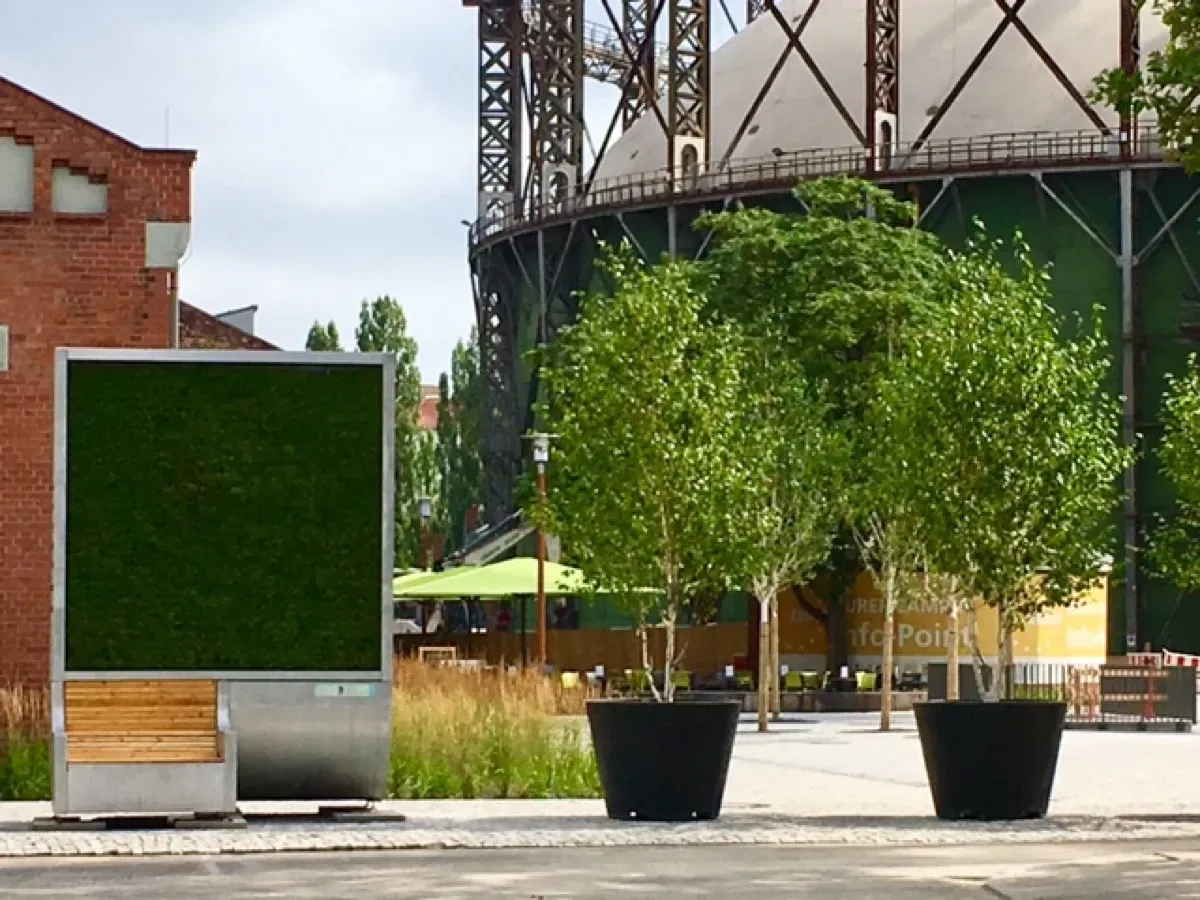
The CityTree, launched in 2014, is a free-standing wall about 4 m tall covered in living moss cultures. Fans draw air through the moss, which traps particles and evaporates water, cooling the air. Sensors monitor air quality, temperature and the moss’s health, and an automatic system waters it.
The EcoBreeze is the new solar-powered version. According to Green City Solutions, it:
- fits a 9 m² footprint and needs no groundwork;
- delivers the air-cleaning equivalent of 81 trees;
- has a cooling capacity of “up to 6,500 W/h” and reduces ambient temperature by up to 4 K nearby;
- feeds surplus solar power to its host building (Green City Solutions).
The first EcoBreeze was installed on 10 June 2026 in the schoolyard of Villa Elisabeth primary school in Wildau, Brandenburg, for about 120 pupils and 8 staff.
How it works
- Grow: moss cultures are grown at the company’s farm in Bestensee and mounted in panels.
- Draw in: fans pull street air through the moss panels.
- Filter: fine particles stick to the moss leaves; some pollutants are taken up by the plants and microbes.
- Cool: water evaporating from the moss lowers the temperature of the air passing through.
- Monitor: sensors track air quality, temperature and moisture, and irrigation keeps the moss alive.
- Power: in the EcoBreeze, rooftop solar panels run the fans and pumps, with surplus fed to the host site.
Timeline
| Date | Milestone |
|---|---|
| 2014 | First CityTree installed in Jena, Germany |
| 2018 to 2019 | Amsterdam trial on Valkenburgerstraat; units removed in June 2019 |
| 2021 | Cork City Council installs five CityTrees |
| 2021 | Modena study (Villani et al.) published in Atmosphere |
| 18 May 2025 | Cork removes its CityTrees after criticism over costs |
| 10 Jun 2026 | First solar EcoBreeze installed at a school in Wildau |
Impact and numbers
- Company claim: 81 trees of air-cleaning, up to 4 K cooling, under €0.29 per person per day for the school (Green City Solutions).
- Modena study: a CityTree in a Modena street canyon reduced PM10 and NOx by only 0.1 to 0.8% within a 10 by 20 m area in passive mode; with fans on, PM10 reductions near the unit rose to 1.5 to 15%, with no extra NOx benefit (Villani et al., Atmosphere, 2021). Peter Sänger was a co-author.
- Energy and water: the same study reported that the CityTree 2.0 uses about 120 to 150 W and 2 to 8 litres of water an hour.
- Amsterdam: a city trial found less than 1% particle reduction, part of the moss died, and the units were removed in 2019 (NRC).
Honest caveats. The evidence is weaker than the marketing. The “81 trees” figure is a company calculation for filtering capacity, not shade or long-term cooling, and is not independently verified. Peer-reviewed measurements show the effect on wider street air is small, though air right in front of the unit is cleaner and cooler. Amsterdam, Glasgow and Waltham Forest in London dropped their units (Wikipedia). In Cork, five CityTrees installed in 2021 for a reported €355,106 were removed on 18 May 2025 after criticism; total spending with transport and maintenance reached about €444,000 (Irish Examiner, Echo). The units need water, power and regular moss care. The EcoBreeze is new, and its cooling figure has not been measured independently. In a school with space, real trees and shade sails may give more cooling per euro over time. Where trees are impossible, the honest pitch is a small clean, cool zone and an education tool, not a city-scale fix.
What’s next
Green City Solutions is pitching the solar EcoBreeze to schools, bus stops, hospitals and event spaces, where its no-groundwork, rental approach cuts permits and upfront costs. The company says it has experience with school projects in Germany and the UK. The key next step would be independent measurement of the Wildau unit’s cooling and air effects through a full summer, ideally by a university or city team. Buyers should also watch how the rental contracts handle moss die-off, sensor data access and removal at the end of the term, since the Cork experience showed that storage and transport after a failed project can add real costs.
Why it matters for Europe / green buyers
The EU Nature Restoration Regulation, Regulation (EU) 2024/1991, requires no net loss of urban green space and urban tree canopy by 31 December 2030 compared with 2024, and an increasing trend afterwards (EUR-Lex). Cities will look for ways to add greenery on sealed surfaces, and moss filters will be offered as one. Buyers should treat them as a complement, not a substitute, for trees, and should set measurable targets in contracts, such as temperature reduction at a stated distance, independently monitored.
In India, many cities have hot, polluted streets where tree planting is hard. A unit that relies on moss, water and fans would struggle in a Delhi summer at 45 °C and under water shortages, and would need careful adaptation. Low-tech options such as shade structures, terracotta evaporative coolers and street trees are likely to give more cooling per rupee, but the idea of small, monitored “clean air zones” outside schools is relevant.
Sources & image credits
- Green City Solutions, “Green City Solutions installs solar-powered moss filter in Wildau” (published 8 Jul 2026): https://greencitysolutions.de/en/green-city-solutions-installs-solar-powered-moss-filter-in-wildau/
- Villani M.G. et al., “Evaluating the impact of a wall-type green infrastructure on PM10 and NOx concentrations in an urban street environment”, Atmosphere 12(7), 839 (2021): https://www.mdpi.com/2073-4433/12/7/839
- NRC, “Nepbomen in vieze Valkenburgerstraat weg: lucht werd niet schoner” (7 Jun 2019): https://www.nrc.nl/nieuws/2019/06/07/nepbomen-in-vieze-valkenburgerstraat-weg-lucht-werd-niet-schoner-a3962683
- Wikipedia, “CityTrees”: https://en.wikipedia.org/wiki/CityTrees
- Irish Examiner, “Planters replace Cork’s controversial ‘robotrees’ after €444,000 spend” (2025): https://www.irishexaminer.com/news/munster/arid-41663747.html
- The Echo, “‘Expensive benches’ a public relations failure as ‘CityTrees’ go into storage” (2025): https://www.echolive.ie/corknews/arid-41636857.html
- EUR-Lex, Regulation (EU) 2024/1991 on nature restoration: https://eur-lex.europa.eu/eli/reg/2024/1991/oj/eng
Images:
- “CityTree auf dem EUREF-Campus” by KarinTeichmann, 2017, licensed under CC BY-SA 4.0 (https://creativecommons.org/licenses/by-sa/4.0), via Wikimedia Commons: https://commons.wikimedia.org/wiki/File:CityTree_auf_dem_EUREF-Campus.jpg