The problem
Street trees cool streets, catch rain, clean the air and make walking pleasant. But a pavement needs compacted ground to carry people, vans and kerbs, and compacted ground is exactly what roots cannot grow through. Starved of soil volume, water and oxygen, many urban trees never reach full size. Roots that do find a way run just under the slabs, cracking paving and becoming a trip hazard, which in turn leads to trees being removed.
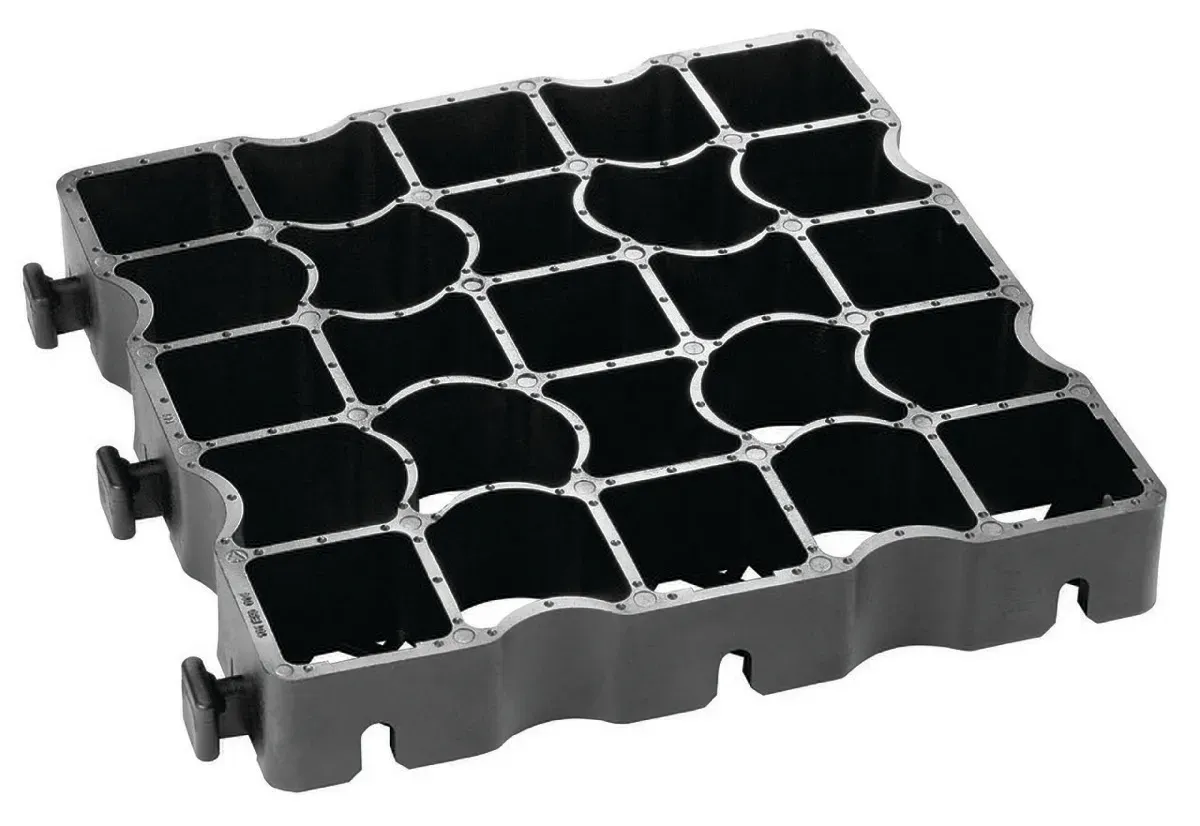
One older fix is structural soil, a blend of crushed stone and soil that can be compacted to carry paving; it works, but the stone takes up much of the volume that roots could use. Soil cells take the opposite approach: a rigid frame carries the load, so the soil inside can stay loose.
Cities across Europe now have canopy targets, and the trees planted to meet them will only deliver if they survive for decades rather than years.
The product
RootSpace is GreenBlue Urban’s structural soil cell system, designed in 2016 to create large volumes of uncompacted soil beneath paved surfaces while supporting the loads of pavements and infrastructure (GreenBlue Urban). Key points from the company:
- more than 95% void space, so nearly all of the frame volume can be filled with growing soil;
- an open lattice that lets roots reach the full soil volume;
- BBA certified, with high lateral strength;
- depths from 400 to 1200 mm, configurable around pipes, ducts and chambers;
- made in the UK from 100% recycled polypropylene and recyclable.
RootSpace is often combined with GreenBlue’s ArborSystem tree pit components and, where drainage is needed, its ArborFlow SuDS tree pits. The company is clear that the soil cell is not a drainage strategy by itself: inlets, storage, aeration and outlets must be designed together.
GreenBlue Urban is a family business based in Bodiam, East Sussex. It grew out of Greenleaf, founded in 1992, and has been developing soil cells since about 2000 (GreenBlue Urban, about).
How it works
- Excavate: a wide, shallow trench is dug along the street, often linking several tree positions.
- Build the frame: the modules are assembled into a continuous structure, around existing services.
- Fill: uncompacted, high-quality soil is placed inside the open lattice.
- Pave: a deck and the pavement go on top; the frame, not the soil, carries the load.
- Grow: roots spread sideways through connected soil, fed by aeration, irrigation and, in SuDS designs, runoff from the street.
Timeline
| Date | Milestone |
|---|---|
| 1992 | Greenleaf, GreenBlue Urban’s predecessor, founded |
| 2016 | RootSpace designed |
| 2019 | US study finds trees in soil cells grow larger than in compacted soil |
| 2024 | Sloane Street, London, completed with RootSpace |
| Feb 2026 | RootSpace installed in Enfield Town, London |
Impact and numbers
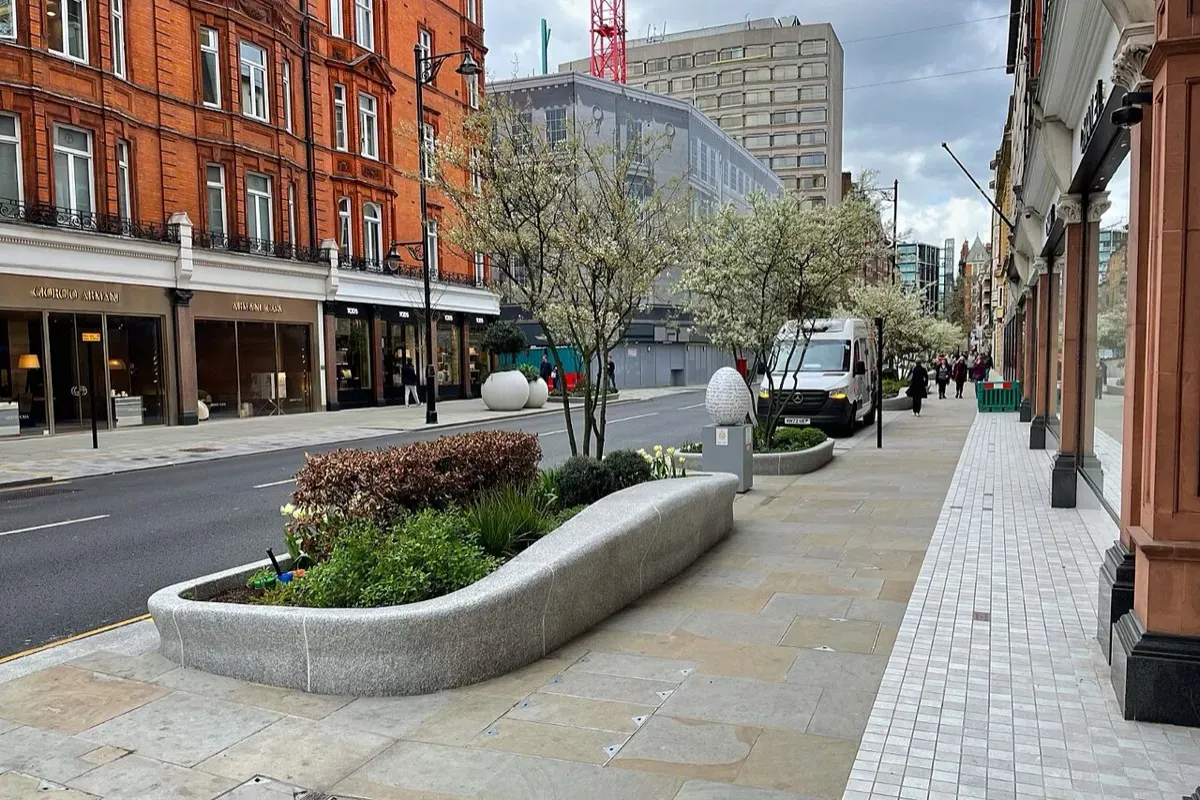
Sloane Street in Kensington and Chelsea is the showcase. Cadogan and the Royal Borough of Kensington and Chelsea delivered a GBP 46 million public realm scheme with more than 100 new street trees. The street is crowded with utilities and private basements, so excavation depth was limited; RootSpace was chosen because its shallow, modular frame could sit above basement slabs and around services. Tree grilles, ArborVent aeration, ArborGuy underground anchors and RootRain Urban irrigation completed the pits. FM Conway installed the system, and the scheme was completed in 2024 (GreenBlue Urban, Sloane Street).
Enfield Council in north London reported RootSpace being installed in Enfield Town in February 2026, as part of a regeneration scheme whose next phase started in May 2026 (Enfield Council).
Independent research backs the principle. A study by Smiley, Urban and Fite in Arboriculture and Urban Forestry (2019) found that trees grown in low-density soil under suspended pavement became larger and healthier than trees in compacted soil, and that compacted media under pavement subsided less (Journal of Arboriculture).
Honest caveats. That study tested Silva Cells and Stratacells, not RootSpace, so it supports soil cells in general rather than this product. GreenBlue’s project pages are marketing material, and no published monitoring of tree growth on Sloane Street was found; the trees are only a few years old. Soil cells are costly compared with a standard tree pit, and the trench is large, which is hard where services crowd the footway. They need good soil, sound design and aftercare; a frame full of poor soil will not grow a healthy tree. The frame is plastic, even if recycled, and stays underground for decades. Load claims depend on the specific build-up, as the company itself notes.
What’s next
The EU Nature Restoration Regulation (EU) 2024/1991 requires member states to ensure there is no net loss of urban green space or urban tree canopy cover by the end of 2030, compared with 2024, and an increasing trend after that (EUR-Lex). Cities that must add canopy in already-built streets will need ways to give trees soil under hard surfaces. Combining tree pits with drainage, so that street runoff waters the trees, is likely to become standard practice.
Why it matters for Europe / green buyers
For local authorities, the question is no longer how many trees are planted but how many survive to maturity. Buyers should ask for the soil volume per tree, the load design, a utilities plan, the soil specification and a maintenance budget. In England, sustainable drainage remains voluntary for most developments under the June 2025 non-statutory standards, so SuDS tree pits are still a choice rather than a requirement (New Civil Engineer).
In Indian cities, street trees often stand in tiny openings in concrete footpaths. During Bengaluru’s May 2025 storms, a branch fell and killed a man in Koramangala, one of several rain-related deaths that week (The New Indian Express). Not every failure is about roots, and strong winds were blamed. But cramped, sealed root zones weaken trees over time, and giving roots soil under footpaths is part of the answer to safer and healthier urban canopy.
Sources & image credits
- GreenBlue Urban, RootSpace structural soil system: https://uk.greenblue.com/products/soil-cells/rootspace/
- GreenBlue Urban, about us: https://uk.greenblue.com/about/
- GreenBlue Urban, project “Sloane Street, London”: https://uk.greenblue.com/project/sloane-street-london/
- Enfield Council, “Notification of upcoming works: Phase 2B”, Enfield Town: https://letstalk.enfield.gov.uk/enfieldtown/news_feed/notification-of-upcoming-works-phase-2b
- Smiley, E.T., Urban, J. and Fite, K., “Comparison of tree responses to different soil treatments under pavement”, Arboriculture and Urban Forestry 45(6), 2019: https://joa.isa-arbor.com/article_detail.asp?ArticleID=3490&IssueID=6&JournalID=1&VolumeID=45
- EUR-Lex, Regulation (EU) 2024/1991 on nature restoration: https://eur-lex.europa.eu/eli/reg/2024/1991/oj/eng
- New Civil Engineer, “Experts ‘disappointed’ drainage regulation update still does not make SuDS mandatory” (23 Jun 2025): https://www.newcivilengineer.com/latest/experts-disappointed-drainage-regulation-update-still-does-not-make-suds-mandatory-23-06-2025/
- The New Indian Express, “SWD project: BBMP secures Rs 1,600 crore World Bank loan” (23 May 2025): https://www.newindianexpress.com/cities/bengaluru/2025/May/23/swd-project-bbmp-secures-d1600-crore-world-bank-loan
Images:
- “Sculpted planters on Sloane Street” by Philip Jeffrey, geograph.org.uk, licensed under CC BY-SA 2.0 (https://creativecommons.org/licenses/by-sa/2.0), via Wikimedia Commons: https://commons.wikimedia.org/wiki/File:Sculpted_planters_on_Sloane_Street_-_geograph.org.uk_-_8006427.jpg