The problem
Germany converted about 50 hectares a day into settlement and transport land between 2021 and 2024, well above the national goal of less than 30 hectares a day by 2030. About 45% of settlement and transport land is sealed, meaning covered by buildings, asphalt, concrete or paving (Umweltbundesamt). Sealed soil cannot absorb rain, recharge groundwater, store carbon or support life, and it heats up in summer.
Car parks, driveways, overflow parking and fire lanes make up a large share of that sealed area, even though many of them are used only part of the time. They need to carry vehicles, but they do not need to be watertight.
The product
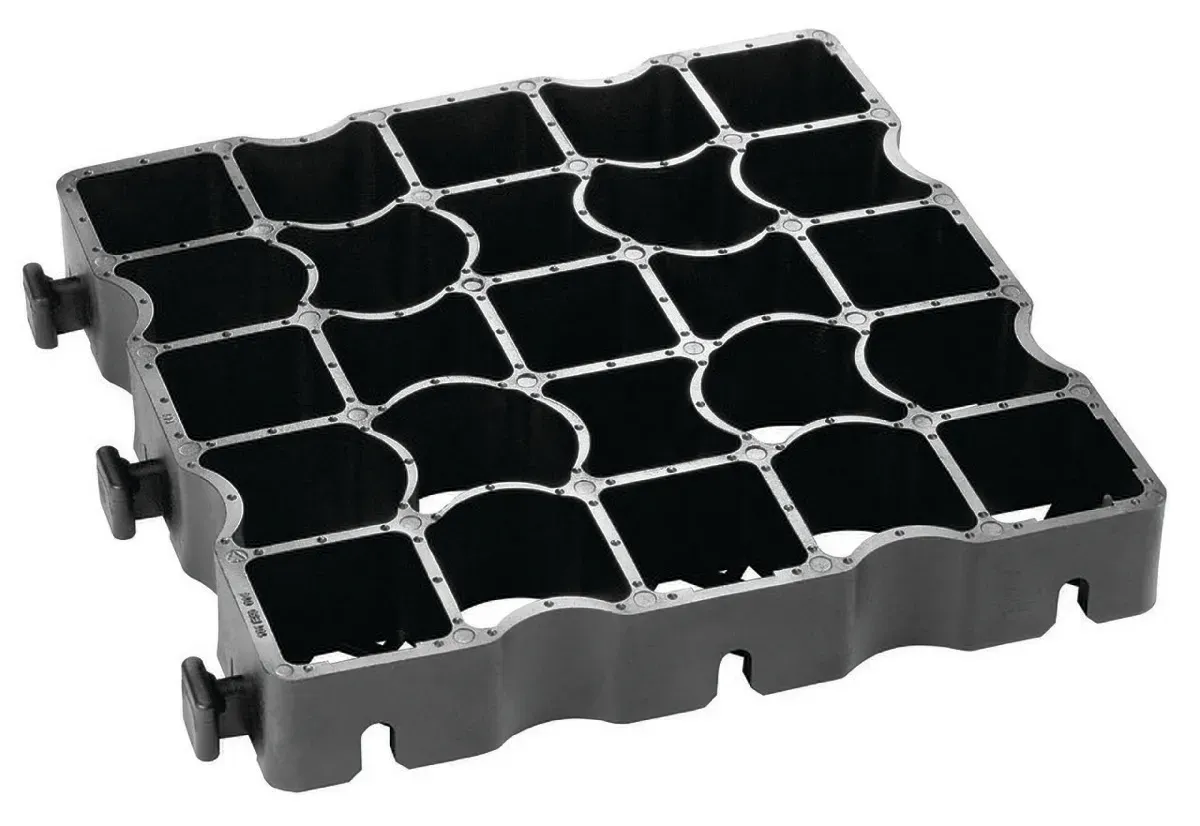
ECORASTER is a permeable ground reinforcement system: plastic grids that lock together and are filled with soil and grass, gravel or paving stones. PURUS says the grids are made from recycled plastic, carry loads up to 800 t/m², come with a 20-year material warranty, work from minus 50 to plus 90 °C and can be laid at about 80 m² per hour (PURUS).
The E50, the standard tile, has these specifications (PURUS, E50):
- size 33.3 x 33.3 x 5 cm, with walls up to 5 mm thick;
- 0.98 kg per tile, about 8.82 kg per m²;
- about 57 m² per pallet;
- fill options branded Green (grass), Microgreen, Mineral (gravel) and Bloxx (paving stones).
The design includes integrated expansion joints, added in 2001, so large areas can move with heat and cold without buckling, and a click connection that resists lifting.
PURUS PLASTICS was founded in 1994 as a family firm in Arzberg, in Upper Franconia near the Czech border, and launched ECORASTER the same year (PURUS, success story). In July 2022 the Bremen-based recycling and logistics firm Dettmer Group took full ownership. At the time PURUS processed about 30,000 tonnes a year of plastic waste, mainly PP, HDPE and LDPE from Germany’s dual-system packaging collection, had revenue of EUR 25.7 million in 2020 and more than 100 staff, and planned a EUR 30 million investment to double its recycling capacity, with construction from early 2023 and start-up in 2024 (EUWID).
How it works
- Prepare: the ground is excavated and a load-bearing base of gravel is laid and compacted, sized to the expected traffic.
- Lay: the tiles are clicked together on a levelling layer, by hand.
- Fill: the cells are filled with a soil and grass mix, gravel or stones.
- Drive: cars and lorries run on the fill, while the grid spreads the load and stops ruts.
- Infiltrate: rain soaks through the fill and the base into the soil, instead of running into drains.
Timeline
| Date | Milestone |
|---|---|
| 1994 | PURUS PLASTICS founded in Arzberg; ECORASTER launched |
| 2001 | Integrated expansion joint added |
| Jul 2022 | Dettmer Group takes full ownership; EUR 30m recycling expansion planned |
| 2024 | Planned start-up of expanded recycling capacity |
| 16 Dec 2025 | EU Soil Monitoring Directive enters into force |
Impact and numbers
- Recycled plastic: about 8.8 kg per m² of surface, so a 1,000 m² car park uses close to 9 tonnes of recycled packaging plastic.
- Recycling scale: about 30,000 tonnes of plastic waste processed a year in 2022, with capacity planned to double.
- Soil: a grassed ECORASTER car park keeps a living soil surface, unlike asphalt.
Honest caveats. The headline claims (800 t/m², 20-year warranty, environmental neutrality) come from PURUS and were not checked against independent tests here. PURUS describes the material differently on different pages: recycled LDPE on one page and a polyolefin PE-PP blend on the E50 page. Plastic grids in soil raise fair questions about long-term abrasion and microplastics, especially where snow ploughs or heavy traffic scrape the surface; no independent study of this for ECORASTER was found. Grass in grids struggles in shade and under daily parking, so heavily used spaces often end up gravel-filled. Permeable surfaces also need a suitable sub-base and soil, and are not suitable where fuel or chemical spills are likely. A recycled plastic product is only as green as the fossil plastic economy that feeds it.
What’s next
The EU Soil Monitoring Directive, Directive (EU) 2025/2360, entered into force on 16 December 2025. It obliges member states to monitor soil health, including land take and soil sealing, and sets out principles to mitigate the impact of land take, such as limiting sealing and using permeable surfaces (EUR-Lex). As cities map sealed land more carefully, unsealing car parks and choosing permeable surfaces for new ones is an easy win. For PURUS, the expanded recycling line should also mean more tiles from German household waste.
Why it matters for Europe / green buyers
Germany offers a direct money signal. Many German municipalities split their wastewater charges and bill rainwater separately, by the square metre of sealed or partly sealed area that drains to the sewer. Permeable surfaces are often charged at a reduced rate or not at all, depending on local rules, so a grassed or gravel grid can pay back over the years on a large site. The “Schwammstadt”, or sponge city, idea in German urban planning points the same way: keep rain where it falls.
For a municipality, supermarket or logistics park, permeable grids can cut drainage costs and stormwater fees, and help meet local rules that cap sealed area. Buyers should check the traffic class, sub-base design, fill choice, the recycled content declaration and how the surface will be maintained.
In India, the same logic applies to parking and walkways rather than main roads. Experts quoted by Citizen Matters argue that roads cannot be made permeable safely, but walkways and parking can, and point to grid mats sold by Bengaluru’s Pothole Raja (Citizen Matters). Bengaluru’s Climate Action Plan aims for 40% of the city’s surface to be permeable by 2040 (NbS4India). Grids made from India’s own plastic waste could help, if their quality and load ratings are proven.
Sources & image credits
- PURUS PLASTICS, ECORASTER permeable ground reinforcement: https://www.purus-plastics.com/ecoraster/ecoraster-permeable-ground-reinforcement/
- PURUS PLASTICS, ECORASTER E50 product page: https://www.purus-plastics.com/ecoraster/product-overview/ecoraster-e50/
- PURUS PLASTICS, company success story: https://www.purus-plastics.com/company/success-story/
- EUWID Recycling, “Dettmer kauft Kunststoffrecycler Purus Plastics” (Aug 2022): https://www.euwid-recycling.de/news/wirtschaft/dettmer-kauft-kunststoffrecycler-purus-plastics-020822/
- EUR-Lex, Directive (EU) 2025/2360 on soil monitoring and resilience: https://eur-lex.europa.eu/eli/dir/2025/2360/oj/eng
- Umweltbundesamt, “Bodenversiegelung”: https://www.umweltbundesamt.de/daten/umweltzustand-trends/flaeche-boden-land-oekosysteme/boden/bodenversiegelung
- Citizen Matters, “Rethinking road infrastructure: road designs for groundwater recharge” (2 Jun 2025): https://citizenmatters.in/rethinking-road-infrastructure-road-designs-for-groundwater-recharge/
- NbS4India, “BBMP’s BCAP and BlueGreenUru: charting a greener future for Bengaluru”: https://www.nbs4india.org/bbmps-bcap-and-bluegreenuru-charting-a-greener-future-for-bengaluru/
Images:
- “EcorasterE50” by Black&yellow, licensed under CC BY-SA 3.0 (https://creativecommons.org/licenses/by-sa/3.0), via Wikimedia Commons: https://commons.wikimedia.org/wiki/File:EcorasterE50.jpg