The problem
Enzymes in cow dung break down the urea in urine within hours, releasing ammonia that drifts out of the barn and settles on nearby land. In the Netherlands, one of Europe’s densest livestock regions, that nitrogen deposition damages protected Natura 2000 habitats. After a 2019 court ruling struck down the country’s permitting approach, permits for farm expansion, roads and housing became tangled in legal uncertainty. Lely says permitting for more sustainable dairy farming has been almost at a standstill since then.
For farmers near sensitive nature, the choice can look stark: cut emissions sharply, stop growing, or sell out.
The product
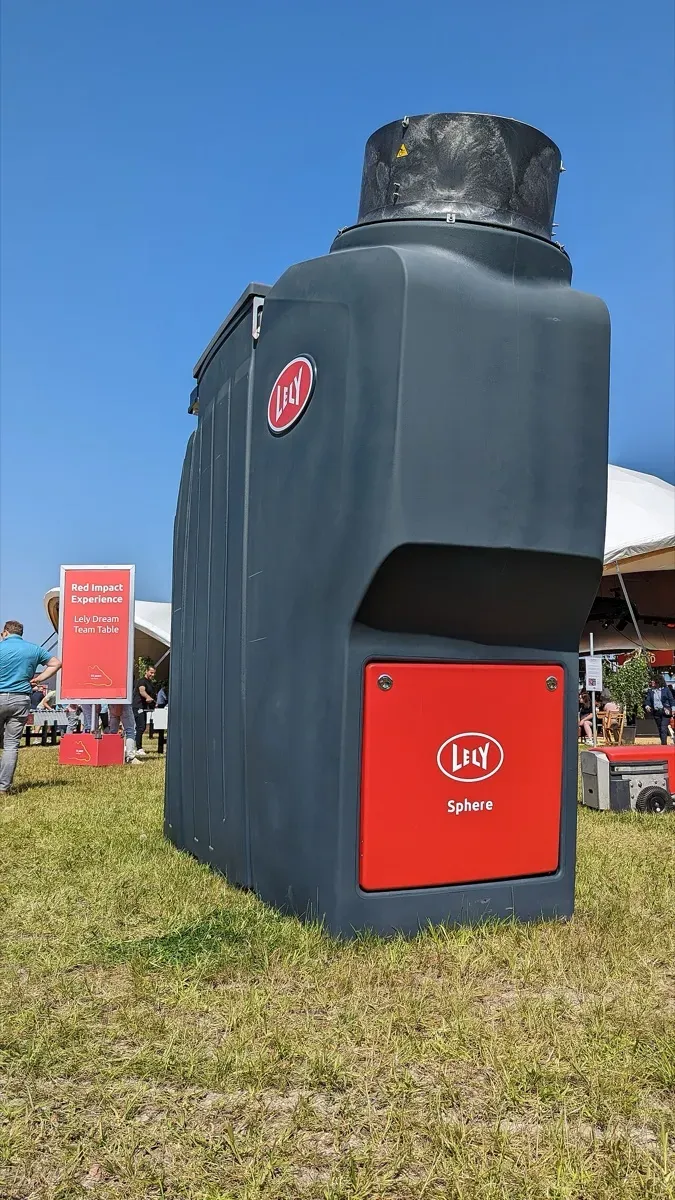
Lely presented Sphere on 6 October 2020. It is not a single box but a system fitted into a cow barn, new or existing. A modified floor separates liquid from solid manure. The N-Capture unit, one or more depending on farm size, extracts manure gases from the pit and just above the floor. A silo stores the resulting liquid fertiliser, and the Discovery Collector robot vacuums up solid dung, cleaning the floor every two hours on average.
The output is three separate mineral streams, including a liquid nitrogen fertiliser made from captured ammonia and the solid dung fraction. Each can be applied exactly where and when crops need it, rather than spread as mixed slurry. Lely says Sphere can supply up to 15 kg of nitrogen per cow per year as circular fertiliser, reducing the need to buy mineral fertiliser. Lely now links this to RENURE, the EU concept for manure-derived products that can replace synthetic fertiliser.
How it works
- Separate. Urine drains through narrow strips into the pit while dung stays on top.
- Collect. The Discovery Collector removes dung before more ammonia can form.
- Extract. N-Capture creates low pressure in the pit and sucks out manure gases.
- Bind. The air passes through a sulphuric or nitric acid solution that captures ammonia.
- Store. The saturated solution becomes liquid ammonium sulphate or nitrate in a silo.
- Log. Lely’s Horizon software records operating parameters for five years as evidence of performance.
Timeline
| Date | Milestone |
|---|---|
| 1948 | Lely founded in Maassluis |
| 6 Oct 2020 | Lely Sphere presented |
| 1 Oct 2021 | Sphere enters the Dutch emission list with a provisional factor of 3.6 kg ammonia per animal place per year |
| 4 Jan 2025 | De Volkskrant questions long-term performance; Lely replies citing about 30 systems in use |
| 24 Mar 2025 | Agriculture minister tells parliament there are no indications Sphere will miss its average reduction in practice |
| 5 Jul 2025 | Gelderland adopts new policy rules for nitrogen offsetting |
| 3 Feb 2026 | First final nature permit for a Sphere, for a dairy farm in Barneveld, Gelderland |
Impact and numbers
When Sphere entered the Dutch emission list on 1 October 2021, its provisional factor was 3.6 kg of ammonia per animal place per year, against 13 kg for a traditional slatted-floor barn, a cut of more than 70%. Lely’s product page now cites up to 77% on average from independent, recognised measurements. At that 2021 event, Lely CEO André van Troost estimated the investment at around €150,000 per farm, according to Boerenbusiness.
The 2026 permit is the newest step. The province of Gelderland granted dairy farmer Gert van Middendorp in Barneveld an irrevocable nature permit, under its July 2025 offsetting rules, for a Sphere that will cut his farm’s nitrogen emissions by more than 50%. Lely developed a model “appropriate assessment” with the agriculture ministry, several provinces and Wageningen University & Research, and made it available so farmers in other provinces can apply.
Lely itself is financially strong. It reported 2025 turnover of €1,014 million, up 18% from €857 million, with more than 8% of turnover invested in research and development, and started 2026 with a healthy order book. It also warned that 2026 would be harder because of lower milk prices, geopolitical tension and chip supply risks.
Honest caveats
Long-term proof. De Volkskrant reported in January 2025 that it was unclear whether such systems keep delivering in long-term use. Lely replied that it trusts a “rigorous, independent and scientifically assured authorisation process”, and the minister said there were no indications of underperformance. Field monitoring over many years is the real test.
Permit is not a barn. Van Middendorp told Sterke Erven: “It is only a plan. There is nothing here yet.” He still needs financing and a subsidy payout, and he said the system costs money in maintenance and may not even pay for itself.
Policy risk. Sphere’s value depends on Dutch nitrogen rules, which have changed repeatedly since 2019. Gelderland’s permit rests on rules adopted only in July 2025, and other provinces may set different thresholds.
Running inputs. The system needs acid deliveries, power and maintenance, and buyers must budget for them.
Commercial results. Lely does not report Sphere sales separately, so adoption beyond the roughly 30 systems cited in 2025 is not documented in the sources.
What’s next
Lely hopes the Gelderland decision restarts permitting across the Netherlands. Its model assessment can include farm-specific measures such as grazing or milk urea levels, which fits the government’s move towards target-based nitrogen policy. Subsidies matter too: Van Middendorp chose Sphere partly because of subsidy options, and he needed the permit to claim them. He expects steps towards installation during 2026, but no build date has been published.
Why it matters for Europe and green buyers
Ammonia from livestock is a Europe-wide problem. The National Emission Reduction Commitments Directive pushes member states to cut it, and dairy regions in Germany, Denmark, Belgium and Ireland face pressures similar to the Dutch. A system that turns a pollutant into fertiliser that replaces bought-in nitrogen is a genuine circular-economy idea.
For India, the world’s largest milk producer, most cows live in small herds rather than enclosed barns, so Sphere itself is unlikely to fit; the principle of capturing manure nitrogen at source still applies. For the world, cleaner air near farms and less synthetic fertiliser mean healthier ecosystems and lower emissions from food.
Sources & image credits
- Lely, “Lely launches a system separating mineral streams and converting emissions into value”, 6 October 2020. https://www.lely.com/global/news/lely-launches-barn-system-circular-creation-value/
- Lely, “New circular barn system for livestock reduces nitrogen emissions by more than 70%”, 1 October 2021. https://www.lely.com/global/news/new-circular-barn-system-livestock-reduces-nitroge/
- Lely, “Circular manure handling system: Lely Sphere”. https://www.lely.com/solutions/manure/sphere/
- Boerenbusiness, “CEO Lely calls on politicians to help pay for Sphere”, 1 October 2021. https://en.boerenbusiness.nl/melk/artikel/10894454/ceo-lely-roept-politiek-op-mee-te-betalen-aan-sphere
- Lely, “Official response to Volkskrant article of 4 January 2025”. https://www.lely.com/global/news/we-trust-our-technology/
- Tweede Kamer, answers of the Minister of Agriculture to parliamentary questions on agricultural innovations, 24 March 2025. https://www.tweedekamer.nl/downloads/document?id=2025D12516
- Lely, “Verduurzaming vergund: perspectief voor melkveehouders”, 3 February 2026. https://www.lely.com/nl/over-lely/nieuws/verduurzaming-vergund-perspectief-voor-melkveehouders/
- Sterke Erven, “Eerste melkveehouder met onherroepelijke vergunning voor Lely Sphere”, 3 February 2026. https://sterke-erven.nl/artikel/612728-eerste-melkveehouder-met-onherroepelijke-vergunning-voor-lely-sphere-een-stap-om-mijn-bedrijf-toekomstbestendig-te-make/
- Lely, “Lely reports 2025 financial results: a formidable year”, 2026. https://www.lely.com/gb/about-lely/news/lely-reports-2025-financial-results-a-formidable-year/
- Wikimedia Commons, “Lely Sphere on display - 2023-06-08”. https://commons.wikimedia.org/wiki/File:Lely_Sphere_on_display_-_2023-06-08.jpg
Images: “Lely Sphere on display - 2023-06-08”, Wvdp, CC0 1.0, via Wikimedia Commons. Shows the product itself.