The problem
Sea ice is one of the planet’s natural mirrors. The Guardian, reporting from Real Ice’s test site, notes that ice reflects about 70% of the sun’s heat back to space, while open ocean reflects just 7%. As the ice shrinks, the dark sea absorbs more heat, which melts more ice. Mongabay, citing NASA and the US National Snow and Ice Data Center, reports that Arctic sea ice extent has fallen by more than 12% per decade since satellite records began.
The Guardian puts the summer loss since 1979 at about 3 million square kilometres, with roughly 80,000 square kilometres more lost each year on average. For Inuit communities such as Cambridge Bay, or Ikaluktutiak, thinner ice means less safe travel, hunting and fishing.
The product
Real Ice was formed in 2022 by Simon Woods and Cían Sherwin and is led by chief executive Andrea Ceccolini. Its idea builds on a 2017 proposal by astrophysicist Steven Desch, who imagined millions of wind-powered pumps. Desch’s version was priced at about $500 billion; he now advises Real Ice.
The hardware is simple. Holes are drilled through the winter ice and small pumps lift seawater from just under the ice onto the surface. The Guardian reports that the pumps need less power than a toaster, because they only lift water a short distance. Real Ice’s website shows battery-powered pumps on the ice and says the team has tested its first hydrogen-powered pump in the Arctic.
The next product is an autonomous underwater drone. A prototype was tested in February 2026 in Finland’s Gulf of Bothnia, poking holes in sea ice with an electrically heated probe, and is being refined with the BioRobotics Institute in Pisa, Italy. Real Ice says it is developing a modular system of such drones that would use only zero-carbon energy.
How it works
- Drill. In deep winter, the team drills holes through ice that is already about 1.5 metres thick.
- Pump. Seawater is lifted onto the surface, turning the insulating snow layer into slush and then ice.
- Freeze from both sides. With the snow gone, cold air reaches deeper, and extra ice also grows on the underside.
- Repeat. Pumping later in winter, in two rounds, has improved results.
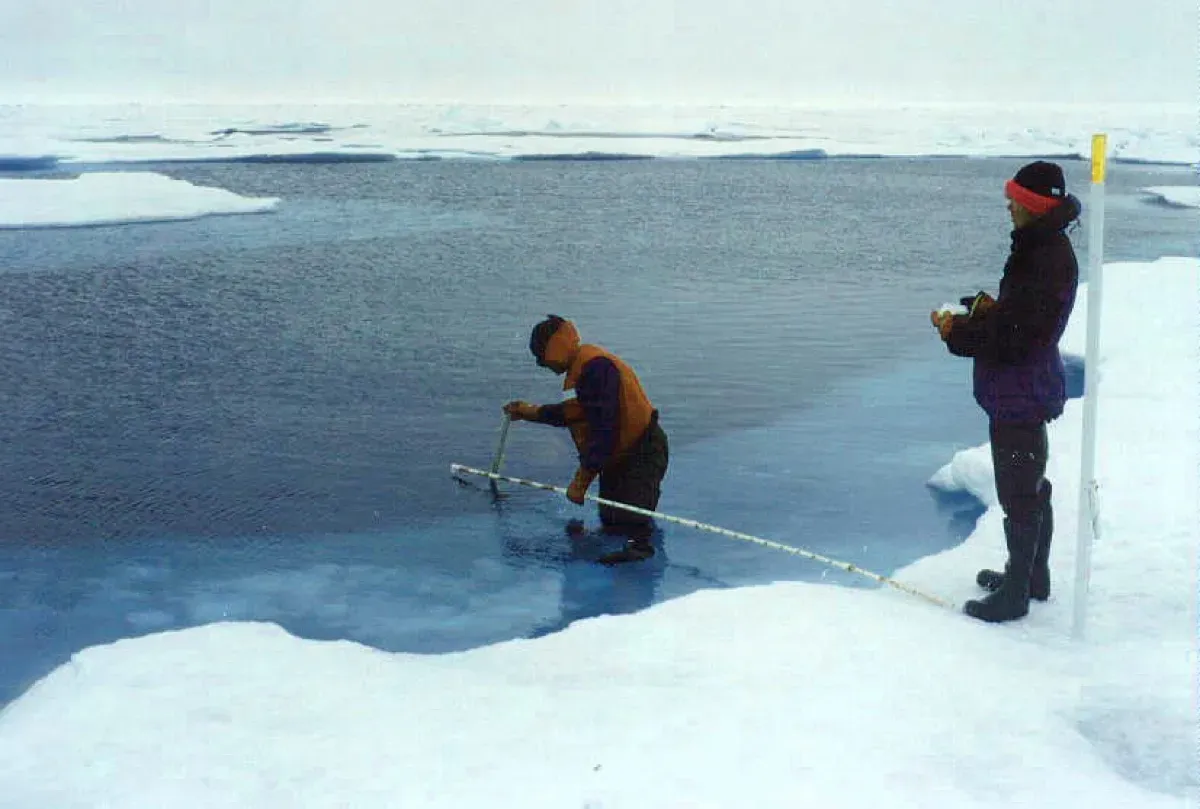
- Drain melt ponds. In summer, small holes let blue meltwater drain away, exposing brighter ice again.
- Measure. Drones, ice cores and temperature sensors track thickness, saltiness and reflectivity.
Timeline
| Date | Milestone |
|---|---|
| 2017 | Steven Desch proposes thickening Arctic ice with wind-powered pumps |
| 2022 | Real Ice is formed |
| 2023 | Field work with the Cambridge Bay community begins |
| Winter 2024/25 | Full-season trial: flooded ice up to 32 cm thicker by the end of winter |
| 9 and 18 Dec 2025 | ARIA’s oversight committee recommends, and its CEO approves, the outdoor experiments |
| Jan to Feb 2026 | Pumps run for 1,080 hours and move about 50,000 tonnes of seawater |
| Feb 2026 | Underwater drone prototype tested in the Gulf of Bothnia, Finland |
| 20 Mar 2026 | Real Ice publishes its 2024/25 field data openly on Zenodo |
| 26 May 2026 | Peer-reviewed paper on the 2024/25 trial announced by Cambridge’s Centre for Climate Repair |
Impact and numbers
The first full-season results come from the 2024/25 campaign. Writing with the University of Cambridge’s Centre for Climate Repair, Real Ice said flooded areas ended the winter up to 32 cm thicker than untreated ice, roughly equal to the local thinning seen over the past 50 years. Treated areas stayed brighter during the melt season and appeared to melt more slowly. The paper, led by Ed Blanchard-Wrigglesworth of the University of Washington, is titled “Artificial flooding leads to thicker and brighter Arctic sea ice”.
The 2026 campaign went further. The Guardian reports the pumps ran for 1,080 hours in January and February, icing over a square about 450 metres on a side, and added about 50 cm to the ice. Ceccolini says that could add 7 to 10 days to the ice’s life. By late May, satellite images showed the treated area as a white island in blue meltwater.
Funding comes from the UK’s Advanced Research and Invention Agency (ARIA). Its Re-thickening Arctic Sea Ice project, led by Shaun Fitzgerald, has a £9.9 million grant over 42 months, and the Guardian reports Real Ice’s share as £3.5 million. Real Ice and a second team, Arctic Reflections, have signed an IP pledge to share findings freely for research.
Honest caveats
Strong scientific opposition. A 2025 assessment in Frontiers in Science led by Martin Siegert reviewed five polar geoengineering ideas, including sea ice management. The authors judged them unfeasible at a meaningful scale, environmentally dangerous and a distraction from cutting emissions.
Governance and ethics. Deliberately changing how much sunlight the Earth reflects is a form of solar radiation modification. The European Commission’s scientific advisers recommended an EU-wide moratorium on using such technologies in December 2024, while backing careful research. Even Fitzgerald warns of moral hazard, the risk that such fixes delay emissions cuts.
Consent and Indigenous rights. Real Ice says Inuit expertise guides site choice and safety and that free, prior and informed consent is renewed every year. The Guardian heard strong local support, but Mongabay’s request for comment to the Ekaluktutiak Hunters and Trappers Organization went unanswered.
Ecology is still unknown. Pumping brings salt, nutrients and microbes onto the ice, and samples are still being studied. ARIA notes that brine could pool on the surface and make ice melt faster. Flooding snow could also block seals and polar bears from digging dens, though none breed at the test site.
Scale is a huge leap. Real Ice’s own estimate is roughly $10 billion to halt annual ice loss, using swarms of drones that cost about $5,000 each. Neither figure has been tested.
What’s next
ARIA’s outdoor experiments run across three winters, from 2026 to 2028, and may grow to 1 square kilometre per site only if early results look ecologically sound. Real Ice plans to keep refining its drone, and models will test whether thickening ice “arches” in straits such as the Nares Strait could slow ice loss.
Why it matters for Europe and green buyers
For Europe, this is a public research bet run with unusual openness: ARIA publishes permits, community engagement reports and oversight letters. That sets a benchmark that EU research funders could adopt as they decide how to treat sunlight reflection research under a possible moratorium.
For India, the Arctic is far away but not irrelevant. India runs Arctic research and is an observer at the Arctic Council, and its scientists will need independent data to judge any future proposal to engineer the ice. Around the world, Real Ice’s results matter mostly as evidence, not as a ready solution. As Ceccolini told Mongabay, without real emissions cuts the method would soon be “insufficient”.
Sources & image credits
- The Guardian, “‘At first, the idea does sound crazy’: meet the scientists trying to refreeze the Arctic”, 16 Jun 2026. https://www.theguardian.com/environment/2026/jun/16/arctic-sea-ice-rethickening-climate-geoengineering
- Mongabay, “In the Canadian Arctic, an experiment aims to stabilize thinning sea ice”, Jul 2026. https://news.mongabay.com/2026/07/in-the-canadian-arctic-an-experiment-aims-to-stabilize-thinning-sea-ice/
- Centre for Climate Repair, University of Cambridge, “New paper: Artificial flooding leads to thicker and brighter Arctic sea ice”, 26 May 2026. https://www.climaterepair.cam.ac.uk/news/new-paper-artificial-flooding-leads-thicker-and-brighter-arctic-sea-ice
- Real Ice, “Data collected during the winter and spring 2024/25 by Real Ice in Cambridge Bay, Canada”, Zenodo, 20 Mar 2026. https://zenodo.org/records/19120738
- ARIA, “Exploring Climate Cooling: Rethickening Arctic Sea Ice”. https://aria.org.uk/exploring-climate-cooling-rethickening-arctic-sea-ice
- Real Ice, company website. https://www.realice.eco/
- Siegert et al., “Safeguarding the polar regions from dangerous geoengineering”, Frontiers in Science, 2025. https://www.frontiersin.org/journals/science/articles/10.3389/fsci.2025.1527393/full
- European Commission, “Solar radiation modification technologies cannot fully address climate change, and responsible research on impacts is needed”, 9 Dec 2024. https://research-and-innovation.ec.europa.eu/news/all-research-and-innovation-news/solar-radiation-modification-technologies-cannot-fully-address-climate-change-and-responsible-2024-12-09_en
- Wikimedia Commons, “Summer Arctic Melt Pond-SHEBA”. https://commons.wikimedia.org/wiki/File:Summer_Arctic_Melt_Pond-SHEBA.JPG
Images: “Summer Arctic Melt Pond-SHEBA”, Donald K. Perovich, Arctic Ocean, July 1998, public domain, via Wikimedia Commons. Illustrative; not a Real Ice site.