The problem
Cooling buildings is one of the fastest growing uses of electricity. JStories, citing the International Energy Agency, notes that global electricity demand for cooling is expected to roughly triple by 2050. Every air conditioner also dumps heat outdoors, which warms cities and drives even more cooling demand.
Most heat-shielding products only slow down how much solar heat gets in. Conventional white paint helps, but a steel plate coated with solar reflective paint can still sit 10 to 20°C above air temperature in strong sun, according to SPACECOOL’s own comparison test.
The product
SPACECOOL was developed by Osaka Gas using its optical control technology. The company SPACECOOL Inc., jointly run by Osaka Gas and the venture capital firm WiL, began operations, marketing and production in May 2021, with first sales that summer. In a 2020 test at Osaka Gas’s laboratory, the material stayed up to about 6°C below ambient air in direct sunlight.
The product is a multilayer optical film. SPACECOOL says it reflects up to 95% of sunlight and emits up to 95% of its heat as infrared, mostly in the 8 to 13 micrometre “atmospheric window” that lets heat escape to space. It comes as an adhesive film that can be cut with scissors, and as a membrane or canvas that can be sewn into tents, sheets, flags and building skins.
Its European website lists summer performance of 2 to 6°C below outdoor air, a cooling capacity of 70 to 100 W per square metre and an operating range of minus 20 to plus 50°C. One white film version has been tested to ASTM E108 for Class A roof assemblies and is covered by an ICC-ES evaluation report for US building codes. Xenon weathering tests suggest UV durability of about 15 years, which the company stresses is not a warranty.
How it works
- Reflect. The top layers bounce back up to 95% of incoming sunlight.
- Emit. The material radiates heat at infrared wavelengths that pass easily through the atmosphere.
- Dump to space. That heat escapes to the cold of space, at about minus 270°C.
- Stay below air temperature. In clear sun, the surface ends up cooler than the air around it.
- Cool what is underneath. A roof, tent, container or cabinet gains less heat, so less air conditioning is needed.
Timeline
| Date | Milestone |
|---|---|
| Summer 2020 | Osaka Gas test: material up to about 6°C below ambient air in direct sun |
| May 2021 | SPACECOOL Inc. begins operations, marketing and production |
| 26 Aug 2021 | Demonstration starts at the future Expo site on Yumeshima, Osaka |
| Feb 2025 | Saudi container trial with Red Sea Global reports a 29% average cut in air conditioning energy |
| Apr 2025 | Product fitted to more than 5,000 outdoor units |
| Apr to Oct 2025 | Full outer membrane of the Gas Pavilion at Expo 2025 |
| Dec 2025 | Wins the Grand Prize in Japan’s Energy Conservation Awards |
| 5 Mar 2026 | Gas Pavilion study finds up to about 40% lower air conditioning load |
| 20 May 2026 | Top three finalist in Temasek Foundation’s Liveability Challenge 2026 |
Impact and numbers
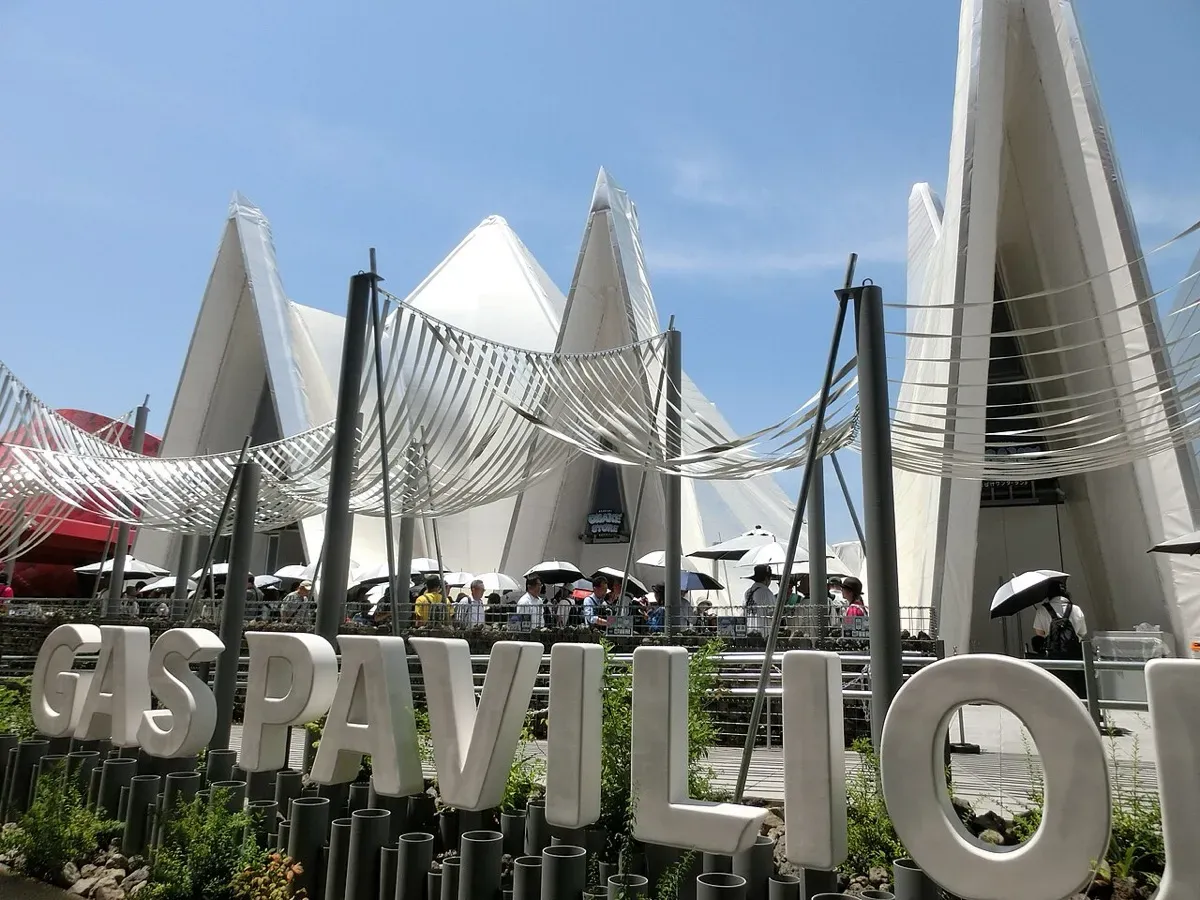
The showcase is the Gas Pavilion at Expo 2025, sponsored by the Japan Gas Association and designed by Nikken Sekkei. Nikkei xTECH reports that its triangular roofs rise to about 18 metres over roughly 1,558 square metres of floor. The whole outer membrane used SPACECOOL, which the Japanese government’s Kizuna magazine described as the world’s first structure built with a radiative cooling membrane.
In March 2026, SPACECOOL, the Japan Gas Association and Professor Tomoyuki Chikamoto of Ritsumeikan University published their analysis. Combining temperatures measured during the Expo with computer fluid modelling, they estimated that summer air conditioning load was 35 to 40% lower than with a light-transmitting membrane and 18 to 24% lower than with an opaque one. At the height where visitors stood, modelled temperatures were up to about 2 to 9°C lower.
Other trials point the same way. SPACECOOL reports that two Red Sea Global container houses in Saudi Arabia, tested with the Zamil group and the national Oil Sustainability Program, cut air conditioning energy by 29% on average, with a maximum of 37%. On a 600 square metre Tokyo office roof, summer electricity use fell by up to 8.7%. JStories reports more than 5,000 outdoor units fitted by April 2025.
Honest caveats
Mostly company data. Nearly all performance figures come from SPACECOOL, Osaka Gas or partners. JStories notes there is no public independent comparison with rival materials. The pavilion savings were estimated with modelling, not measured against an identical building.
Weather limits. SPACECOOL says cooling is weaker in winter and under cloud, and the material is not meant for indoor use. Humid, hazy places get less benefit than clear, dry ones.
Local, not planetary. Radiative cooling films lower the temperature of the surface they cover. They are not a way to cool the planet, and marketing that blurs that line risks feeding the hype around solar radiation modification. The European Commission’s scientific advisers, who recommended an EU moratorium on using such technologies in December 2024, listed “small-scale local surface brightening” as one end of the spectrum. Surface products like this raise far fewer governance worries than stratospheric aerosols, but honest claims matter.
Durability and end of life. The 15 year durability figure is based on accelerated tests, and long-term data on large buildings are still building up. The company does not publish a take-back or recycling route for used film.
Cost unknown. Prices and large-scale installation costs are not public.
What’s next
SPACECOOL is pushing into Europe, the Middle East and Southeast Asia. In 2026 it was named in the German Energy Agency’s SET100 list of energy transition start-ups and joined meetings of PaRaMetriC, a European research project working on standard tests for radiative cooling materials. Agreed test methods would let buyers compare products fairly.
Why it matters for Europe and green buyers
For Europe, which faces more frequent heatwaves in buildings designed to keep warmth in, a peel-and-stick film for roofs, tents, containers and outdoor electrical cabinets is a low-disruption way to cut cooling demand without refrigerants. Public buyers should ask for independent, metered results in European climates, and support common test standards.
For India, the case is even stronger. Hot, sunny months, fragile grids and fast-growing air conditioner sales make passive cooling attractive for warehouses, telecom shelters, bus stops and informal housing, though humidity and dust will cut performance and must be tested locally. For the world, cheap ways to stay cool without extra electricity are a core part of adapting to heat.
Sources & image credits
- SPACECOOL Europe GmbH, company website and product information. https://spacecool.eu/
- SPACECOOL Inc., “Announcing Business Commencement of SPACECOOL”, 2021. https://spacecool.jp/en/news/announcing-business-commencement-of-spacecool-a-radiative-sky-cooling-material-that-boasts-one-of-the-highest-levels-of-cooling-performance-in-the-world-2/
- Daigas Group (Osaka Gas), “SPACECOOL: New zero-power cooling material”. https://www.daigasgroup.com/en/rd/topic/1768556_56103.html
- SPACECOOL and Japan Gas Association, press release on Gas Pavilion verification results (Japanese), 5 Mar 2026. https://www.gas.or.jp/newsrelease/20260305.pdf
- Nikkei xTECH, “Expo Gas Pavilion membrane SPACECOOL, room temperature 9 degrees lower than translucent membrane” (Japanese), Mar 2026. https://xtech.nikkei.com/atcl/nxt/column/18/02484/031700170/
- JStories, “Throwing heat into space from the ground” (Japanese), 2026. https://jstories.media/ja/spacecool-zero-energy-cooling-film/
- Government of Japan, Kizuna, “Defying the heat, defining the future: innovative zero energy radiative cooling material at Expo 2025”, Apr 2025. https://www.japan.go.jp/kizuna/_userdata/pdf/2025/04/zero-energy_radiative_cooling_material.pdf
- European Commission, “Solar radiation modification technologies cannot fully address climate change, and responsible research on impacts is needed”, 9 Dec 2024. https://research-and-innovation.ec.europa.eu/news/all-research-and-innovation-news/solar-radiation-modification-technologies-cannot-fully-address-climate-change-and-responsible-2024-12-09_en
- Wikimedia Commons, “Expo 2025 Gas Pavilion 01”. https://commons.wikimedia.org/wiki/File:Expo_2025_Gas_Pavilion_01.JPG
Images: “Expo 2025 Gas Pavilion 01”, Abasaa, Osaka, Japan, 20 Jun 2025, public domain, via Wikimedia Commons. Shows the SPACECOOL membrane on the pavilion.