The problem
How fast Antarctica’s ice melts is one of the biggest uncertainties in forecasts of sea level rise. Much of that melting happens out of sight, where warm ocean water flows into the cavities beneath floating ice shelves and eats at the ice from below.
Satellites and ice cores show how glaciers change over time, but they cannot see inside those cavities. Ships cannot get there. Remotely operated vehicles on cables cannot reach far enough. Scientists need a robot that can dive under hundreds of metres of ice, navigate for days with no GPS, map what it finds and come back on its own.
The product
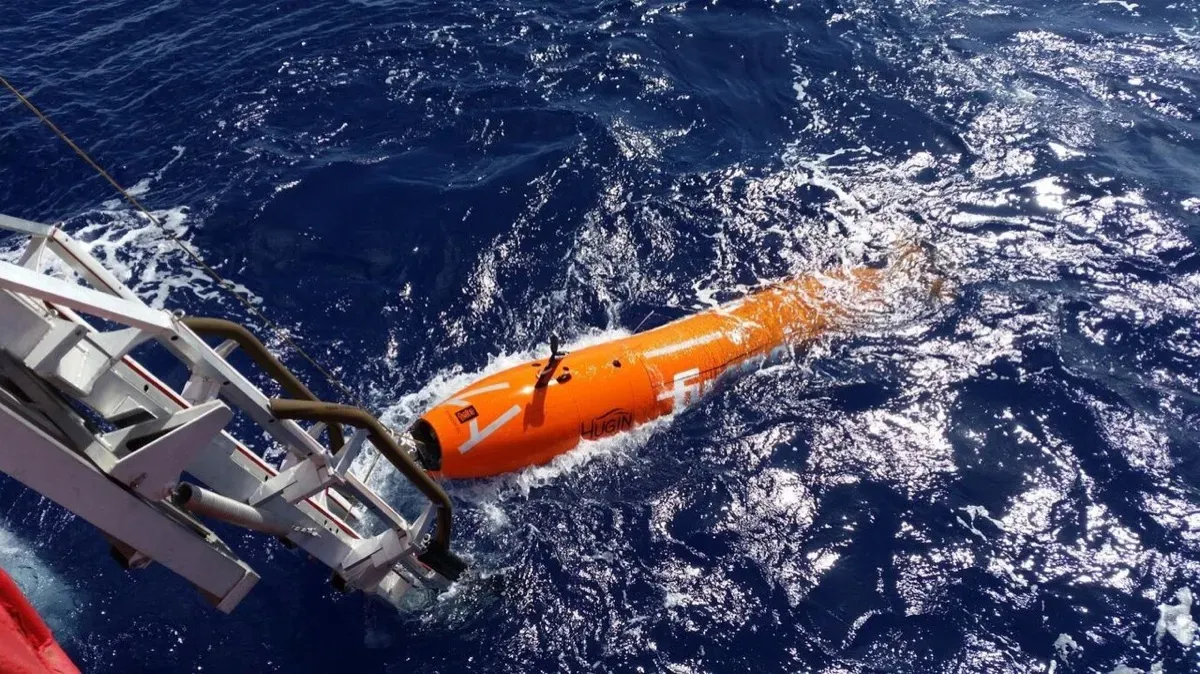
HUGIN is a family of autonomous underwater vehicles built by Kongsberg in Norway. It was created in collaboration with the Norwegian Defence Research Establishment 35 years ago, according to Kongsberg’s chief technology officer. Kongsberg describes HUGIN as the most successful commercial AUV available, combining survey-grade positioning with high-resolution sensors that collect topography, current and water property data at the same time.
The University of Gothenburg’s HUGIN, named Ran, was commissioned in 2018. It was then one of only three research AUVs of its type in the world and the only one in Sweden. Funded by the Knut and Alice Wallenberg Foundation, Ran carried a Kongsberg EM2040 multibeam echo sounder, a side scan sonar and dual temperature and salinity sensors.
In January 2024, Ran disappeared beneath the ice in West Antarctica during an expedition to the Thwaites Glacier. Thanks to a donation from the Voice of the Ocean Foundation and Eric Douglas, plus insurance funds, the university has ordered a replacement from Kongsberg: Ran II, a 3,000 m rated HUGIN with more robust emergency decision support and improved navigation.
How it works
- Programme. Scientists plan a mission and load it into the vehicle.
- Dive. HUGIN leaves the ship and swims into the ice shelf cavity.
- Navigate. Onboard systems estimate position and make decisions without a pilot.
- Scan. Upward-looking multibeam sonar maps the ice base about 50 m above.
- Measure. Sensors log currents, temperature and salinity along the route.
- Return. The AUV comes back to the ship to deliver its data.
Timeline
| Date | Milestone |
|---|---|
| 2018 | University of Gothenburg commissions Ran, a Kongsberg HUGIN |
| 2022 | Ran maps the underside of Dotson Ice Shelf over 27 days |
| Jan 2024 | Ran is lost beneath the ice in West Antarctica |
| 2024 | Dotson findings published in Science Advances |
| 2025 | Gothenburg orders Ran II from Kongsberg |
| 2026 | Norway’s Offshore Directorate starts HUGIN Superior surveys; NTNU orders a HUGIN 6000 |
| Winter 2026/2027 | Ran II due for delivery |
Impact and numbers
During the 2022 expedition, Ran was programmed to dive into the cavity of the Dotson Ice Shelf. Over 27 days it travelled more than 1,000 km back and forth under the glacier, reaching 17 km into the cavity and scanning the ice from about 50 m below.
The result, published in Science Advances in 2024, was the first detailed map of the underside of a glacier. The researchers confirmed that the ice melts fastest where strong currents erode its base, measured those currents beneath the glacier for the first time and found very high melting at vertical fractures through the ice. They also saw unexpected peaks, plateaus and dune-like formations. Lead author Anna Wåhlin compared it to “seeing the back of the moon”. Gothenburg says Ran also made its team the first researchers in the world to enter beneath the Thwaites Glacier, a glacier that partly lies in the sea. Satellites could show the melting and movement; Ran brought back close-up images of the ice underside and the mechanisms behind the melt.
Beyond Antarctica, larger HUGINs are expanding. In 2026, Norway’s Offshore Directorate began operating its own HUGIN Superior, rated to 6,000 m, in the northern Norwegian Sea, and NTNU announced it is buying a HUGIN 6000. Kongsberg’s Discovery division sits within a group that reported second quarter 2026 revenue of NOK 10,389 million, up 31%, and an order backlog of NOK 157,540 million.
Honest caveats
Kongsberg is a defence company. The group’s results highlight missiles, air defence and remote weapon stations, and Norway’s defence minister calls HUGIN dual-use technology. This story covers only HUGIN’s science use.
Seabed resources. Norway’s Offshore Directorate says its HUGIN Superior will help it understand and manage deep-sea resources, an area tied to controversial plans for seabed mining.
Robots get lost. Ran vanished without a trace under the ice. Gothenburg’s scientists accepted the risk; Wåhlin said losing Ran was “a better end than it gathering dust in a garage”. But each vehicle is expensive, and the replacement depended on a private donation.
Rare capability. Only a handful of research groups can afford and operate AUVs of this class.
What’s next
Ran II is due in winter 2026/2027. The university and Voice of the Ocean will also share it for studies closer to home, such as in the Baltic Sea, through VOTO’s Ocean Support initiative. Voice of the Ocean’s chief executive, Sanna Thimmig Johansen, says the investment will strengthen Swedish research at the forefront of polar science. Ran’s earlier years also served as a training platform for early-career scientists and for testing within the Swedish Maritime Robotics Centre.
Why it matters for Europe and green buyers
For Europe, HUGIN is a Norwegian product that keeps Swedish and European scientists at the front of polar research. Better data on melting beneath ice shelves improves the sea level projections that coastal cities from the Netherlands to Venice depend on when planning flood defences.
For India, which runs Antarctic stations and deep ocean programmes, AUVs like HUGIN show the value of autonomous tools for studying ice, seabed and monsoon-driving oceans. For the world, every map made beneath an ice shelf narrows the uncertainty around one of the largest risks of climate change.
Sources & image credits
- University of Gothenburg, “Replacement for lost AUV Ran is on its way”, 2025. https://www.gu.se/en/news/replacement-for-lost-auv-ran-is-on-its-way
- Kongsberg, “New HUGIN for the University of Gothenburg to Replace Ran”, 2025. https://www.kongsberg.com/news/news-archive/2025/new-hugin-for-the-university-of-gothenburg-to-replace-ran/
- University of Gothenburg, “Ran: Autonomous Underwater Vehicle (AUV)”. https://www.gu.se/en/skagerak/ran-autonomous-underwater-vehicle-auv
- University of Gothenburg, “A whole new view on glacier melting in Antarctica”, 2024. https://www.gu.se/en/news/a-whole-new-view-on-glacier-melting-in-antarctica
- Marine Technology News, “Norway Deploys New Deep-Sea Mapping AUV On First Expedition”, 2026. https://www.marinetechnologynews.com/news/norway-deploys-mapping-first-663547
- Kongsberg, “NTNU celebrates its new HUGIN”, 2026. https://www.kongsberg.com/news/news-archive/2026/ntnu-celebrates-its-new-hugin/
- Kongsberg, “Q2 2026: KONGSBERG delivers a strong second quarter”, Jul 2026. https://www.kongsberg.com/news/news-archive/2026/q2-2026-kongsberg-delivers-a-strong-second-quarter-with-increased-revenue-and-solid-profitability/
- Wikimedia Commons, “The HUGIN 4500 AUV in the water”. https://commons.wikimedia.org/wiki/File:The_HUGIN_4500_AUV_in_the_water.jpg
Images: “The HUGIN 4500 AUV in the water”, ATSB, photo by Fugro, 2015, CC BY 4.0, via Wikimedia Commons. Shows a HUGIN vehicle, not Ran.