The problem
A tokamak confines a plasma of hydrogen isotopes at around 100 million degrees Celsius using strong magnetic fields. The stronger the field, the smaller the machine can be for the same output: at a given ratio of plasma pressure to magnetic pressure, fusion power density rises roughly with the fourth power of the field. Field strength is therefore the main design lever for cost.
Most large fusion machines, including ITER in France, use low-temperature superconductors such as niobium-tin and niobium-titanium. These must be cooled to around 4 kelvin with liquid helium, which demands large, expensive cryogenic plants. Rare-earth barium copper oxide (REBCO) tapes, known as high-temperature superconductors, carry far higher currents at stronger fields and can run at about 20 kelvin. The catch is that nobody had operated a complete, interacting set of HTS fusion coils in a realistic configuration. Single test coils do not reveal how each tape behaves inside the combined field, forces and fault conditions created by its neighbours.
The product
Demo4 is Tokamak Energy’s answer: a complete HTS magnet system arranged exactly as it would be in a spherical tokamak, the compact “cored apple” shape the company has worked on since 2009. It contains 44 HTS coils. Fourteen toroidal field (TF) limbs each hold two partially insulated coils, and two poloidal field (PF) stacks each contain eight fully insulated coils (Tokamak Energy, 9 September 2026).
The device is a test rig, not a reactor. There is no plasma. Its job is to prove that the magnets, current leads, joints, cryogenics, power supplies, quench detection and controls work together under fusion-relevant fields and loads. That makes it a product in two senses: a physical system that has been built and operated, and a reference design that Tokamak Energy now sells as magnet engineering to fusion programmes and other industries.
How it works
The coils are wound from HTS tape, typically 12 mm wide and less than 0.1 mm thick, mostly made of strong conductive metals with a thin internal layer of REBCO superconductor. According to the company, REBCO magnets use 99% less rare-earth material than permanent magnets (Tokamak Energy, 3 September 2024).
The cold mass hangs below the cryostat top plate and is cooled by a pressurised helium system rather than a liquid helium bath. Conference papers describe a magnet built to run at a few kiloamperes steady state at a base temperature of 20 K, with every coil tested in liquid nitrogen at 77 K before assembly (MT29 abstract). More than 600 temperature, Hall, voltage and fibre Bragg grating sensors produce over 3 TB of diagnostic data per day (SMTF 2025 abstract).
During the campaign, engineers ran the TF coils at 5,600 amperes, cycled the whole system between 77 K and 17 K and applied transverse compressive stress of 150 MPa, almost 1,500 times atmospheric pressure. They also triggered deliberate forced discharges at up to 12.5 tesla to test how the system behaves in a fault.
Timeline
| Date | Milestone |
|---|---|
| 2009 | Tokamak Energy founded in Oxfordshire |
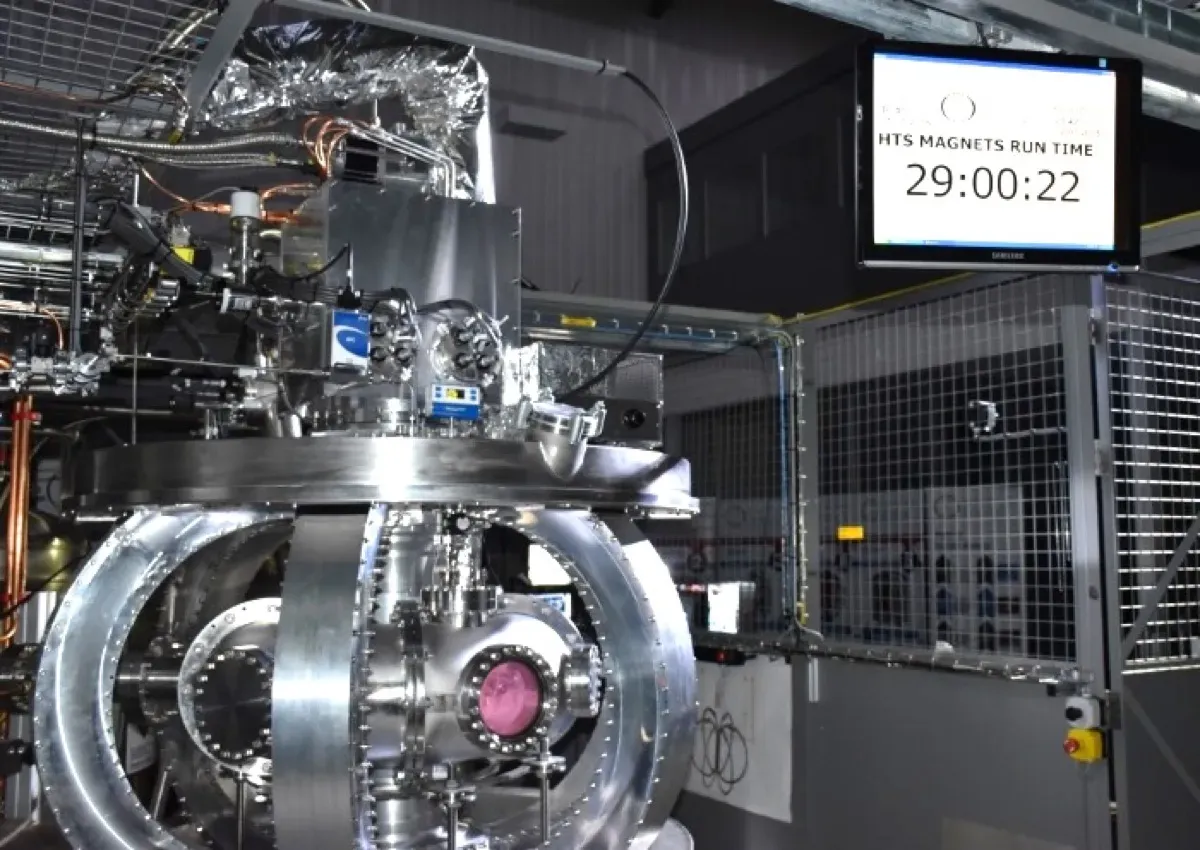
| June 2015 | ST25-HTS, the first tokamak with only HTS magnets, runs a 29-hour discharge |
| 2022 | ST40 spherical tokamak reaches a plasma ion temperature of 100 million degrees |
| 2024 | Accelerated build: 28 TF and 16 PF coils assembled into a cold mass; sub-assemblies tested to 18 K |
| 3 September 2024 | TE Magnetics division launched to sell HTS magnet systems |
| Early 2025 | Full Demo4 cold mass enters commissioning |
| 19 November 2025 | 11.8 T at minus 243 °C, with seven million ampere-turns in the centre column |
| 9 September 2026 | 14-month campaign completed: 13.7 T peak, about 10,000 hours of operation |
Impact and numbers
- Field: 13.7 tesla peak, up from 11.8 tesla reported in November 2025 (NEI Magazine).
- Current density: seven million ampere-turns ran through the centre column; HTS can carry around 200 times the current density of copper, according to Tokamak Energy (19 November 2025).
- Reliability: more than 90 HTS joints performed as expected; a forced discharge at 12.5 T showed no hotspots or degradation.
- Endurance: roughly 10,000 hours in various states of energisation, including long periods at high field.
- Industrial pull: the learning now feeds STEP model coil testing for UK Fusion Energy, and Tokamak Energy sits in the UK Infinity Fusion Consortium with Type One Energy and AECOM.
Honest caveats. All performance figures come from Tokamak Energy and its conference papers; independent peer-reviewed analysis of the full campaign is still to come. Demo4 operated without plasma, neutrons or the heat loads of a burning reactor, so radiation damage to HTS tape, a key long-term question, was not tested. Fusion electricity remains years away, and Tokamak Energy’s commercial case currently rests as much on magnet sales as on future power plants.
What’s next
Tokamak Energy says Demo4 data is already shaping its next generation of magnets, with refined manufacturing and jointing methods, better instrumentation and a clearer view of operating margins. The immediate customer is STEP, the UK government programme to build a prototype spherical tokamak power plant at West Burton in Nottinghamshire, where the company leads magnet systems work until at least March 2029.
Beyond fusion, TE Magnetics targets HTS magnets and power systems for wind turbines, grid energy storage, maritime and aerospace propulsion, and scientific instruments. For these markets, the main selling points are compactness, fields above what copper or permanent magnets can achieve, and cooling with cryocoolers instead of liquid helium, which is itself a scarce resource.
Why it matters for Europe / green buyers
Fusion is often presented as a distant promise. Demo4 is a reminder that the supply chain is being built now, in Europe, through tangible hardware. Superconducting magnets are where the money and risk sit in any tokamak, and the UK is betting that domestic expertise in HTS winding, joints and cryogenics will become an export industry whether or not the first power plants arrive on schedule.
For investors, utilities and policy makers, the useful questions are concrete: what field and current density has been shown, for how many hours, with what fault testing, and with what independent review. Demo4 sets a public benchmark on each of those points. For buyers of industrial magnets today, HTS systems also offer a route to lower energy use and less dependence on rare-earth permanent magnets.
Sources & image credits
- Tokamak Energy, “Tokamak Energy completes world-leading fusion magnet campaign, validating technology for commercial HTS systems”, 9 September 2026: https://tokamakenergy.com/2026/09/09/tokamak-energy-completes-world-leading-fusion-magnet-campaign-validating-technology-for-commercial-hts-systems/
- Tokamak Energy, “Tokamak Energy announces fusion power plant magnet technology breakthrough”, 19 November 2025: https://tokamakenergy.com/2025/11/19/tokamak-energy-announces-fusion-power-plant-magnet-technology-breakthrough/
- Nuclear Engineering International, “Tokamak Energy announces magnet breakthrough”, 20 November 2025: https://www.neimagazine.com/news/tokamak-energy-announces-magnet-breakthrough/
- G. Dunbar (Tokamak Energy), “Demo4: assembly and commissioning of a representational set of high field HTS magnets in a reactor relevant configuration”, MT29 conference abstract, July 2025: https://indico.cern.ch/event/1431972/contributions/6420097/
- S. Ghannadzadeh (Tokamak Energy), “Demo4 HTS Magnet System”, SMTF/IDSM 2025 abstract, PSI: https://indico.psi.ch/event/16393/contributions/55374/
- A. Davies (Tokamak Energy), “Quality control and cryogenic testing of complete HTS coil set for Demo4 magnet”, MT29 poster abstract, July 2025: https://indico.cern.ch/event/1431972/contributions/6420407/
- Tokamak Energy, “Tokamak Energy launches TE Magnetics”, 3 September 2024 (company history, ST25-HTS and ST40 milestones): https://tokamakenergy.com/2024/09/03/tokamak-energy-launches-te-magnetics-to-open-new-fields-of-performance-with-transformative-hts-technology/
Images:
- “Tokamak ST25 rf discharge” by A. Sykes et al., licensed CC BY 3.0 (https://creativecommons.org/licenses/by/3.0), via Wikimedia Commons: https://commons.wikimedia.org/wiki/File:Tokamak_ST25_rf_discharge.jpg